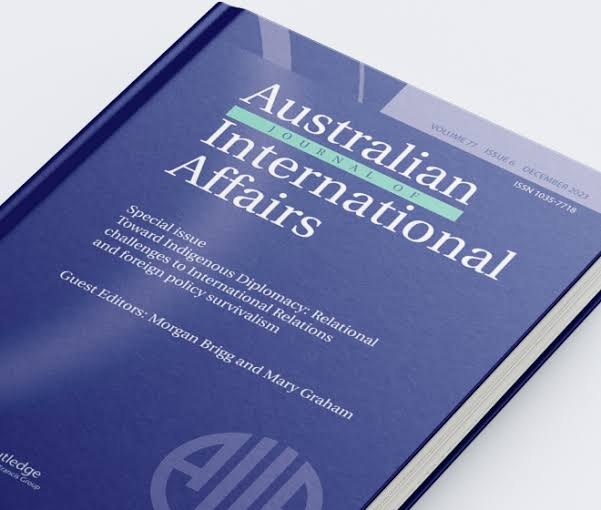
In “India and Taiwan’s evolving entente commerciale: trade and informal defense cooperation between Taiwan-India”, published in the Australian Journal of International Affairs in 2026 (Volume 80, Issue 5), Benjamin Tkach and Vasabjit Banerjee examine whether India and Taiwan’s growing economic relationship is beginning to extend into defence cooperation. They argue that the two countries are developing the foundations of an informal entente, with China serving as their common strategic concern. An entente would allow them to cooperate more closely without committing to a formal military alliance or promising to defend one another.
Tkach and Banerjee identify three conditions for an entente: a shared rival, strong economic ties, and a security relationship. In the case of India and Taiwan, the first two are well established, while defence cooperation remains at an early stage. India does not formally recognise Taiwan, and any overt defence partnership risks provoking Beijing. An informal arrangement offers a way to deepen cooperation while allowing both governments to retain flexibility in their foreign policies.
The article traces the growth of economic ties through successive Indian governments, beginning with the Look East Policy and continuing under the Act East Policy. Taiwan’s New Southbound Policy has also encouraged closer engagement. Bilateral trade rose from US$1.19 billion in 2001 to US$10.6 billion in 2024.
Smartphone manufacturing illustrates the benefits of this relationship. India offers lower labour costs, a large workforce, and government incentives, while Taiwanese companies bring manufacturing expertise and established links to global supply chains. Investments by firms such as Foxconn, alongside expanding semiconductor-related projects, have strengthened these ties. Tkach and Banerjee argue that this cooperation reflects deliberate political choices, not simply the complementary strengths of the two economies.
China’s opposition forms an important part of the analysis. Tkach and Banerjee discuss efforts to disrupt manufacturing cooperation, including restrictions affecting skilled workers, component supplies, and critical materials. Taiwanese firms remain exposed because many depend on mainland China for parts of their operations. Nevertheless, investment in India has continued, even as Beijing’s response creates commercial and strategic risks for both sides.
Defence cooperation remains less developed than economic engagement. Tkach and Banerjee point to the participation of three retired Indian service chiefs at Taiwan’s Ketagalan Forum in September 2023 and a cybersecurity workshop involving Indian, Taiwanese, and American officials that December. They propose expanding cooperation through joint research, personnel exchanges, and regular consultations between officials. Informal arrangements could also support collaboration in dual-use technologies without requiring formal diplomatic recognition or binding defence commitments.
The article is particularly relevant to current India-Taiwan relations, as cooperation is expanding beyond smartphone manufacturing into semiconductors, advanced technology, and supply-chain diversification. In October 2026, Taiwan’s Foreign Minister Lin Chia-lung identified a free-trade agreement and improved connectivity as important to closer economic ties with India, while highlighting opportunities for further semiconductor cooperation.
These developments raise a question central to Tkach and Banerjee’s argument: whether closer economic engagement will lead to more sustained security cooperation. Their framework offers a way to examine that possibility without assuming that growing trade will necessarily produce a formal strategic partnership.