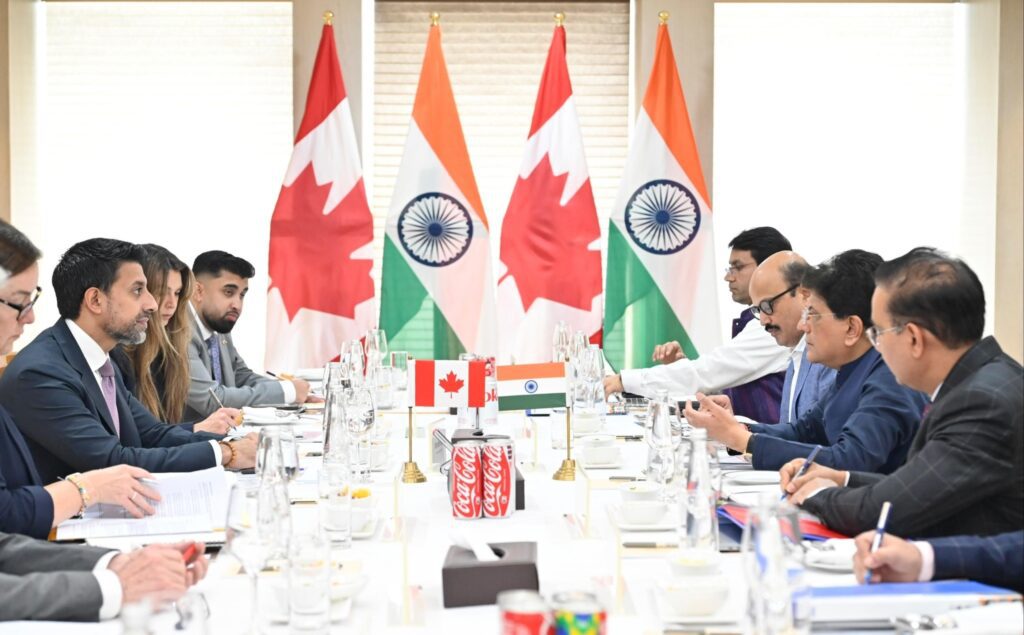
The article “Compound Network Power: India’s Minilateral Diplomacy under Modi” by Zhenlei Deng, published in International Studies Perspectives in 2026, examines how India has used minilateral diplomacy under the Modi government to expand its influence within an increasingly fragmented system of international cooperation. Rather than examining individual minilateral groupings in isolation, Deng looks at how India’s participation across multiple arrangements creates a broader network of relationships spanning security, economic and science-and-technology issues.
Using social network analysis and theories of network power, Deng develops the concept of “compound network power”, which brings together two dimensions of influence. The first, relational network power, comes from a state’s position within a network, including its connectivity, access to information and resources, and ability to act as a broker between partners. The second, structural network power, comes from the organisation of institutional connections themselves, particularly a state’s ability to connect different clusters of cooperation across issue areas.
Deng’s central argument is that minilateralism should not be seen merely as a smaller substitute for multilateralism or as a temporary mechanism for crisis coordination. Instead, it can function as a “network-building strategy capable of generating cumulative and cross-issue influence over time”. By participating in overlapping arrangements, India can build connections that extend beyond individual groupings and can be used across different partners and issue areas, allowing it to expand its diplomatic reach while preserving strategic flexibility.
The article situates India’s strategy within the broader fragmentation of global governance. Deng defines minilateral arrangements as relatively small and flexible forms of cooperation, typically involving three to six participants, with narrower agendas and relatively limited institutional constraints. Their importance lies not simply in having fewer members, but in allowing states to select partners, concentrate on specific issues and reduce the costs associated with large-scale consensus-building. Crucially, the author notes that minilateralism prioritises “shared interests over shared values or ideology”, making it possible for states with different political systems and strategic outlooks to cooperate on particular issues.
For India, Deng argues, minilateralism forms part of a broader multilateral-minilateral institutional portfolio. India continues to rely on institutions such as the United Nations and G20 for legitimacy, representation and global agenda-setting, while using minilateral arrangements where more focused coordination and implementation are required. Minilateralism is therefore presented not as a rejection of multilateralism, but as an additional institutional tool that enables India to pursue strategic autonomy while working with different partners in different settings.
The comparison between 2014 and 2025 shows a significant change in India’s position within these networks. In 2014, Australia and the United States occupied the strongest overall positions, while India had fewer direct connections but already possessed a notable brokerage role. Deng describes India at this stage as an “emerging actor, rather than a dominant one”. By 2025, India had become the most central actor in the network in terms of degree, closeness and betweenness, indicating that it had developed broader connections, greater reach and a stronger capacity to connect otherwise weakly connected partners.
This expansion was also geographic. The number of minilateral mechanisms involving India increased from four in 2014 to nine in 2025, while its network expanded beyond the traditional Indo-Pacific setting to include the Middle East, Central Asia and Europe. Countries such as the UAE, Israel and Bahrain became increasingly important within this network. Deng argues that India’s growing connectivity has strengthened its ability to coordinate across regions rather than relying primarily on a small group of traditional Indo-Pacific partners.
Deng identifies three mechanisms through which India generates compound network power. The first is “proactive network weaving”, through which India expands its partnerships horizontally while also deepening existing relationships through institutional nesting. Horizontal expansion brings new regions and partners into India’s network, while nesting involves developing additional mechanisms around established partnerships. The Quad, for example, provides a basis for further trilateral arrangements involving countries such as Japan, Australia and France. Deng argues that this combination of expansion and nesting makes India’s institutional relationships more numerous, denser and more reusable, strengthening its brokerage capacity.
The second mechanism is “modular shaping”, through which India helps organise cooperation into differentiated clusters across security, economics and science and technology while also creating connections between those clusters. The article finds that institutional clustering became stronger across all three domains between 2014 and 2025. Economic cooperation showed the clearest differentiation, developing distinct clusters around port connectivity, Indo-Pacific supply chains, regional maritime economic development and Gulf-Europe energy investment. Deng argues that this allows India to develop multiple institutional pathways rather than relying on a single platform.
The author attaches particular importance to connections between these different clusters. Security cooperation remains relatively concentrated around established mechanisms, while economic cooperation has become more differentiated. Science and technology, by contrast, remains comparatively loose, with weak institutional density and no strong consolidated core. Deng argues that such gaps can create opportunities for actors able to connect otherwise separate clusters. In this sense, structural power comes not simply from being central within one issue area, but from possessing the connections that allow cooperation to move between different institutional domains.
The third mechanism is “dynamic recalibration”, through which India adjusts the intensity of its engagement with different institutional arrangements as circumstances change. Rather than committing itself equally or permanently to every grouping, India can strengthen, reduce or redirect its engagement according to changing strategic risks, partner commitments and domestic priorities. This flexibility allows India to benefit from multiple institutional arrangements without becoming locked into a single strategic camp. Deng therefore sees recalibration as an important element of India’s effort to preserve strategic autonomy while deepening its network influence.
Deng concludes that these three mechanisms have increased India’s ability to access information and resources, coordinate partners, enter important agendas and link different institutional arenas. The result is a form of influence that is cumulative rather than tied to any single minilateral arrangement. India’s growing network position gives it greater “brokerage capacity”, while the development of institutional linkages across issue areas provides an additional source of structural influence.
The strategy nevertheless carries limitations. Deng notes that the expansion of overlapping institutional groupings can itself contribute to fragmentation and weaken broader coordination. India’s growing network can also create problems of commitment and credibility, particularly where expansion outpaces institutional consolidation. This is most evident in science and technology, where India’s network remains relatively loose and lacks a strong institutionalised core. The author therefore cautions that network expansion does not automatically produce influence. It must be accompanied by sufficiently strong institutional connections and the capacity to sustain them.
Overall, Deng presents Modi-era minilateralism as a strategy through which India seeks to convert participation into cumulative network influence. Its significance lies not simply in the number of groupings India joins, but in how those relationships are expanded, layered and connected across different regions and issue areas. Through proactive network weaving, modular shaping and dynamic recalibration, India has moved from being an emerging broker in 2014 to a much more central actor in the minilateral network by 2025. The broader argument is that minilateral diplomacy gives India a means of extending its influence and strategic flexibility while navigating an increasingly fragmented and institutionally complex international order.