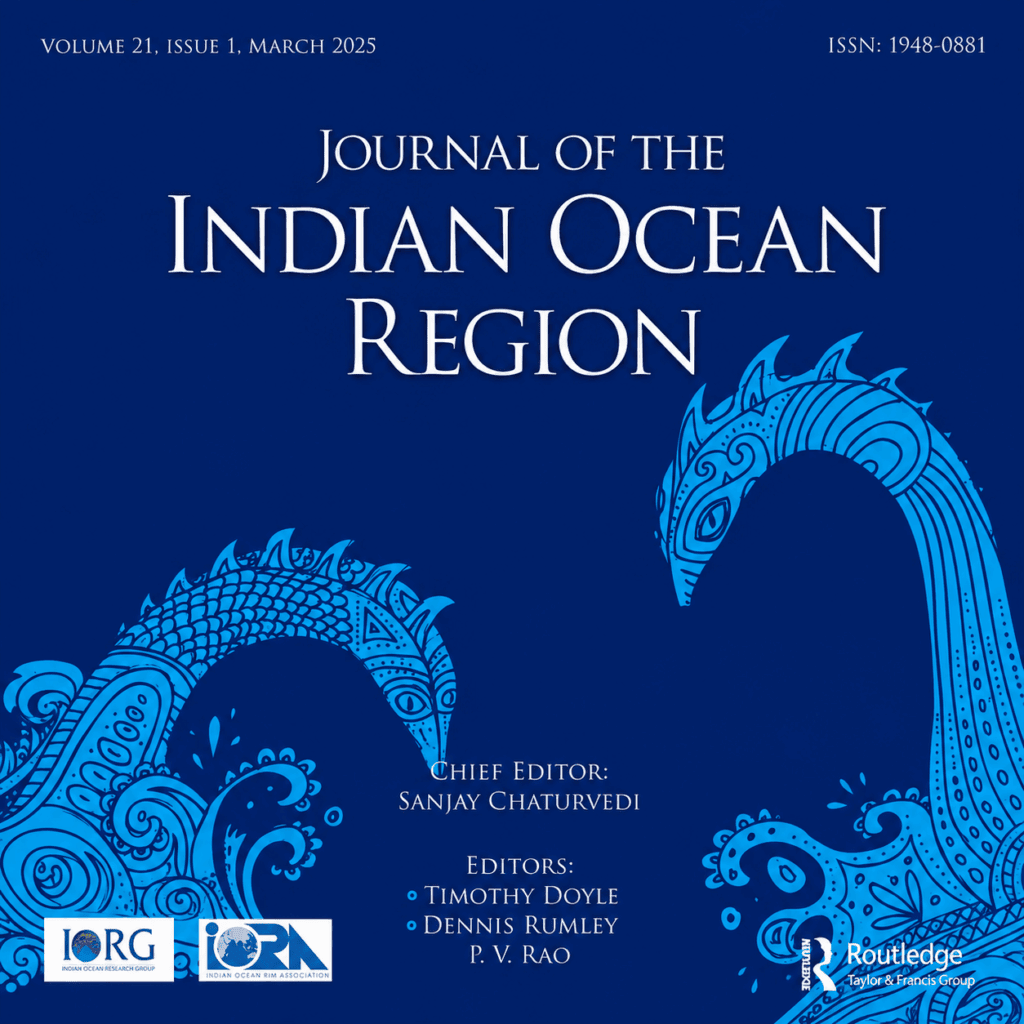
The article ‘Security architecture of the Indian Ocean, minilaterals, and middle powers’ by Shivali Lawale, published online in the Journal of the Indian Ocean Region on 19 August 2026, examines how the Indian Ocean is evolving as a regional security complex amid growing Chinese and US involvement and the emergence of cooperation among middle powers.
Using Regional Security Complex Theory (RSCT), Lawale examines three arrangements involving India, France and the UAE: the India-France-UAE trilateral, I2U2 and the India-Middle East-Europe Economic Corridor (IMEEC). She argues that these issue-based arrangements are reshaping the region’s security architecture through selective forms of securitisation and deterrence while allowing middle powers to preserve strategic autonomy.
Lawale’s central argument is that the Indian Ocean, despite not fitting the traditional land-based conception of a regional security complex, can be understood as an ‘evolving, expansive maritime regional security complex’ linking South Asia, the Middle East, East Africa and the wider Indo-Pacific. Its trade routes, chokepoints and interconnected security concerns mean that developments across these sub-regions increasingly affect one another.
She identifies China’s expanding presence as a major driver of this transformation. Through the Belt and Road Initiative, port development, infrastructure investment and military expansion, China has generated what she describes as ‘deep extra-regional power penetration’, altering regional threat perceptions and contributing to new patterns of alignment. The United States, meanwhile, has expanded its Indian Ocean engagement through its partnerships with India and participation in initiatives such as I2U2 and IMEEC.
The article places India, France and the UAE at the centre of this emerging middle-power alignment. Lawale presents India as seeking to maintain its position in the Indian Ocean while responding to perceived Chinese encirclement. France’s overseas territories, military presence and maritime interests make it a resident Indian Ocean power, while the UAE adopts a hedging approach, maintaining relations with China while deepening cooperation with India and France.
Lawale sees minilateralism as increasingly important because existing institutions such as IORA and IONS have not provided sufficiently decisive regional leadership. Minilaterals allow states to cooperate around specific interests without the constraints of formal multilateral institutions. Importantly, she argues, they are based on ‘common interests rather than shared values and ideological orientations’, allowing states with different political systems and strategic outlooks to cooperate selectively.
The three arrangements perform different functions. The India-France-UAE trilateral combines defence cooperation, naval and air exercises, and strategic signalling. I2U2 is primarily geo-economic, focusing on areas including food, energy, water, health, space and transport, while also contributing to supply-chain diversification. IMEEC focuses on trade, infrastructure and connectivity and is widely discussed as an alternative to, or means of diversifying from, China’s Belt and Road Initiative. Lawale therefore identifies different forms of deterrence across the three arrangements, ranging from strategic signalling to geo-economic and infrastructure-based approaches.
Lawale concludes that these minilaterals are recalibrating rather than replacing existing regional institutions. Together, they contribute to what she describes as a ‘fluid, complex and contested maritime security order’, in which middle powers use flexible, issue-specific partnerships to respond to shifting security pressures while retaining strategic autonomy. Her broader conclusion is that the Indian Ocean is ‘a regional security complex in the making’, shaped by China’s expanding presence, US-China competition and the growing role of India, France and the UAE.
The article is particularly useful for understanding the region’s changing geopolitical context because it shows that competition in the Indian Ocean is not confined to naval power. Connectivity, infrastructure, energy, food security and supply chains have become part of the strategic landscape, while middle powers are using minilateral partnerships to manage great-power competition. This is especially relevant as security developments across the Red Sea, Arabian Sea and wider Indian Ocean become increasingly interconnected.