In its September 2026 Discussion Paper #349, “Neighbourhood First Policy: India’s Role in Sri Lanka’s Debt Recovery”, Dr Ganeshan Wignaraja, Adjunct Senior Fellow at RIS and Visiting Senior Fellow at ODI Global, examines India’s role in Sri Lanka’s debt recovery. The paper is published by the Research and Information System for Developing Countries (RIS).
The paper examines India’s response to Sri Lanka’s economic crisis and asks what should follow now that the country has moved into recovery. Written by Ganeshan Wignaraja, the paper makes a straightforward argument: India’s role as a crisis responder has been important, but that role now needs to give way to a relationship built more firmly around trade, investment, and connectivity. As Wignaraja puts it, “the time is therefore ripe” for India’s Neighbourhood First Policy (NFP) engagement with Sri Lanka to move “beyond aid towards trade and connectivity”.
The scale of the starting crisis explains why India’s intervention mattered. Sri Lanka defaulted on its foreign debt in April 2022, with public debt at about US$80 billion and foreign reserves down to just US$25 million. The economy contracted by 7.3% that year, inflation surged, and poverty doubled. Wignaraja links the collapse to accumulated fiscal and current account deficits; extensive external borrowing, including for low-return infrastructure; the economic effects of Covid-19 and the Ukraine war; and a series of domestic policy decisions such as tax cuts, the fertiliser ban, exchange-rate controls, and import restrictions.
India’s assistance formed an important part of the response. In 2022–23, it provided around US$4 billion in support, including a US$1 billion credit facility for essential imports, US$500 million for fuel and energy, a US$400 million currency swap, and US$2 billion in deferred payments through the Asian Clearing Union. India also supplied food and medicines. Wignaraja places this alongside the International Monetary Fund (IMF) programme, tighter domestic policies, and debt restructuring in explaining Sri Lanka’s recovery. By 2025, growth had returned to 5% and inflation had fallen from 46.4% in 2022 to −0.5%. Foreign reserves reached more than US$6.4 billion by July 2026. Yet the recovery remains fragile: public debt was still 101.1% of gross domestic product (GDP) in 2025, while about a quarter of the population continued to live in poverty.
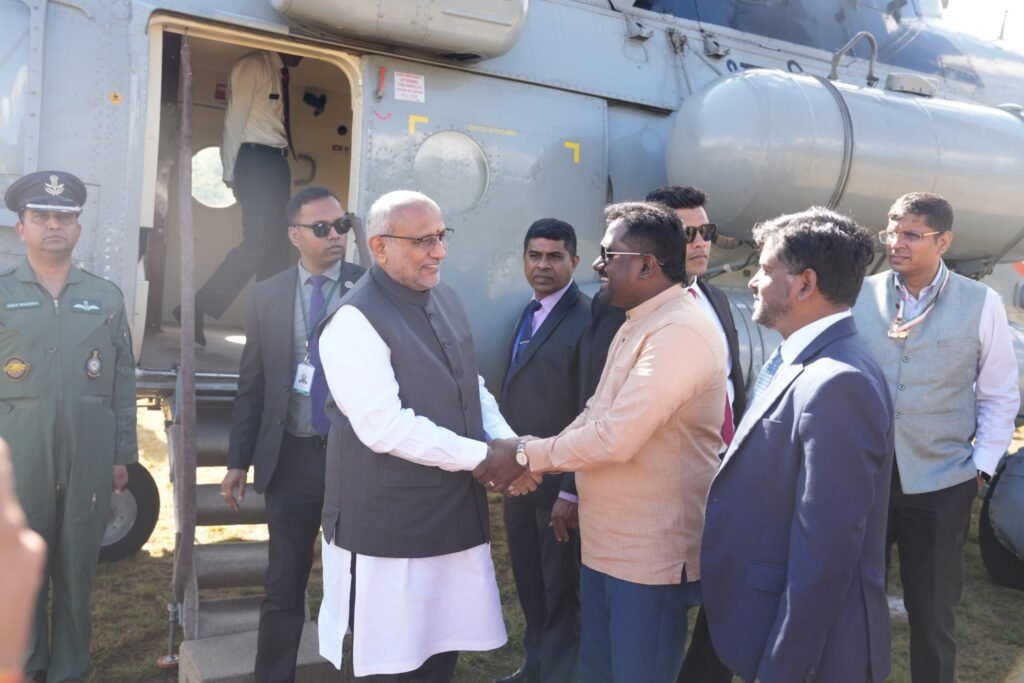
That fragility was tested again by Cyclone Ditwah and the Iran war. Ditwah affected nearly 10% of Sri Lanka’s population, damaged or destroyed more than 91,000 homes, and caused an estimated US$4.1 billion in damage, around 4% of GDP. India responded with a US$450 million reconstruction package, along with helicopters, relief supplies, and disaster-response personnel. The Iran war has exposed a different set of vulnerabilities. Higher oil prices and disruption to shipping and aviation matter particularly for a country that receives about US$8 billion a year in remittances, around half of them from the Middle East, while the region also accounts for roughly half of Sri Lanka’s tea exports. India responded by sending 38,000 metric tonnes of petroleum products and helping evacuate Sri Lankan nationals from Iran.
For Wignaraja, these repeated shocks point to the limits of an aid-centred relationship. Sri Lanka now needs to reduce the chances of another crisis, not simply find help when one occurs. The immediate concern is debt. The present IMF programme ends in March 2027, while large external repayments resume from 2028. The author estimates that Sri Lanka could require at least US$20–25 billion between 2028 and 2030 for debt servicing, essential imports, and investment. An 18th IMF programme would not provide enough on its own, so he argues that India should support an early start to negotiations and help organise a wider aid consortium involving Japan, the United States, the European Union, the IMF, and multilateral development banks.
The paper’s longer-term prescription is economic integration. Wignaraja wants the India-Sri Lanka Free Trade Agreement, signed in 1998, to be modernised, with changes to rules of origin, services, customs procedures, and investment protection. Bilateral merchandise trade had reached about US$5.4 billion in 2025, and he sees US$10–12 billion by 2030 as achievable. Better connectivity would support that expansion, including stronger air and ferry links, port investment, digital connectivity, an undersea electricity transmission line linking Sri Lanka and India, and an oil pipeline. The proposed electricity link between Anuradhapura and Chennai is estimated to cost about US$1.2 billion.
None of this, however, removes the need for reform inside Sri Lanka. The paper points to regulatory barriers, weak export capacity, skills gaps, and constraints on private investment, and argues that Sri Lanka needs stronger macroeconomic management, better state capacity, more competitive businesses, and greater participation in regional supply chains. India can contribute experience from its own economic reforms and from areas such as digital public infrastructure and investment facilitation. The paper thus arrives at a fairly practical proposition: India’s emergency assistance helped Sri Lanka get through the crisis, but the more important task now is to help build an economic relationship that can withstand the next one. For India, that would also serve a strategic purpose by strengthening its position in Sri Lanka and reducing the risks to its own neighbourhood from renewed instability.