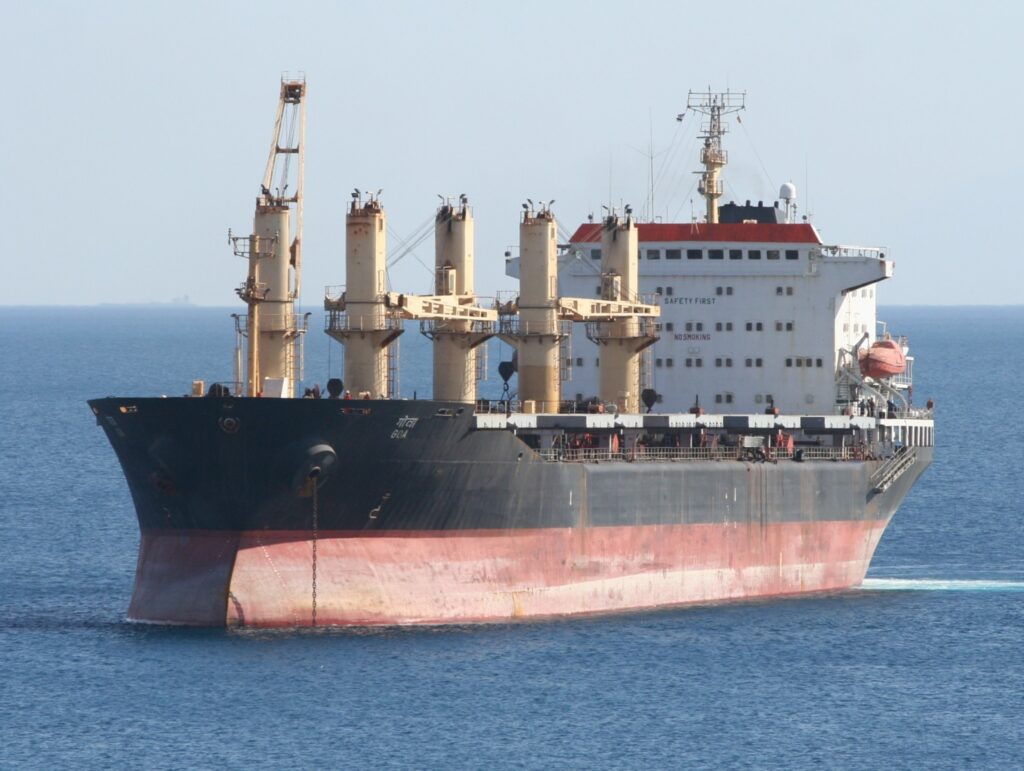
India has proposed adding 100 vessels to its merchant fleet over the next five years, as part of an effort to expand Indian shipping capacity and reduce dependence on foreign shipping lines. The proposal was discussed at the first Sagar Samvad organised by the National Shipping Board (NSB) in New Delhi on August 25, 2026. The event brought together government officials, shipowners, financiers, maritime experts and trainee seafarers to discuss the roadmap for Maritime India Vision 2030 and Maritime Amrit Kaal Vision 2047.
The government says India pays close to $75 billion in freight to foreign shipping lines each year, including for cargo such as crude oil, gas, coal and urea. At the same time, industry representatives at Sagar Samvad said operating under the Indian flag remains 16 to 20 per cent more expensive than operating under a foreign flag.
The proposal is therefore not simply about acquiring more vessels. It is about making Indian shipping competitive enough to expand domestic tonnage and capture a larger share of the trade it already serves, while strengthening the wider maritime ecosystem around shipbuilding, financing and maritime employment.
Why Does India Need More Ships?
India is heavily dependent on maritime transport. Nearly 95 per cent of India’s trade by volume and around 70 per cent by value moves through maritime routes, making shipping central to the country’s external trade.
But dependence on maritime transport does not mean that Indian companies own the ships carrying that trade. A substantial share of India’s international cargo continues to be moved by foreign shipping companies, meaning a significant part of the associated freight payments goes to foreign carriers.
A larger Indian merchant fleet would give domestic shipping companies a greater role in transporting India’s international trade, including cargo such as crude oil, gas, coal and fertilisers. The objective is therefore not to reduce India’s use of maritime trade, but to reduce its dependence on foreign maritime capacity.
What Does the $75 Billion Figure Actually Mean?
The $75 billion freight bill is the amount the government says India currently pays each year in freight to foreign shipping lines. It should not be read as an estimate of savings that will automatically result from adding 100 ships.
The amount eventually retained by Indian companies would depend on which vessels are added, the cargo they carry, how fully they are utilised and whether Indian operators can compete on price with foreign carriers. The 100-ship target is therefore best understood as a fleet-expansion and capacity-building proposal, not as a plan to save $75 billion a year.
Why Are Indian-Flagged Ships More Expensive?
This is the central competitiveness problem identified at Sagar Samvad. Industry representatives said operating under the Indian flag remains 16 to 20 per cent more expensive than operating under a foreign flag. They attributed the difference to taxes on ship imports and maintenance services, tax deducted from seafarers’ wages, taxes on freight and higher domestic financing costs.
That means the problem is not simply a shortage of vessels. Indian operators can also face a higher cost base when competing with foreign shipping companies for cargo. Any significant increase in Indian tonnage therefore depends on making the Indian flag commercially viable, rather than merely adding ships to the register.
What Is the Right of First Refusal?
The Right of First Refusal (RoFR) is a mechanism used in tendering to give Indian-flagged vessels preferential access to cargo. In the system described by the Directorate General of Shipping, an eligible Indian bidder can match the lowest rate offered by a bidder using a foreign-flag vessel and secure the contract.
The mechanism gives Indian operators an opportunity to compete, but it does not remove the price pressure. The NSB panel noted that Indian owners are still expected to match foreign freight rates to win cargo. That is why the current policy discussion is focused not only on preferential access to cargo but also on reducing the underlying cost of operating Indian vessels.
What Is the NSB’s Five-Point Roadmap?
Fiscal reform: Address the tax and cost disadvantages faced by Indian shipping companies.
Assured cargo support: Provide greater certainty over future cargo demand.
Competitive financing: Improve access to financing for acquiring vessels.
Regulatory streamlining: Reduce regulatory burdens affecting shipping companies.
Ease of doing business: Make operating under the Indian flag more commercially attractive.
The panel said these measures, if implemented, could help India add 100 vessels to its fleet within five years and support the longer-term ambition of becoming one of the world’s five largest ship-owning nations by 2047.
Is India Simply Planning to Acquire 100 Ships?
No. The 100-ship proposal sits within a much broader effort to expand India’s maritime industrial base. The government has said it will use both new shipbuilding and the reflagging of foreign-owned vessels to raise Indian tonnage.
In September 2025, the Union Cabinet approved a ₹69,725 crore package to strengthen domestic shipbuilding capacity, maritime financing, shipyard development and skilling. It includes ₹24,736 crore for the Shipbuilding Financial Assistance Scheme, ₹25,000 crore for the Maritime Development Fund and ₹19,989 crore for the Shipbuilding Development Scheme, which aims to expand India’s shipbuilding capacity to 4.5 million gross tonnes annually.
The government has also prepared a 400-plus vessel acquisition plan as part of demand aggregation. Its stated purpose is to provide longer-term order visibility to Indian shipyards. The 100-ship target and the 400-plus vessel plan therefore refer to different but related parts of the wider strategy: one focuses on expanding Indian tonnage, while the other is intended to build a pipeline of future vessel demand for domestic shipyards.
Why Does Demand Aggregation Matter?
Shipbuilding requires substantial capital and long production cycles. For Indian shipyards to expand capacity, they need greater visibility over future orders. Demand aggregation attempts to create that visibility by bringing together vessel requirements into a larger pipeline of potential orders.
This links the shipping and shipbuilding sides of the policy. India wants more vessels operating under its flag while simultaneously trying to build the domestic capacity to construct and finance more of them.
What Has Changed in India’s Shipping Policy?
The fleet expansion comes after changes to India’s maritime regulatory and financing framework. The Merchant Shipping Act, 2025 came into force on 15 March 2026. India Code says the Act consolidates and amends the law relating to merchant shipping and is intended to support the development of Indian shipping and the efficient maintenance of India’s mercantile marine.
The government has also used infrastructure-status measures to improve access to finance. Indian-flagged commercial vessels of 10,000 GT or above were given infrastructure status, while vessels constructed in India of 1,500 GT or above were also included.
The Act provides the statutory basis for the National Shipping Board, a body first constituted in 1958 to advise the government on shipping policy and related matters.
Has India’s Merchant Fleet Already Grown?
Yes. As of December 2025, India’s 1,592-vessel fleet had a total gross tonnage of 14.02 million GT, according to the Ministry of Ports, Shipping and Waterways’ Indian Shipping Statistics 2025.
The ageing of that fleet is significant. Nearly half of India’s registered vessels were more than 20 years old at the end of 2025: 744 vessels, or about 47 per cent of the fleet. Another 327 vessels were in the 16-20-year category. That means a large share of the existing fleet could require replacement or renewal during the period covered by the 100-ship target.
The fleet stood at 1,246 vessels in 2015, rising to 1,592 in 2025, a net increase of 346 vessels over 10 years, or about 35 vessels a year. Gross tonnage increased from 10.51 million GT to 14.02 million GT over the same period. The 100-ship target may therefore not translate into 100 net additions if older or commercially unviable ships leave the fleet.
Where Do Indian Seafarers Fit into the Plan?
The maritime strategy also includes India’s workforce. At Sagar Samvad, a separate session focused on employment, seafarer skills, workforce development and opportunities in emerging segments such as cruise shipping and advanced shipbuilding.
Government data shows that the number of Indian seafarers increased from 1.27 lakh to 3.20 lakh between 2014 and 2026. The government sees maritime employment and skills development as part of its wider Maritime India Vision 2030 and Maritime Amrit Kaal Vision 2047 agenda, although it has not quantified how many jobs the 100-ship target itself would create.
What Is the Strategic Significance?
The immediate issue is economic, but the policy also has implications for India’s dependence on foreign maritime capacity. The government has explicitly linked fleet expansion to reducing reliance on foreign shipping and has highlighted maritime security measures involving Indian-flagged vessels and coordination with relevant agencies.
A larger domestic fleet could give Indian operators a greater role in transporting cargo important to the economy and could reduce some exposure to disruptions in international shipping markets. The scale of that benefit would depend on the composition of the additional fleet and, above all, on whether Indian operators can compete with foreign-flag alternatives.
What Will Determine Whether the 100-Ship Plan Works?
The central challenge is not simply putting 100 more vessels into the fleet. It is making them commercially competitive under the Indian flag.
The NSB’s diagnosis points directly to that problem: industry representatives estimate that Indian-flagged vessels are 16 to 20 per cent more expensive to operate than foreign-flagged vessels. The proposed reforms therefore target the economics of Indian shipping through fiscal measures, assured cargo, financing, regulation and ease of doing business.
The larger question is whether India can make these vessels commercially competitive under the Indian flag, allowing it to carry a larger share of its own maritime trade.
Note: This explainer has been researched, edited, and fact-checked by India’s World staff and prepared with AI assistance.