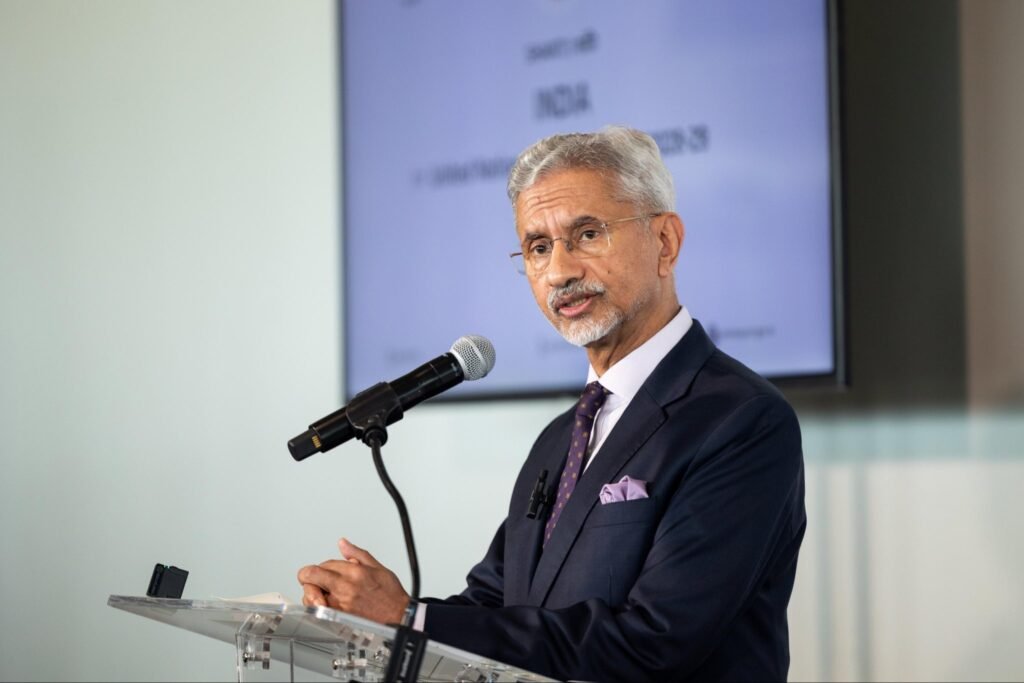

Speaking at News18 DEFCON 2026 in New Delhi on 24 September, Chief of Defence Staff (CDS) General N.S. Raja Subramani, who took charge as India’s third CDS on 31 May, set out a five-point framework called “BUILD” for preparing India’s armed forces and defence ecosystem for future wars. His remarks came amid a changing character of warfare, with drones, artificial intelligence, networks, long-range precision, cyber, and space capabilities reshaping military operations. The CDS argued that India cannot prepare for future conflict by focusing only on new weapons platforms. It must build an ecosystem that can sense faster, connect systems, learn faster, and deliver capabilities at scale.
BUILD stands for Battlefield, Understanding the changing economics of warfare, Integration, Learning and adaptation, and Delivery at scale. The framework brings operational, technological, institutional, and industrial questions into a single approach. It was presented by Subramani in the context of a defence ecosystem that, in his view, has to adapt faster than conventional planning and procurement cycles.
B for Battlefield
The first “B” addresses the changing character of the battlefield. Subramani said future conflicts will be increasingly transparent, connected, and contested across multiple domains. For India, he added, continental, maritime, space, cyber, and electromagnetic challenges cannot be treated as separate problems.
A central warning concerns the disappearance of the traditional distinction between the front and the rear. Surveillance and strike capabilities allow targets far from the immediate line of contact to be located and attacked. “There is increasingly no safer rear”, Subramani said, pointing to logistics nodes, headquarters, airfields, ammunition stocks, and communications infrastructure as potential targets. For the CDS, the Russia-Ukraine conflict shows that war now reaches well beyond the front line and involves the whole nation, not only its soldiers.
The other major change is the shrinking sensor-to-shooter cycle. Sensors can detect a target, algorithms can classify it, networks can transmit the information, and forces can act within minutes or even seconds. That makes speed of detection, decision-making, and engagement a central part of military capability.
U for Understanding the Changing Economics of Warfare
The “U” focuses on the changing cost equation of conflict. Subramani cited relatively inexpensive drones locating high-value targets and argued that low-cost autonomous systems can challenge expensive military defences. He also highlighted the three Cs of the new economy: Compute, Compatibility, and Collaboration.
The framework suggests that sophisticated platforms are not automatically the most economical answer to every military problem. The question becomes how to achieve the required military effect at an acceptable cost.
Economics is also about endurance. A weapon system has to remain effective beyond the opening phase of a war. Subramani referred specifically to the 50th and 100th days of conflict and to operating conditions ranging from high-altitude areas to deserts and extreme hot or cold environments. Sustainment, maintenance, ammunition, and supply chains therefore become part of combat capability, not simply logistical support.
The CDS also cited lessons from the wars in Ukraine and West Asia, where relatively inexpensive drones and other systems have demonstrated how lower-cost capabilities can impose costs on more expensive forces. Technology, he added, is an equaliser that puts weapons within reach of non-state actors and makes asymmetric means more useful, a change of particular consequence for India.
I for Integration
Integration is the technological and organisational core of BUILD. Subramani argued that defence capability should no longer be viewed only through aircraft, ships, tanks, and missiles. Increasingly, he said, the decisive layer lies between those platforms, in networks, data, software, and algorithms.
He stressed that “networks must talk, data must flow” and that systems and algorithms need to interoperate across services so commanders receive decision advantage rather than simply more information. The objective is an architecture in which the right information reaches the right person at the right time, securely and accountably.
This is also where artificial intelligence (AI) enters the framework. Subramani called for a shift from AI demonstrations to battlefield applications in intelligence analysis, mission planning, logistics, maintenance, wargaming, training, and decision support, and for AI that keeps working when battlefield communications are degraded. He also pointed to unmanned surface vessels and unmanned underwater vessels as emerging capabilities requiring integration into the wider operational architecture.
In another intervention at DEFCON, Subramani drew an analogy with India’s digital payments infrastructure, the Unified Payments Interface (UPI): “Just like we built UPI, we now need to build similar equivalents for the military on scale”. The point was to illustrate the need for interoperable military systems capable of operating across organisational and technological boundaries.
L for Learning and Adaptation
The fourth pillar is institutional. Subramani described contemporary conflicts as “massive learning laboratories” and said the speed of learning and adaptation is itself becoming a combat capability. He added that some of the assumptions on which military operations have been built are becoming obsolete.
His argument challenges slow innovation cycles. For rapidly evolving technologies, a sequence of requirement, prototype, trials, and eventual induction may not move quickly enough. He instead proposed a faster cycle of experiment, deploy, learn, and modify at scale.
The significance is operational as well as technological. Lessons from an ongoing war can quickly alter tactics, equipment requirements, and force protection. A military that takes too long to incorporate those lessons risks fielding solutions after the battlefield has already changed.
D for Delivery at Scale
The final “D” connects military effectiveness to industrial capacity. For Subramani, defence industry cannot be judged only by the sophistication of the systems it designs. Strategic endurance also depends on whether industry can manufacture, modify, repair, and sustain those systems quickly and economically.
He called for production lines, tooling, supply chains, inventories, and surge capacity, with companies able to move “from 10 systems to 100, and from 100 to 1,000” when strategic circumstances demand it.
The emphasis comes as India’s defence industrial base expands. According to the Ministry of Defence, defence production reached a record ₹1.78 lakh crore in fiscal year 2025-26, up 15.6% from the previous fiscal year. Defence exports reached ₹38,424 crore. BUILD, however, places the focus not only on aggregate output but on whether industrial capacity can respond at wartime speed and sustain prolonged operations.
Subramani identified long-range precision weapons, underwater capabilities, engines and propulsion, explosives, sensors and electro-optics, maintenance, repair and overhaul, testing and certification, and components and subsystems as areas requiring deeper cooperation among the armed forces, industry, academia, and technology institutions. Startups, universities, engineers, students, and technology companies, he emphasised, can all contribute to the country’s mission of self-reliance and defence manufacturing.
Why BUILD Matters
The five elements of BUILD are interdependent. A changing battlefield creates the demand for new capabilities. Changing economics asks whether those capabilities can be produced and sustained affordably. Integration determines whether technologies and services can function as one system. Learning determines how quickly that system can evolve. Delivery at scale determines whether it can survive a prolonged conflict.
BUILD is therefore less a list of weapons to acquire than a framework for thinking about military preparedness. Its emphasis shifts attention from individual platforms towards the wider ecosystem of technology, data, doctrine, industry, logistics, and institutional learning. The framework also fits a broader Ministry of Defence emphasis on future warfare. At the same event, Defence Minister Rajnath Singh said that threats have become fluid even though borders remain fixed. In August 2026, during the Tri-Services Future Warfare Course, Subramani highlighted artificial intelligence, cyber capabilities, autonomous systems, information warfare, space technologies, and data-driven decision-making, while stressing jointness and cooperation between the armed forces, industry, academia, and research institutions.
The practical test of BUILD will be implementation. Its five components point to a common requirement: India must not only design advanced military capabilities, but also connect them, adapt them, produce them in sufficient numbers, and keep them functioning through the changing conditions of war.
Note: This explainer has been researched, edited, and fact-checked by India’s World staff and prepared with AI assistance.