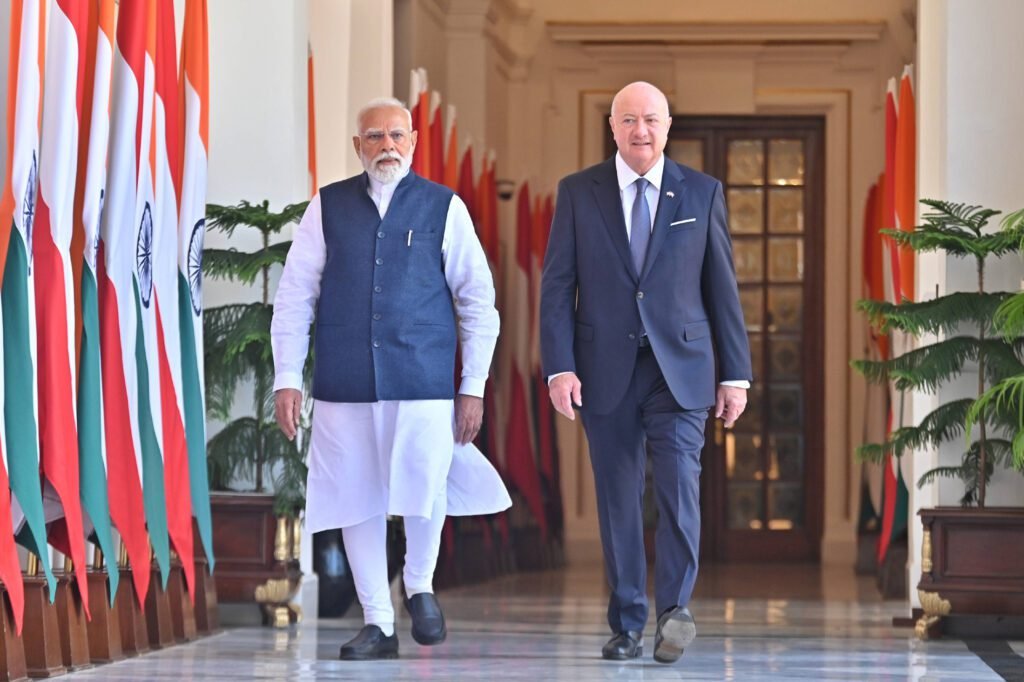
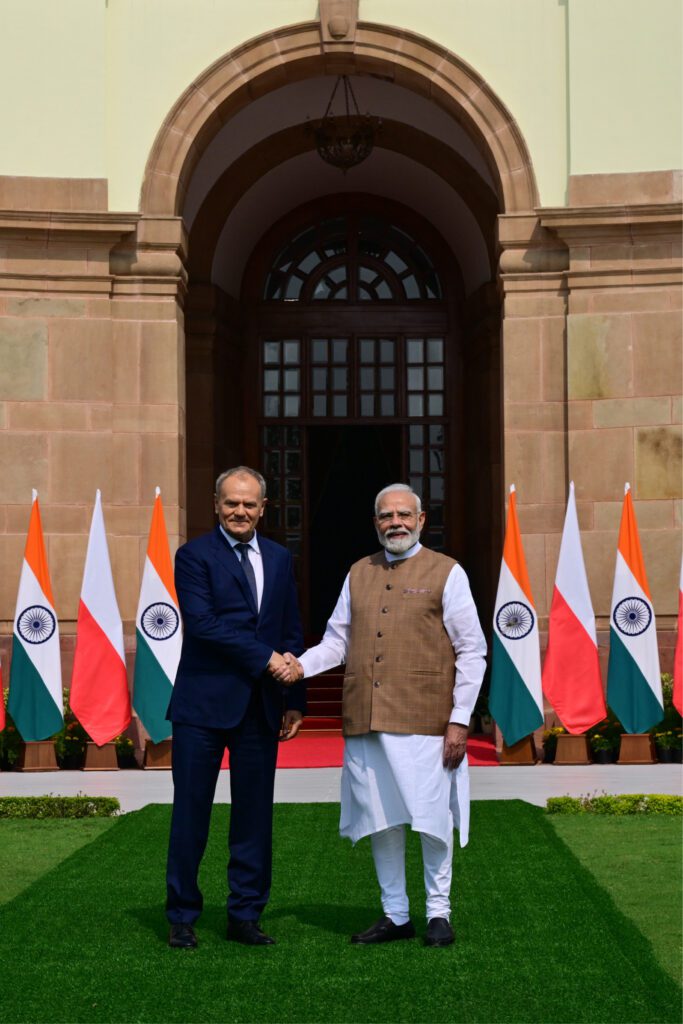
India and Poland are looking to give their Strategic Partnership a stronger economic and security footing. Polish Prime Minister Donald Tusk’s recent visit to India from 21 to 23 October 2026 put that ambition into focus, with both governments setting a target to double bilateral trade by 2030 and outlining cooperation in defence, space and critical minerals. Accompanied by around 100 business leaders, Tusk met Prime Minister Narendra Modi in New Delhi and travelled to Bengaluru for business and technology meetings.
India and Poland established diplomatic relations in 1954 and built close ties during the Cold War. Relations continued after Poland’s transition to democracy in 1989, while its accession to the European Union (EU) in 2004 added an economic dimension. High-level engagement, however, remained relatively infrequent.
That changed in August 2024, when Modi became the first Indian prime minister in 45 years to visit Warsaw. The trip marked 70 years of diplomatic relations and elevated ties to a Strategic Partnership, supported by an Action Plan for 2024–28. Tusk’s visit followed a mid-term review of the partnership in September 2026 by External Affairs Minister S. Jaishankar and Polish Deputy Prime Minister Radosław Sikorski.
At a briefing during Tusk’s visit, Ministry of External Affairs (MEA) Secretary (West) Sibi George said the focus was on “consolidating the progress made since 2024 and translating our growing convergence into practical cooperation and tangible outcomes”. The MEA briefing transcript sets out the government’s assessment of the visit.
The relationship also has a historical and human dimension. During the Second World War, the Jam Saheb of Nawanagar and the Kolhapur royal family sheltered Polish women and children. Decades later, in 2022, Polish authorities helped Indian students leave Ukraine under Operation Ganga.
Key Outcomes
The clearest economic commitment was a target to double bilateral trade by 2030. The Indian Embassy in Warsaw puts trade at US$6.36 billion in 2025, comprising Indian exports of US$4.83 billion and imports from Poland worth US$1.53 billion. The governments also agreed to revive the bilateral working group on agriculture. The MEA list of outcomes provides details of the formal announcements.
A proposed Defence Industry Dialogue will provide a platform for companies to explore technology partnerships, co-development and co-production. The two governments also agreed to establish a Counter-Terrorism Dialogue. The two leaders “condemned in the strongest terms the terrorist attack in Pahalgam, Jammu and Kashmir on 22 April 2025”. An agreement on the protection and exchange of classified information, which is important for sensitive technology cooperation, remains under negotiation. Both sides expressed “their expectation that it would be signed soon”.
The technology agenda covers artificial intelligence, semiconductors, quantum technologies and space. Modi announced an India–Poland Startup Bridge and technology hackathons for young people in his joint press statement. The leaders also identified opportunities in battery recycling, rare-earth refining and critical minerals. A memorandum of understanding on geology and mining is still under negotiation.
Connectivity and multilateral cooperation formed another part of the discussions. The leaders considered direct flights, shipping, maritime security and cooperation between ports, including through the India–Middle East–Europe Economic Corridor. Poland will join India’s Coalition for Disaster Resilient Infrastructure. India also invited Poland to join the Indo-Pacific Oceans Initiative, the International Solar Alliance and the Global Biofuels Alliance. Warsaw backed India’s 2028–29 candidature for a non-permanent seat on the UN Security Council, as well as its bid for membership of a reformed and expanded Council.
Alongside the government-level announcements, business forums in New Delhi and Bengaluru resulted in company-level agreements. The Polish Institute of International Affairs (PISM) reported 13 cooperation agreements, including one between railway manufacturer PESA and Jupiter Wagons, and another between Poland’s Scanway and India’s Pixxel on satellite projects. These are commercial arrangements rather than government treaties.
Why Now?
Two wider developments help explain the renewed engagement. First, negotiations on the India–EU Free Trade Agreement (FTA) concluded in January 2026, although the agreement has yet to be signed or enter into force. Modi and Tusk called for “its early signing and ratification as well as timely implementation”. According to the European Commission’s published text, the text may still undergo legal revision and will become binding only after signature and completion of domestic procedures.
The second factor is the changing European security landscape following Russia’s war against Ukraine. Poland, a frontline member of both NATO and the EU, has assumed a central role in European security. The conflict has also encouraged European capitals to strengthen engagement with India, given New Delhi’s continued relationship with Moscow.
In an October 2026 German Marshall Fund commentary, Garima Mohan describes Poland as a key interlocutor for India in Central and Eastern Europe. She links the renewed engagement to the war in Ukraine, the FTA and European concerns about economic security and supply chains.
What Does Poland Seek From India?
For Warsaw, India represents a large market and an opportunity to diversify its international trade. Polish companies see potential in industrial machinery, electrical equipment, processed food, infrastructure and advanced manufacturing. The India–EU FTA could further improve their access to the Indian market once it enters into force.
Poland is also seeking to reduce its dependence on China and build more resilient supply chains. Speaking at the business forum, Tusk said: “We want Poland to be a gateway to Europe for companies from India, and India to be a gateway for companies from Poland to Asia”. Polish Radio reported his remarks. Defence, space, cybersecurity and critical minerals are among the other areas where Warsaw sees scope for cooperation.
What Does India Seek From Poland?
For New Delhi, Poland is both a market and an entry point into Central and Eastern Europe. It is India’s largest trading and investment partner in the region, with Indian investments exceeding US$3 billion. Tata Consultancy Services, Infosys, Wipro and HCL have operations in the country, while Indian IT companies employ nearly 10,000 professionals there.
India hopes to expand this presence and attract Polish investment in railways, electric mobility, manufacturing, food processing and biotechnology. New Delhi is also interested in Polish expertise in mining, coal gasification and renewable energy. The proposed Defence Industry Dialogue could help companies identify specific projects, although the agreement on classified information still needs to be concluded.
The V4 Opening
The bilateral relationship is part of India’s renewed engagement with Central Europe. The Visegrad Group (V4), comprising Poland, Hungary, the Czech Republic and Slovakia, offers a regional platform for cooperation. On 21 September 2026, Jaishankar attended the first V4+India Foreign Ministers’ Meeting on the sidelines of the UN General Assembly in New York.
The ministers discussed trade, technology, supply chains, defence, connectivity, education and mobility, according to the Akashvani report. The format complements India’s bilateral relationships with the four countries; it does not replace them. The India–Poland joint statement also welcomed the inaugural meeting.
The Road Ahead
Differences over Russia and the war in Ukraine remain a factor in the relationship. The joint statement reiterated “the need for a comprehensive, just, and lasting peace in line with international law, consistent with the purposes and principles of the UN Charter, including respect for sovereignty and territorial integrity”. However, New Delhi and Warsaw continue to approach the conflict from different strategic positions. The pending agreement on classified information is another test of how far they can take defence and technology cooperation.
The 2024 Strategic Partnership now has a more detailed agenda, but much will depend on its implementation. Starting the proposed dialogues, completing pending agreements and turning company-level arrangements into projects will require sustained engagement from both governments and businesses. PISM’s assessment of the visit makes a similar point about the need for continued institutional and commercial involvement.
For India, closer ties with Poland offer a stronger foothold in Central Europe. For Warsaw, India is a major market and a partner in diversifying its economic relationships. The V4 format adds a regional dimension to this engagement. Ultimately, the value of Tusk’s visit will be judged by how much of the agenda both countries translate into action.
Note: This explainer has been researched, edited, and fact-checked by India’s World staff and prepared with AI assistance.