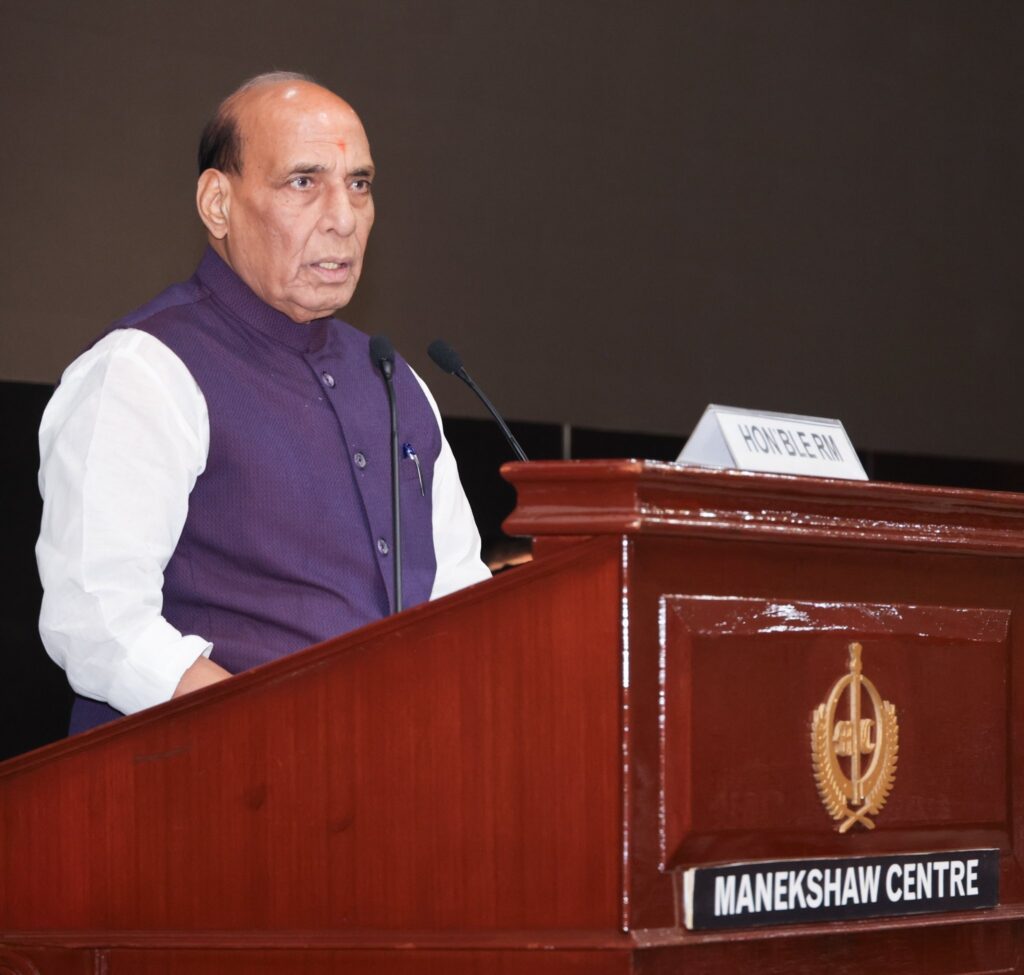
On 23 October 2026, India’s Defence Minister Rajnath Singh released the Indian Army’s Land Warfare Doctrine on the closing day of the biannual Army Commanders’ Conference in New Delhi. The Ministry of Defence described it as an overarching framework to prepare the Army for future conflicts. Singh asked the service’s senior leadership to plan for the next 20 to 30 years while remaining ready for immediate challenges.
Defence Minister stated that Operation Sindoor had demonstrated “innovative thinking, enhanced synergy and superior coordination, complemented by advanced weaponry”. He also called for faster progress in artificial intelligence (AI), autonomous systems, data analytics, cybersecurity, and secure communications. The ministry’s release records the announcement and the minister’s remarks, but does not reproduce the doctrine itself. Specific details about its provisions therefore come mainly from media reporting so far.
What Doctrine Does
A military doctrine sets out how a service understands warfare and how it prepares for and conducts operations. In his 2018 study “Personalities, Organizations, and Doctrine in the Indian Military”, Christopher Clary calls doctrine a “theory of victory”: an institutionally approved set of ideas about how military force can be used to achieve national aims. Strategy establishes the political purpose for which force may be used. Doctrine addresses how military capabilities should be organised and employed in pursuit of those aims.
Doctrine guides training, force structure, procurement, and operational planning. It is not a battle plan, and publishing one does not mean that a service has the equipment or organisation it describes. Secure communications, precision weapons, and unmanned systems need trained personnel, maintenance, logistics, and funding. Doctrine also sets priorities: no army can buy every promising technology or prepare equally for every scenario. It should identify essential capabilities while leaving commanders room to adapt.
Why Update It Now?
The Army last issued a land warfare doctrine in December 2018. Since then, the military stand-off with China in eastern Ladakh has tested India’s ability to sustain troops and infrastructure in difficult terrain. The Army must also prepare for contingencies on the western front. Operation Sindoor in May 2025 added recent Indian operational experience to a debate shaped by developments in other theatres.
In his 2011 study “Assessing India’s Emerging Land Warfare Doctrines and Capabilities: Prospects and Concerns”, Harinder Singh distinguishes near-term “operational” readiness for western-front contingencies from longer-term “structural” readiness on the China front, including mountain-warfare capabilities and border infrastructure. Written before the Ladakh stand-off, his distinction helps explain the different demands on the Army.
The 2018 doctrine already addressed hybrid conflict, multi-front operations, human-machine teaming, and warfare beyond the land domain. Recent wars show how these issues affect troops. Drones can expose positions, unmanned systems can strike them, and electronic warfare can disrupt communications. Units need to operate when an adversary can see their movements or their networks fail.
The new doctrine reportedly draws lessons from the Russia-Ukraine war, Iran-US conflicts, and Operation Sindoor. Citing sources, one report highlighted unmanned systems, persistent surveillance, contested communications, and information warfare. This report describes the doctrine’s reported rationale, not its provisions in full.
What Reports Say About the 2026 Doctrine
The Ministry of Defence’s public release does not include the full details of the doctrine. The points below draw on the minister’s remarks and media reports, some based on unnamed sources, and should be read as reported priorities rather than a line-by-line account of the document.
Drones and Disrupted Communications
The doctrine reportedly prioritises drones, AI, and precision warfare, while Singh’s remarks stressed autonomous systems, data analytics, secure communications, and cybersecurity. These capabilities can help forces gather information, identify targets, and coordinate action under enemy disruption. A key issue is whether frontline units will have access to these systems and can integrate them into routine operations.
Human Judgement and Machine Support
Media reports also identify manned-unmanned teaming and greater soldier empowerment as priorities. Machines can support surveillance and targeting, but personnel must assess incomplete information, decide when to act, and keep units functioning when equipment fails. That requires training and workable command arrangements as well as new equipment.
Operations Across Domains
The doctrine is reportedly aligned with Defence Forces Vision 2047, released by Rajnath Singh in March 2026. The official vision document describes a plan to make the armed forces more integrated, technologically advanced, and capable of operating across multiple domains. Singh’s remarks at the doctrine’s release stressed that ground forces would remain indispensable, while success would depend on multi-domain capabilities and seamless coordination in joint operations.
The doctrine also sits alongside the Joint Doctrine for Multi Domain Operations, released in August 2025. That is a separate tri-service document. Its importance is practical: joint concepts must work across services that have different equipment, communications systems, command structures, and operational priorities.
Logistics and Self-Reliance
Media reports describe resilient logistics, a whole-of-nation approach, and Aatmanirbharta in defence as further priorities. Domestic production can reduce some supply risks, but it does not guarantee that equipment will be reliable, available in sufficient numbers, or straightforward to maintain. These are questions of industrial capacity as well as military planning.
Two reports separately described a five-year roadmap for multi-domain training, a tiered AI programme for officers, and plans to make drone operations a secondary skill across the Army. These reports discussed the initiatives alongside the doctrine. The ministry’s release does not identify them as provisions of the document, so they should not be described as confirmed contents of the doctrine.
Earlier Doctrines
The Army’s published doctrinal record goes back at least to Fundamentals, Concepts, Doctrine – Indian Army (1998), identified in a 2019 critique by retired Major General P.K. Mallick. Indian Army Doctrine followed in October 2004. In his 2012 monograph India’s Limited War Doctrine: The Structural Factor, Ali Ahmed describes the 2004 publication as the official starting point for India’s land warfare doctrine and links its development to the Kargil War and the 2001-02 Operation Parakram mobilisation crisis. Both episodes raised questions about how India could retain conventional options for a limited conflict without creating unacceptable escalation risks.
Cold Start emerged from the debate about faster, limited conventional responses after Operation Parakram. It is best understood as an operational concept associated with that doctrinal evolution, not as a formally published edition of the Army’s doctrine. Its status was disputed. General V.K. Singh, when Army chief, denied that a doctrine by that name existed. In 2017, Army Chief General Bipin Rawat acknowledged it, saying: “The Cold Start doctrine exists for conventional military operations”.
Mallick also records an electronic version of the Army doctrine produced during General V.K. Singh’s tenure as Army chief, although he says it later became difficult to locate publicly. The Army’s 2006 Doctrine of Sub Conventional Warfare was a separate specialist document. The Joint Doctrine of the Indian Armed Forces appeared in 2017, and the Land Warfare Doctrine 2018 stated on its cover that it should be read in conjunction with that joint doctrine.
The 2018 document covered multi-front capability, Integrated Battle Groups (IBGs), surveillance, precision strike, information warfare, cyber and space capabilities, and hybrid or “grey zone” conflict. It stated: “All combat operations will be as Integrated Battle Groups (IBGs), under command of a combined arms operational headquarters”. It also called for integrating soldiers with artificial intelligence and robotics in war-fighting systems. Technology and the need to use it in Army operations were therefore already part of the previous framework.
What Has Changed Since 2018?
The priorities attributed to the 2026 doctrine largely extend ideas already present in 2018. Drones, AI, human-machine teaming, joint operations, and non-contact warfare featured in the earlier document. Current reporting gives more attention to lessons from recent conflicts, persistent surveillance, and the need to operate when communications are contested. The public material does not show which formal provisions have been added, removed, or rewritten.
That limits how far the two documents can be compared. The useful questions concern training and organisation: Will exercises require units to operate without reliable communications? How will formations combine drones with artillery, air defence, intelligence, and electronic warfare? What role will land forces play when the Navy or Air Force leads an operation? The ministry’s announcement and current reporting do not answer these questions in enough detail to establish the scale of doctrinal change.
What the Research Flags
Christopher Clary argues that Indian Army doctrine has tended to change slowly. He writes: “Indian doctrine has been characterized more by inertia than change”. Clary also finds that doctrinal shifts have consistently expanded commanders’ scope for offensive action. The question for 2026 is whether new technology changes the Army’s underlying theory of victory, or mainly gives it additional tools for pursuing familiar objectives.
Harinder Singh argues: “Military doctrines can be credible only if backed by commensurate war-fighting capabilities”. He discusses resource constraints, acquisition delays, and institutional obstacles. Those concerns remain relevant to proposals involving drones, AI, and secure networks. Equipment must be funded, maintained, and integrated, and personnel must be trained to use it before commanders can rely on it in combat.
Arzan Tarapore’s 2020 Carnegie India paper, “The Army in Indian Military Strategy: Rethink Doctrine or Risk Irrelevance”, questions the Army’s long-standing focus on large offensive formations designed to impose costs by capturing enemy territory. He argues that this approach leaves Indian military strategy “ill-equipped to manage more likely scenarios short of war”. Tarapore recommends greater emphasis on denial strategies, intelligence, surveillance and reconnaissance, long-range precision strike, and roles in which the Army supports a joint operation led by another service. Better sensors and more precise weapons will not by themselves resolve when India should use force or what ground forces can realistically achieve.
Mallick’s 2019 critique of the 2018 doctrine raises a related concern. He writes: “Writing of a doctrine can be a helpful exercise, but we have to see if it leads to change in policies”. He found the document too brief on some operational questions, including operational art and manoeuvre warfare, and said it must formally supersede earlier publications. The public announcement does not provide enough of the 2026 text to establish whether these concerns have been addressed.
What Would Count as Change?
Public accounts point to greater emphasis on unmanned systems, data, communications resilience, and coordination among the services. The doctrine’s significance will depend on whether those priorities change procurement, unit organisation, exercises, and command arrangements, and whether they give political leaders credible options below the threshold of a major war. Several reported ideas were already present in 2018. The announcement does not establish a major doctrinal shift; that judgement requires the full text and evidence of changes to training, equipment choices, and commanders’ decisions.
Note: This explainer has been researched, edited, and fact-checked by India’s World staff and prepared with AI assistance.