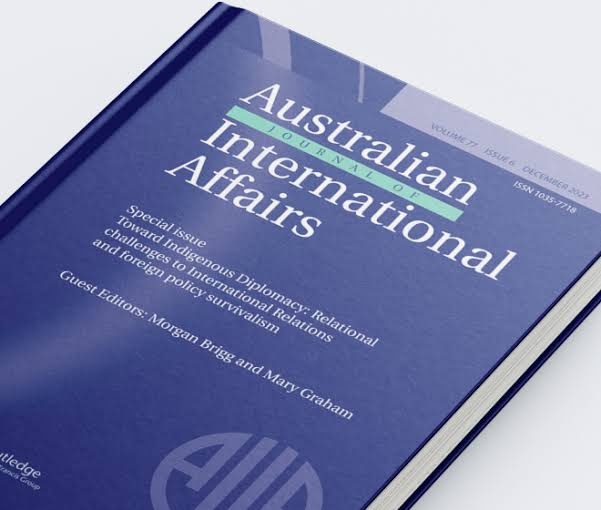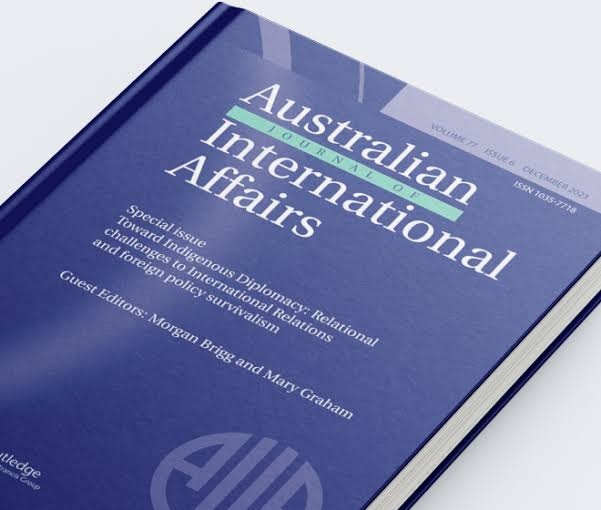
In their article, “Shaping advantages: cognitive warfare, asymmetric competition, and the Ukraine war”, published in the Australian Journal of International Affairs on 4 September 2026, Jiayue Li and Baohui Zhang of Lingnan University examine cognitive warfare as an instrument of strategic competition. They argue that digital technologies have expanded the ability of states to manipulate information, perceptions, and behaviour, making cognitive warfare an increasingly important part of statecraft. It is particularly attractive to states that are disadvantaged in material power because it offers a relatively low-cost way to challenge stronger rivals.
The authors begin by noting that conflict is no longer confined to the physical battlefield. Competition now extends into the cognitive realm, where states seek to influence how people understand events and make decisions. Artificial intelligence, deepfakes, and social media have increased the reach of such operations, while information overload and a fragmented media environment make it harder for audiences to distinguish reliable information from falsehoods. The authors argue that this can deepen social divisions and weaken public trust. Li and Zhang also question whether cognitive warfare should simply be treated as another form of warfare. They “share Miller’s critique” of this approach and argue that it is “far more appropriate to see cognitive warfare as a form of strategic competition”. This places cognitive operations within the broader competition between states, including activity that takes place below the level of armed conflict.
The argument is then linked to offensive realism. States seek to improve their relative position and use different forms of power to do so, including information and influence. For weaker states, cognitive warfare can provide a way of exploiting vulnerabilities in stronger opponents without matching them in conventional capabilities. The authors therefore describe it as a “force multiplier” and argue that it is particularly useful to states facing rivals with superior material power. The Russia-Ukraine war is the article’s main example. Li and Zhang call it a “landmark case of cognitive warfare”, arguing that both sides have used information and influence operations to weaken the other side, maintain domestic support, and shape international opinion. They stress that cognitive warfare is not inherently a tool of the stronger side. Russia has used it to compensate for its disadvantages against the wider West, while Ukraine has used it to counter Russia’s military superiority.
The authors trace Russia’s campaign through three stages: preparation before the invasion, information operations during the early phase of the war, and later adjustments in response to countermeasures. Before the invasion, Moscow sought to weaken confidence in the Ukrainian government and exploit divisions in Western societies. After the invasion, its messaging targeted Ukrainian morale as well as Western support for Kyiv, including through claims about the war, refugees, sanctions, and energy costs. The authors argue that these efforts achieved some political effects but became less effective as Ukraine and Western governments developed countermeasures. Ukraine had also prepared for this contest before February 2022. The authors point to measures taken after 2014, including the creation of institutions focused on strategic communication and countering disinformation. During the war, Ukraine used social media and real-time communication to reinforce domestic morale and reach international audiences. Zelensky’s direct communication with foreign publics became part of this effort.
The Bucha episode illustrates the approach particularly clearly. Ukraine used photographs, testimonies, and video material to draw international attention to the killings and strengthen its case against Russia. Li and Zhang describe this as “strategic narrative shaping”, linking battlefield developments to the wider struggle for international support. The authors’ larger point is that cognitive warfare has become important precisely because it can affect the balance between states without requiring equivalent material resources. Ukraine’s experience, in their account, shows how a weaker state can use information and influence to reduce some of the advantages enjoyed by a militarily stronger opponent. They conclude that cognitive warfare “has become a key competition strategy of states and forms the backbone of statecraft in the twenty-first century”.
For India, the article offers a useful lens for assessing Operation Sindoor. The May 2025 India-Pakistan conflict showed that military action was accompanied by a parallel contest over information, losses, and the interpretation of events. Dinakar Peri, writing for Carnegie India, noted that India’s military victory was partly obscured by undue focus on specific platforms and one-sided narratives, compounded by delays in sharing information about Indian losses. A separate Carnegie India discussion on the global outreach following Operation Sindoor argued that New Delhi needed to strengthen strategic communication and narrative building, while synchronising its ideation, execution, and narration in advance. The Ukraine case therefore suggests a more specific lesson for India: strategic communication should be built into operational planning rather than treated as something that follows military action. In a short conflict, the ability to establish a credible account of events quickly can shape international perceptions, diplomatic space, and, ultimately, the wider effect of military success.