India Formalises Names for 28 Places and Features in Ladakh
On 2 October 2026, the government, in consultation with the Union Territory of Ladakh, identified 28 places and geographical features by standard place and feature names on the Survey of India’s official map. The published list includes peaks, mountains, passes, glaciers, valleys, land areas, a lake, and a river, including Atisha Giri, Zorawar Peak, Guru Rinpoche, and Yangpa River. The government said the official mapping would facilitate accurate recognition and raise public awareness.
Jaishankar Visits Three African Countries
External Affairs Minister S. Jaishankar visited Ghana, Côte d’Ivoire, and Ethiopia from 6 to 10 October 2026 to strengthen India’s economic and development partnerships with Africa. In Ghana, discussions included cooperation in pharmaceutical development, agricultural mechanisation, and industrialisation. In Ethiopia, Jaishankar addressed the Adwa Memorial Museum on the India–Africa partnership and chaired a Regional Heads of Mission Conference attended by Indian envoys in the region.
US Secretary of State Marco Rubio Visits India
US Secretary of State Marco Rubio visited India on 20–21 October 2026 at the invitation of External Affairs Minister S. Jaishankar. During meetings in Mumbai, the two sides reviewed the India–US Comprehensive Global Strategic Partnership and discussed trade, defence, technology, and energy security. They welcomed progress in negotiations on the India–US Bilateral Trade Agreement and reiterated their commitment to an early conclusion. Rubio’s visit, his second to India in 2026, reflected continued high-level engagement between the two countries and their efforts to advance the India–US COMPACT for the 21st century.
India Invites Pakistan to SCO forum in Delhi
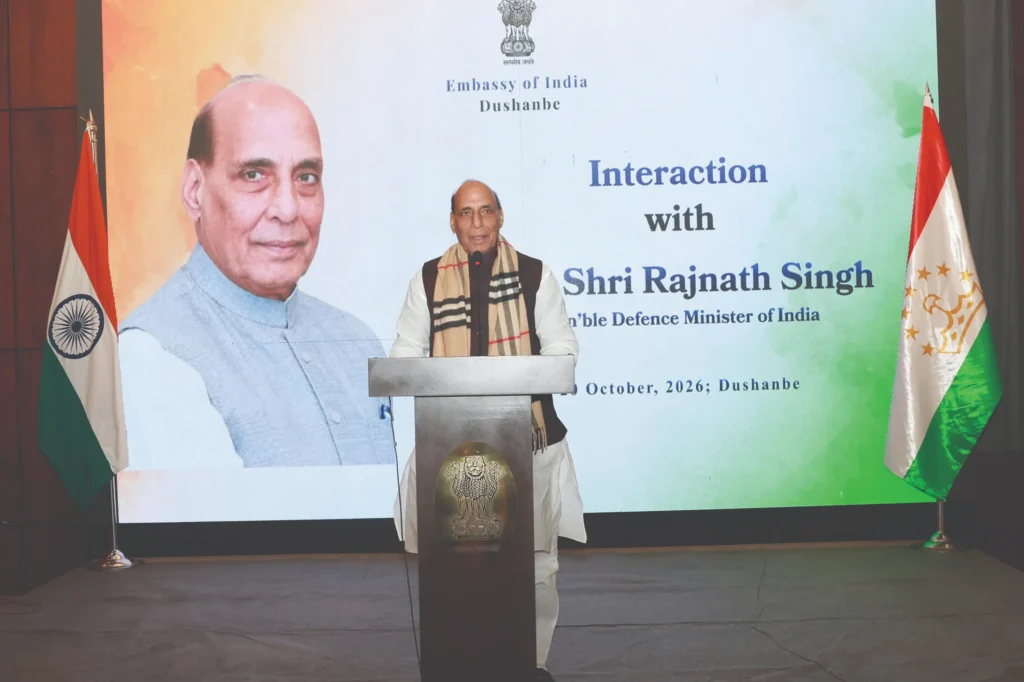
India has invited all ten Shanghai Cooperation Organisation (SCO) member states, including Pakistan, to the inaugural SCO Civilisational Dialogue Forum in New Delhi from 20 to 22 November 2026. Defence Minister Rajnath Singh announced the forum, meant to strengthen cultural ties among member states, on 20 October at the SCO Council of Heads of Government meeting in Dushanbe, also attended by Pakistan’s Deputy Prime Minister Ishaq Dar. There, Singh called for the “entire ecosystem of terrorism” to be dismantled collectively, with “no double standards”. The invitation follows a visit to Islamabad by Alok Dimri, India’s SCO National Coordinator, for a meeting of the SCO Council of National Coordinators that ended on 30 September.
Navy Commissions Third Shallow-Water Anti-Submarine Craft
The Indian Navy commissioned INS Mangrol, its third anti-submarine warfare shallow-water craft, on 12 October 2026. Built by Cochin Shipyard Limited in Kochi, it is designed to detect and counter underwater threats in coastal waters, where larger warships can face operational limitations. More than 80% of its content is indigenous. The vessel carries a hull-mounted sonar, lightweight torpedoes, an indigenous anti-submarine rocket launcher, and the Maareech advanced torpedo decoy system. It can also operate alongside maritime patrol aircraft, helicopters, and other warships to protect ports, harbours, and coastal approaches.
IAF to Get Dedicated GSAT-7C Satellite
On 15 October 2026, the Ministry of Defence signed a ₹2,563 crore contract with NewSpace India Limited for GSAT-7C, a dedicated communications satellite for the Indian Air Force (IAF). The IAF currently shares satellite transponder capacity with the Army and Navy. According to the ministry, the indigenously designed, developed, and manufactured satellite will provide secure, resilient, and seamless communication. The project is intended to strengthen operational effectiveness and support domestic capabilities in critical defence technologies.
Rajnath Singh releases Land Warfare Doctrine
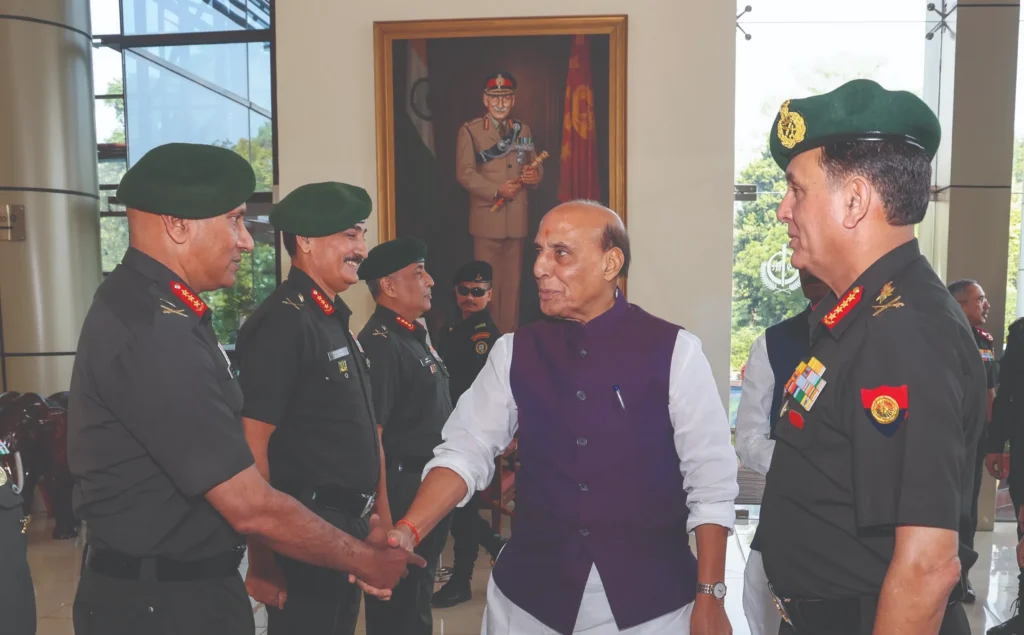
On 23 October 2026, Defence Minister Rajnath Singh released India’s Land Warfare Doctrine at the Army Commanders’ Conference in New Delhi, setting an overarching framework for the Army to prepare for evolving warfare and future conflicts. He called for a 20–30-year strategic vision while urging commanders to remain prepared for immediate and emerging threats. Priorities highlighted alongside the release included modernisation, drones, artificial intelligence, autonomous systems, data analytics, cybersecurity, and secure communications, as well as coordination across land, air, maritime, space, and cyber domains.
India and Poland Deepen Strategic Partnership
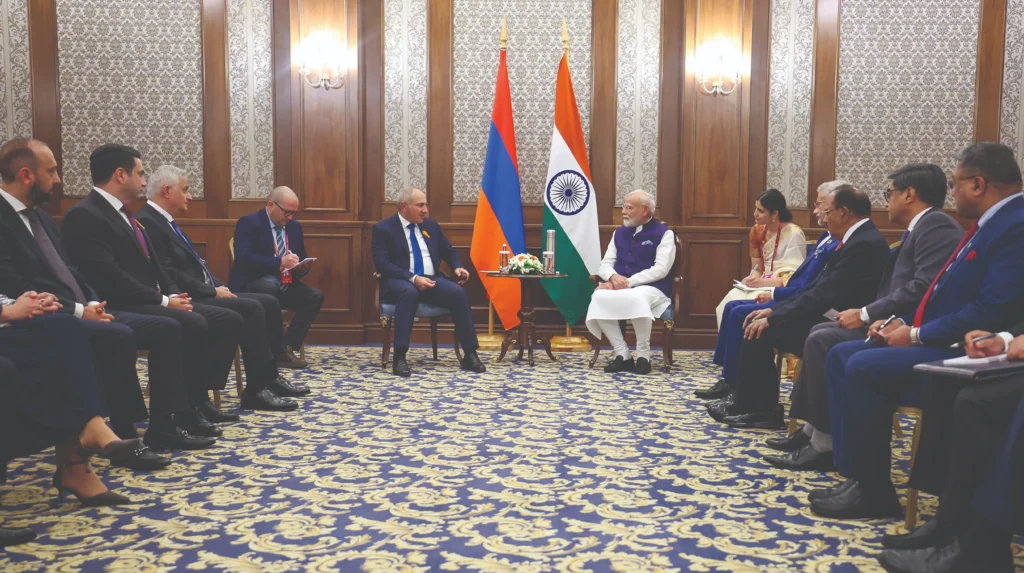
Polish Prime Minister Donald Tusk visited India from 21 to 23 October 2026, accompanied by a high-level delegation that included around 100 business leaders. During talks with Prime Minister Narendra Modi, the two sides reviewed their Strategic Partnership, established in August 2024, and agreed to double bilateral trade by 2030. They also agreed to establish an India–Poland Defence Industry Dialogue and a Start-up Bridge, while expanding cooperation in artificial intelligence, cybersecurity, critical minerals, space, and defence. Poland joined the Coalition for Disaster Resilient Infrastructure (CDRI). The visit also included an India–Poland Business Forum, which brought together business representatives to explore investment and industrial partnerships.
India Backs Minilateral Cooperation
On 14 October 2026, at the Raisina Dialogue’s Middle East edition in Abu Dhabi, External Affairs Minister S. Jaishankar called for urgent reform of multilateral institutions, arguing that stronger cooperation among smaller groups of countries could support changes to global institutions. During a session with UAE Deputy Prime Minister and Foreign Minister Sheikh Abdullah bin Zayed Al Nahyan, Jaishankar said the changing global order was prompting countries to seek new partnerships and move beyond traditional comfort zones. He cited the India–UAE partnership as an example of cooperation adapting to a changing international environment.
Canadian Foreign Minister Visits India
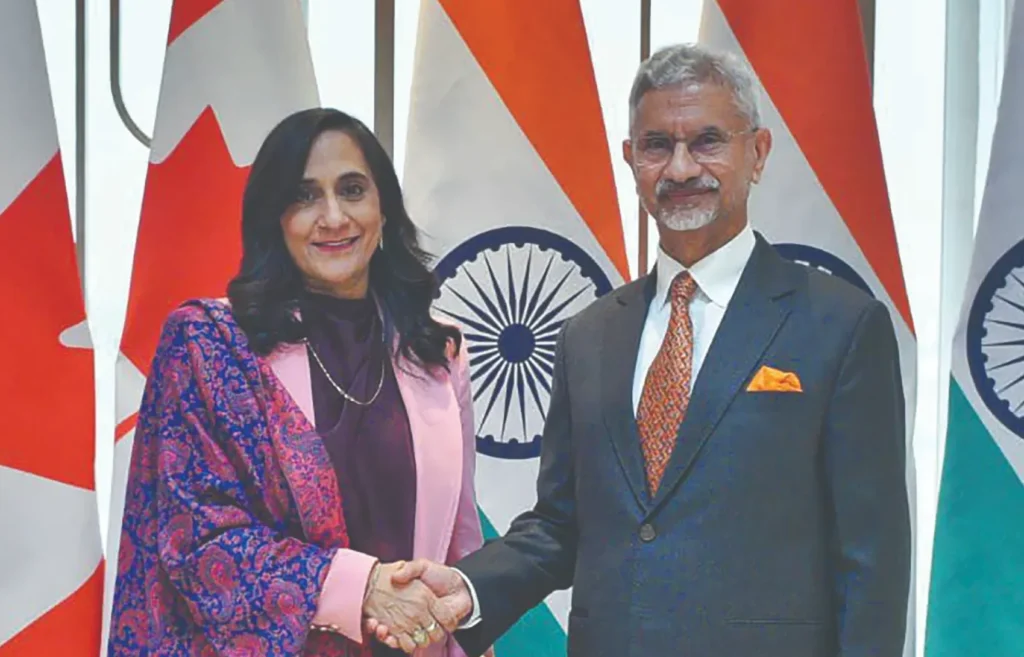
Canadian Foreign Minister Anita Anand visited India from 13 to 16 October 2026 as both countries sought to advance their renewed strategic partnership. During a meeting with External Affairs Minister S. Jaishankar in New Delhi on 14 October, the two sides reviewed progress on their bilateral roadmap, covering trade, energy, people-to-people ties, and security and defence cooperation. They welcomed the recent security dialogue between their National Security Advisers and efforts to advance negotiations for a Comprehensive Economic Partnership Agreement.
IAF Chief Outlines Theatreisation Vision, Opposes Fighter Asset Split
In an interview with the Press Trust of India published on 25 October 2026, Chief of the Air Staff Air Chief Marshal A. P. Singh said the Indian Air Force did not see theatreisation as a way to divide fighter aircraft permanently by geography. “An aircraft is not relevant only to the geographical area from which it operates”, he said. He called for structures suited to India’s own security needs, with “centralised control where necessary, and decentralised execution where appropriate”, and for phased implementation that keeps operational readiness intact. The plan envisages Northern, Western, and Maritime theatre commands, based in Lucknow, Jaipur, and Thiruvananthapuram, but has stalled over differences among the services.
India And Azerbaijan Seek To Stabilise Bilateral Ties
External Affairs Minister S. Jaishankar visited Azerbaijan on 23 October 2026 for talks with his counterpart on bilateral relations. The visit came as New Delhi and Baku sought to stabilise ties following tensions in 2025, when Azerbaijan condemned India’s strikes against terrorist infrastructure in Pakistan and held high-level talks with Pakistan and Türkiye. India and Azerbaijan had resumed official consultations on 3 April 2026, covering trade, technology, tourism, pharmaceuticals, energy, culture, people-to-people exchanges, and cross-border terrorism. Azerbaijan remains an important partner for India in regional trade and energy investment, while the visit provided an opportunity to review cooperation across these areas.
Defence Ministry Clears ₹2.12 Lakh Crore In Proposals For The Armed Forces
On 26 October 2026, the Ministry of Defence accorded Acceptance of Necessity approvals worth ₹2.12 lakh crore for the Army, Navy, and Air Force, with around 82% of the procurement to be sourced from Indian industry. Cleared by the Defence Acquisition Council, these are in-principle approvals rather than contracts. The Army’s list includes high-mobility vehicles, a self-propelled gun system, and surveillance and strike drones. Light multi-role helicopters will serve the Army and the Air Force, while the Navy’s approvals include a decoy system against anti-ship missiles. The same day, Defence Minister Rajnath Singh called for “Aatmanirbharta 2.0” in defence.