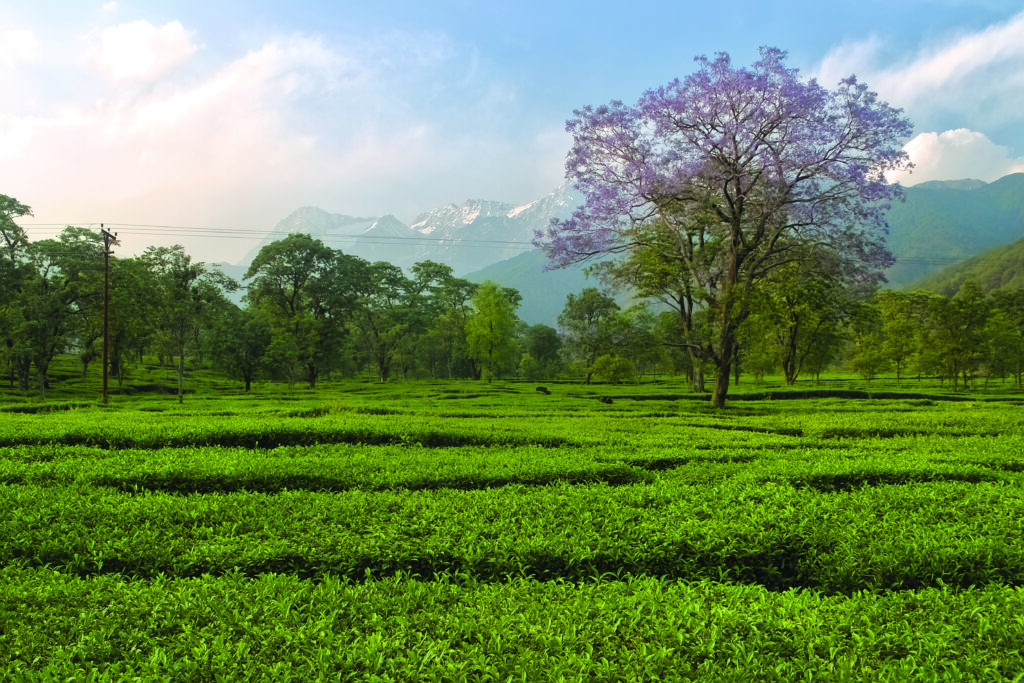
India’s tea story begins in the wild tea forests of Assam, where the indigenous tea plant was documented in the early 19th century and commercial cultivation followed in the 1830s. Two centuries later, tea stretches across 15 states, from the Brahmaputra Valley and the hills of North East India to the Himalayan foothills in the north and the Western Ghats in the south. India now produces more than 1.3 billion kg of tea a year, making it one of the world’s largest tea producers. But this is not one tea landscape: each region has its own climate, elevation, varieties, traditions and communities behind the leaf.
Assam: The Heartland of Indian Tea
| State | Assam |
| Principal areas | Brahmaputra Valley and Barak Valley |
| Tea area | ~3.59 lakh hectares |
| Production | 699.58 million kg (2025) |
| Tea growers | ~1.35 lakh, including more than 1.33 lakh enumerated small growers |
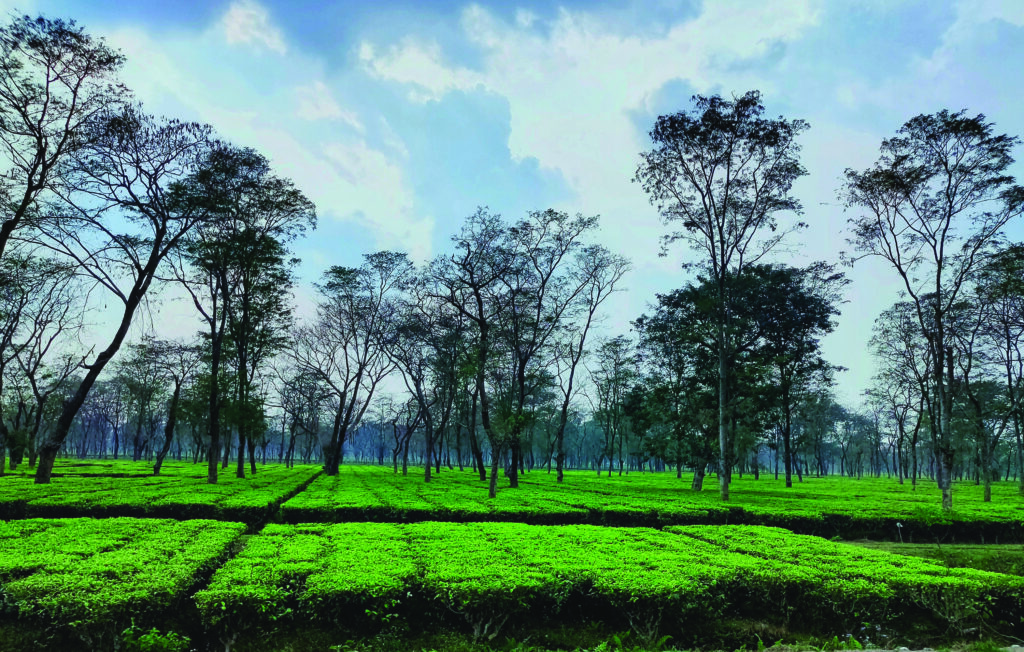
Assam is the largest and most extensive tea-growing landscape in India and the world’s largest contiguous tea-growing region. The story of Indian commercial tea begins here: in 1823, Robert Bruce reported tea plants growing wild around Sadiya in Upper Assam. The first English tea garden was established at Chabua in 1837, followed by commercial production by the Assam Tea Company in 1840.
Today, Assam’s tea country stretches across the Brahmaputra Valley and into the Barak Valley. The Tea Board recorded 359,069 hectares of tea area in the state as of March 2025, including 232,962 hectares in the organised sector and 126,108 hectares among enumerated small growers.
Assam produced 699.58 million kg in 2025, roughly half of India’s total tea output. Small growers contributed almost half of that production: 345.89 million kg, compared with 353.69 million kg from big growers.
Assam tea is predominantly CTC (Crush, Tear, Curl), a mechanical tea-processing method that produces small, granular tea particles typically used for strong black tea and tea bags. It is valued for its strong, brisk and full-bodied character, while Upper Assam also produces important orthodox and specialty teas.
The Government of India estimated 684,064 lakh tea plantation workers in Assam for 2024-25, making the industry one of the state’s largest rural employment systems.
Darjeeling: Tea in the High Himalaya
| State | West Bengal |
| Districts | Darjeeling hills, with GI production centred on recognised gardens |
| Tea area | ~17,500 hectares |
| Recognised gardens | 87 |
| Production | 5.6 million kg (2025) |
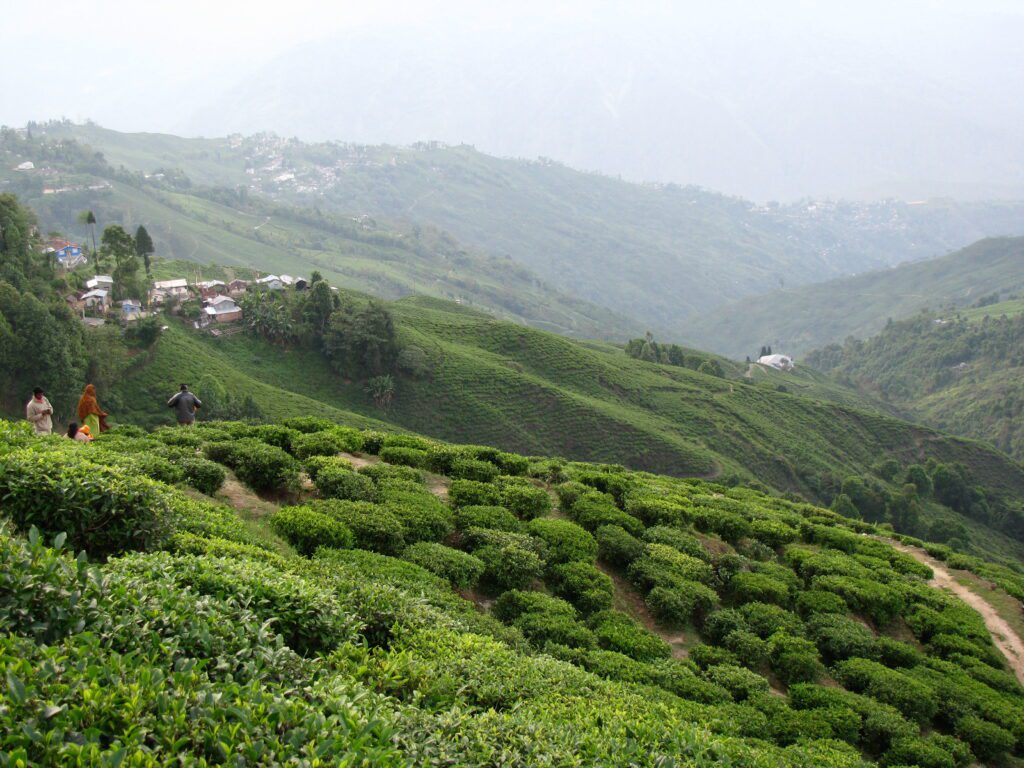
Darjeeling occupies a very small area on India’s tea map but has an extraordinary international identity. Tea was first planted here in the early 1800s, and the gardens climb the Himalayan foothills between roughly 600 and 2,000 metres. The combination of altitude, cool climate, terrain, soil and slow growth gives the tea its distinctive aromatic and muscatel character.
Tea Board’s Darjeeling system recognises 87 tea estates whose produce qualifies for Darjeeling Tea GI protection. The Board gives the cultivated area at around 17,500 hectares. Production has fallen sharply from historical levels: in 2025, Tea Board recorded only 5.60 million kg.
Older government and industry estimates put permanent employment at roughly 55,000, with substantial additional seasonal employment during plucking. A West Bengal government document reported more than 2.37 lakh tea-worker ID cards distributed across the state’s tea gardens, illustrating the much larger workforce of North Bengal as a whole.
Darjeeling’s importance therefore cannot be measured by volume alone. It is India’s most internationally recognisable high-altitude tea origin, protected through a dedicated GI certification and traceability system.
Dooars–Terai: The Great Tea Belt Below the Himalaya
| State | West Bengal |
| Regions | Dooars and Terai, North Bengal |
| Tea area | ~1.0–1.2 lakh hectares combined, depending on definition |
| Production | 416.03 million kg (2025) |
| Small growers | ~38,000+ enumerated in the two belts |
Immediately south and southeast of Darjeeling lies a very different tea landscape. The Dooars and Terai form the great low- and mid-elevation tea belt of North Bengal, extending across Jalpaiguri, Alipurduar, Cooch Behar and the plains around Darjeeling. Tea Board describes the region as ranging from roughly 90 to 1,750 metres, with high rainfall and a warm, humid climate.
Unlike Darjeeling’s relatively small, high-altitude gardens, Dooars and Terai are primarily associated with high-volume CTC tea. Their teas tend to be strong, full-bodied and suited to blending.
In 2025, Tea Board recorded 229.29 million kg from Dooars and 186.74 million kg from Terai, together producing more than 405 million kg.
The region is also becoming increasingly dominated by small growers. Tea Board’s March 2025 enumeration recorded 14,494 hectares of small-grower tea area in Dooars and 10,503 hectares in Terai, with more than 38,000 growers between them.
The labour economy is correspondingly enormous. North Bengal’s tea belt supports hundreds of thousands of workers and their families through plantations, small farms, bought-leaf factories, transport and local commerce. A 2021 assessment described the wider North Bengal tea economy as supporting around 10 lakh workers, though this is broader than the organised plantation workforce and should not be treated as a current official headcount.
Nilgiri: The Tea Country of the Blue Mountains
| States | Primarily Tamil Nadu; tea landscape extends into Kerala and Karnataka |
| Principal district | The Nilgiris, Tamil Nadu |
| State tea area | ~65,955 hectares in Tamil Nadu |
| Production | 171.63 million kg (Tamil Nadu, 2025) |
| Small growers | ~50,748 in Tamil Nadu |
The Nilgiris are India’s great southern highland tea region. The Blue Mountains extend across Tamil Nadu, Kerala and Karnataka, with tea generally grown between 1,000 and 2,500 metres. The region receives both the southwest and northeast monsoons, allowing plucking through much of the year.
Tamil Nadu is by far the largest tea-producing state in South India. Tea Board recorded 65,955 hectares of tea in the state in 2025, including 29,504 hectares in the organised sector and 36,451 hectares among small growers. The state produced 171.63 million kg in 2025, with small growers accounting for 117.24 million kg.
The Nilgiris itself has an unusually strong small-grower economy. A Tea Board-linked regional study found that the district produced 128.64 million kg in 2022-23, with small growers responsible for about 75% of output. The same study recorded more than 46,000 small growers.
Nilgiri tea is made both as CTC and orthodox tea. Its bright liquor, briskness and floral character have made Nilgiri orthodox tea an important export and blending tea.
The region’s workforce is large but increasingly divided between estate labour and smallholder family labour. The Tea Board’s 2015 organised-sector baseline recorded 49,410 workers in Tamil Nadu; this excludes the much larger family-based workforce associated with small holdings.
Munnar: Kerala’s High-Range Tea Country
| State | Kerala |
| Principal district | Idukki |
| Tea area | ~27,000 hectares in Idukki, approximately |
| Kerala’s total tea area | 35,697 hectares |
| Production | 58.16 million kg (Kerala-2025) |
| Small growers in Kerala | 8,079 |
Munnar sits at the centre of Kerala’s High Range tea country, within the Western Ghats. Tea Board places the growing range at approximately 950–2,600 metres, making parts of Munnar among India’s highest tea-growing areas. The region is defined by steep mountains, shola forests, streams and a cool highland climate.
Tea cultivation in Kerala is concentrated overwhelmingly in Idukki and Wayanad districts. A Tea Board special package for Idukki estimated that Idukki alone accounted for about 75% of Kerala’s tea cultivation. Applying that proportion to the Tea Board’s latest state total of 35,697 hectares gives an approximate Idukki area of 26,800 hectares. This is a derived estimate rather than a current district-level Tea Board total.
Munnar’s landscape combines large estates and small growers. Kanan Devan Hills Plantations, for example, has estates spread over about 24,000 hectares and produces around 21 million kg of tea annually.
Kerala produced 58.16 million kg in 2025, of which 46.49 million kg came from big growers and 11.67 million kg from small growers.
Tea is a major plantation employer in Kerala. The Tea Board’s organised-sector baseline recorded 40,773 workers in 2015. Current employment is not directly comparable because smallholder family labour is not captured in that figure.
Kangra: Tea Beneath the Dhauladhars
| State | Himachal Pradesh |
| Principal districts | Kangra, with smaller areas in Mandi and Chamba |
| Small-grower area | ~710 hectares statewide |
| Production | A small, speciality-oriented regional industry |
Kangra is one of India’s smallest established tea regions but one of its most distinctive. Tea cultivation began in the Kangra Valley in the mid-19th century, after the region was identified as suitable for tea. The gardens lie against the Dhauladhar range, generally between 900 and 1,400 metres.
Kangra tea is produced as both black and green tea and is protected by a GI registration. The first flush is particularly valued for its aroma and fruity character. Unlike Assam or the Nilgiris, Kangra is not a volume-producing landscape; its significance lies in its distinctive origin, heritage and speciality market.
The current scale illustrates this difference. Tea Board’s March 2025 enumeration recorded 1,526 small tea growers covering 710 hectares across Himachal Pradesh. Of these, 1,187 growers and 544 hectares were in Kangra district. Mandi accounted for another 337 growers and 165 hectares, while Chamba had 2 growers and 1 hectare.
The organised plantation workforce is correspondingly small. The Tea Board’s 2015 baseline recorded only 563 organised-sector workers across Himachal Pradesh. Much of Kangra’s tea economy is therefore based on small holdings and family labour rather than the large plantation-worker communities characteristic of Assam or North Bengal.
Kangra represents an important alternative model in the Indian tea map: small-scale, high-altitude, speciality production and strong regional identity rather than mass production.
Sikkim: India’s Organic Mountain Tea
| State | Sikkim |
| Principal garden | Temi Tea Estate |
| Tea-growing altitude | ~1,000–2,000 metres |
| Small-grower area | ~14 hectares officially enumerated in 2025 |
Sikkim is one of India’s newest but most distinctive tea regions. Commercial tea cultivation began with the establishment of Temi Tea Estate in 1969. A second boutique garden, Bermiok, followed in 2002. The state’s tea gardens are located in the Himalayan landscape at elevations of roughly 1,000–2,000 metres.
Sikkim’s defining distinction is its organic identity. The state was declared fully organic in January 2016, while Temi’s tea had received organic certification earlier, in 2008. Sikkim produces black, green, white and oolong teas, with production based heavily on hand-plucking and relatively small-scale gardens.
The scale is tiny compared with Assam or West Bengal. Tea Board’s 2025 enumeration recorded just 35 small growers covering 14 hectares. The organised sector is dominated by Temi. A 2026 parliamentary document listed 413 workers at Temi Tea Estate.
Sikkim’s importance is therefore not measured in tonnes. Its value lies in organic production, high-altitude cultivation, hand-plucking and speciality teas. It demonstrates how India’s tea map increasingly includes boutique origins alongside the large plantation economies.
Tripura: The Northeast’s CTC Tea Region
| State | Tripura |
| Tea area | ~1,400 hectares among enumerated small growers, plus organised estates |
| Tea gardens | ~52 |
| Employment | 10,438 tea workers |
Tripura has one of the oldest tea industries in Northeast India outside Assam. Its history is unusual because cultivation was initiated by Indian entrepreneurs rather than British planters. The origins of the organised industry go back to 1916, when Maharaja Birendra Kishore Manikya granted land for tea cultivation.
Today, Tripura is primarily a CTC-producing region. Tea is grown across several districts, and the state has a mix of organised gardens, cooperatives and small growers. Tea Board’s March 2025 enumeration recorded 2,875 small growers covering about 1,423 hectares.
The industry’s social footprint is significant relative to the state’s modest production. In May 2025, the Tripura government reported 10,438 tea workers employed across 52 tea gardens.
Tripura’s tea is closely linked to the Northeast’s domestic CTC market, with Guwahati serving as its nearest major auction centre. The state is also experimenting with organic production, small-scale green tea and mini factories, giving small growers greater scope to process their own leaf rather than simply sell green leaf to larger factories.
The Smaller Tea Map
Beyond the famous origins, India’s tea landscape reaches into eight additional states. Tea Board’s 2024-25 Annual Report classifies Tripura, Himachal Pradesh, Uttarakhand, Bihar and Karnataka as traditional but smaller tea states, while Arunachal Pradesh, Manipur, Meghalaya, Mizoram, Nagaland and Sikkim are described as newer/non-traditional tea states.
| State | Approx. tea area |
| Arunachal Pradesh | 7,852 ha |
| Nagaland | 5,890 ha |
| Bihar | 2,570 ha |
| Meghalaya | 939 ha |
| Uttarakhand | 679 ha |
| Manipur | 347 ha |
| Mizoram | 248 ha |
| Karnataka | 2,093 ha |
*The figures for most of these states are Tea Board’s small-grower enumeration as of 31 March 2025, not necessarily the state’s complete tea area.
Bihar: Kishanganj
Bihar’s tea story is concentrated almost entirely in Kishanganj district, in the state’s northeast corner adjoining West Bengal. Tea Board’s 2025 assessment identified 2,931 small growers covering 2,570 hectares. The landscape is geographically connected to the Terai tea belt rather than resembling the traditional tea-growing plains of central Bihar.
Uttarakhand: Kumaon’s Small Gardens
Uttarakhand has a dispersed tea landscape across Almora, Bageshwar, Chamoli, Champawat, Nainital and Pithoragarh. Tea Board’s 2025 assessment identified 1,493 small growers covering 679 hectares. The sector is overwhelmingly smallholder-based, with speciality and locally branded teas offering significant premium market potential.
Arunachal Pradesh, Nagaland, Meghalaya, Manipur and Mizoram
The North East’s newer tea states represent the expanding edge of India’s tea map. Tea Board’s 2025 enumeration recorded 3,526 growers/7,852 hectares in Arunachal Pradesh; 2,929/5,890 hectares in Nagaland; 735/939 hectares in Meghalaya; 473/347 hectares in Manipur; and 450/248 hectares in Mizoram. These are fundamentally different from Assam’s plantation economy. They are characterised by small growers, scattered holdings and developing processing infrastructure. Their importance may ultimately lie less in competing with Assam on volume and more in creating distinctive regional teas and new rural value chains.