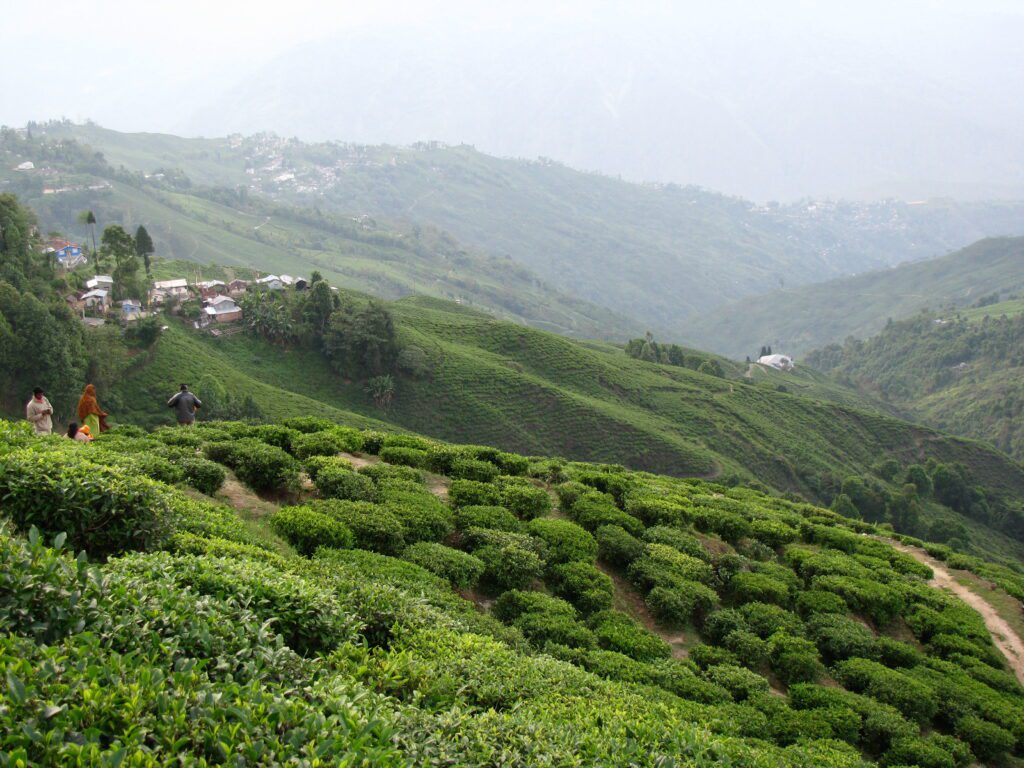
India’s tea industry occupies an unusual position in the global market. It is the world’s second-largest tea producer and the largest producer and consumer of black tea. It is also a major exporter, although it sells far more tea at home than it ships abroad. Its economic story rests on three pillars: production at scale, a vast domestic market and a global export business.
India as a Tea Producer
India produced 1,395.53 million kg of tea in 2025, registering about 7.1% year-on-year growth, according to Tea Board India. China remains the world’s largest producer. In 2024, China accounted for about 53% of global tea production, followed by India at 18%, Kenya at about 8% and Sri Lanka at about 4%. The four countries together accounted for about 83% of world production.
India’s production is highly concentrated geographically. Assam produced 699.58 million kg in 2025, accounting for just over 50% of national output. West Bengal produced 421.63 million kg, followed by Tamil Nadu at 171.63 million kg and Kerala at 58.16 million kg. Together, these four states accounted for about 97% of India’s tea production.
The composition of production is also important. In 2025, India produced 1,227.66 million kg of CTC tea, 149.04 million kg of orthodox tea and 18.83 million kg of green tea. CTC therefore dominates India’s tea economy by volume, supplying the strong black tea widely consumed in India and many overseas markets.
Alongside this large-volume industry is a smaller premium segment. India has four GI-protected teas promoted by Tea Board: Darjeeling, Assam Orthodox, Nilgiri Orthodox and Kangra. Darjeeling is particularly associated with premium tea and its distinctive muscatel character. India also produces smaller quantities of white, oolong, green and other speciality teas.
The contrast is significant: India’s tea industry is built on enormous volumes, but some of its most valuable products are produced in relatively small quantities. The opportunity is therefore not only to produce more tea, but also to increase the value generated from particular origins and speciality categories.
India as a Tea Consumer
Tea Board’s national consumption study estimated India’s tea consumption at approximately 1,197 million kg in 2023. Average per-capita consumption was estimated at about 840 grams a year, with rural consumption at around 797 grams and urban consumption at 925 grams.
India accounted for about 18% of global tea consumption in 2024, according to Tea Board. The Board also estimated that around 84% of India’s tea production was consumed within the country, highlighting the exceptional size of the domestic market.
India’s position is particularly strong in black tea. Tea Board describes India as the world’s largest producer and consumer of black tea. It is important, however, to distinguish this from overall tea consumption: India is not the world’s largest consumer of all types of tea by volume. Its distinction is specifically in black tea.
The scale of domestic demand also explains the difference between India’s production and export shares. In 2024, India accounted for about 18% of world tea production but 13% of world tea exports. Much of the tea that India produces never enters the international market.
The domestic market is also changing. CTC remains dominant, particularly in traditional milk-tea consumption, but green tea, speciality teas, premium packaged products, tea bags and other convenient formats have created additional market segments.
Private market research points to continued value growth, although estimates vary according to the definition of the market. A 2025 Netscribes estimate placed India’s tea industry at ₹1 trillion in 2024, projecting it to reach ₹1.47 trillion by 2029, a CAGR of 6.98%. This is a private-sector forecast, not an official government projection, and should be read as an industry estimate rather than a definitive market-size measure.
The implication is important: future growth does not necessarily require a proportionate increase in tea consumption. Higher spending per consumer, premiumisation and the expansion of packaged and speciality products can increase the value of the domestic market.
India as a Tea Exporter
India exported 257.88 million kg of tea in FY2024–25, earning ₹7,503.52 crore. The previous year, exports stood at 250.73 million kg and ₹6,476.38 crore.
The increase in value was considerably stronger than the increase in volume. Export quantity rose by about 2.9%, while export value increased by nearly 16%. Average export realisation rose from ₹258.30 per kg to ₹290.97 per kg.
The latest figures show another jump. In FY2025–26, India exported a record 282.11 million kg of tea and earned ₹8,718.83 crore, according to the Department of Commerce and Tea Board. Export volume increased by about 9%, while export earnings rose by about 16% over FY2024–25.
India was the third-largest tea exporter globally in 2024, behind Kenya and China. Its position is therefore different from its production ranking: India produces about 18% of the world’s tea but accounts for about 13% of global exports because the domestic market absorbs a large share of production.
The composition of exports also reveals where additional value can be created. In FY2024–25, value-added tea accounted for about 19% of export volume but around 30% of export value. Packet tea, tea bags and instant tea therefore generated a disproportionately larger share of export earnings than their volume would suggest.
This is one of the clearest signals in the Indian tea economy: export growth is not only about shipping more kilograms; it is also about earning more from each kilogram.
Where Indian Tea Is Sold
India’s tea exports reach a broad range of markets. Major destinations include the United Arab Emirates, Iraq, Russia, Iran, the United States, China, the United Kingdom, Germany, Saudi Arabia and Turkey.
The Middle East remains an important market, particularly for Indian black tea. Russia and other CIS markets are also significant, while the UK, US and European markets provide opportunities for speciality and higher-value teas.
Tea Board and the Department of Commerce are simultaneously looking beyond established destinations. China, North Africa, Canada and Egypt have been identified as markets where India is seeking greater penetration.
Market diversification could become increasingly important. A wider geographical spread can reduce dependence on individual markets while allowing exporters to match different varieties and product formats to different consumer preferences.
India Imports Tea Too
India is also a tea importer, although imports remain small compared with domestic production.Tea imports reached 45.51 million kg in FY2024–25, with a CIF value of ₹660.44 crore, compared with 22.97 million kg worth ₹336.71 crore in FY2023–24. Tea Board reported Kenya and Nepal among the major sources during FY2024–25.
The increase in imports partly reflected the decline in India’s domestic production during 2024–25. Even at 45.51 million kg, however, imports represented only a small fraction of India’s roughly 1.3-billion-kg annual production.
The import figures therefore need to be viewed in the context of India’s much larger domestic production and consumption economy.
The Economic Opportunity
Three forces are likely to shape the next phase of India’s tea economy: premiumisation, value addition and market diversification.
Premiumisation: India has globally recognised origins such as Darjeeling, Assam and Nilgiri, as well as GI-protected and speciality teas. Moving a larger share of production into higher-value segments could improve returns without requiring a corresponding increase in volumes.
Value-added exports: The gap between value-added tea’s share of export volume and its share of export value is revealing. In FY2024–25, value-added tea accounted for about 19% of export volume but around 30% of export value. More branded, packaged and processed tea could allow India to capture a larger share of the value generated beyond the plantation and auction.
Market diversification: India’s established markets provide scale, while markets such as China, Egypt, Canada and countries in North Africa offer opportunities to broaden the export base and develop demand for different varieties and product formats.
The numbers underline the scale of the opportunity. India produces nearly 1.4 billion kg of tea, consumes roughly 1.2 billion kg and exports tea worth ₹8,718.83 crore in FY2025–26. For an industry already operating at enormous scale, the next question is not simply how much more tea India can produce, but how much more value it can create from the tea it already produces.