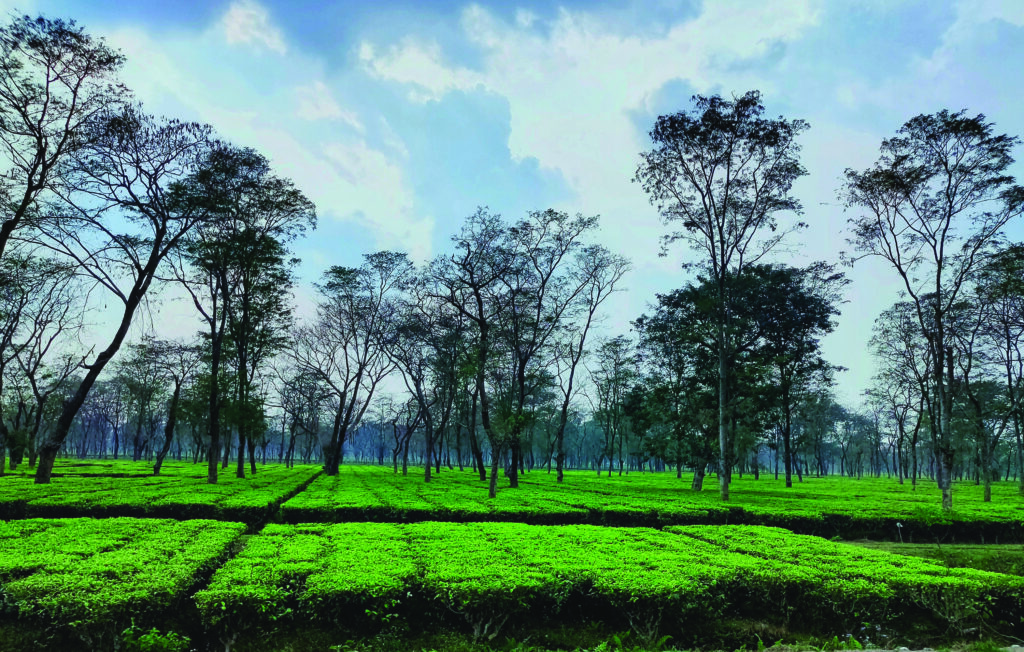
I grew up in the High Range of Kerala, in Idukki, the same district as Munnar, where tea covers the hills in neat green rows for as far as you can see. As a child, I was amazed by its breathtaking green beauty. Yet I was never really a tea person in my early years. Our drink at home was steaming hot black coffee with cardamom pods, both grown at home, and a piece of palm jaggery.
Over the years that changed, and today I drink tea, green tea in particular. Putting this issue together, I realised how little I knew about what was in my cup. Its distinct taste, history, and geopolitics.
The story of Indian tea begins with Britain’s dependence on China. The East India Company bought its tea at Canton and for a long time paid for it with opium grown in India. When the British wanted to grow tea within their own empire, they found a native plant in Assam, brought in Chinese seeds and tea makers, and moved labourers hundreds of miles to work the gardens. Like most things around us, some of this history is inglorious.
Indians themselves took to drinking it much later, encouraged by a strong advertising push in the first half of the twentieth century. And today we drink most of what we grow, and chai feels as native as anything we have.
That is why a foreign policy magazine, that we are, has given so many pages to a cup of tea. Empire, labour, prices, branding, climate and some great images—all blend in this issue.
Prabhat Kamal Bezboruah opens our Argument section by following tea from empire to the long road ahead. We then visit the three great landscapes of the great Indian tea: Arup Kumar Dutta on Assam, Deepanwita Gita Niyogi on the changing aroma of Darjeeling, and George Abraham Pottamkulam on the Kannan Devan Hills around Munnar, a piece I read with particular affection and nostalgia.
In our Insight Interview, Junjun Sharma Pathak speaks to C. Murugan, the Deputy Chairperson, Tea Board India, about shaping the future of Indian tea. K. Mathew Abraham talks about tea and beyond, and photo essays from the Kannan Devan team and Rujani Tea follow the leaf from slope to cup.
Beyond the teapot, our Great Indian Debate asks what BRICS means for India, and Gustavo Pessoa makes the case for linking Brazil’s Pix with UPI. Manoj Kewalramani writes on the India–China border, Smita Sharma looks at the long road to rebuilding Nepal, Anil Kumar Chawla draws lessons from Hormuz, and Vineet Thakur revisits the place of women at the founding of the Ministry of External Affairs.
My personal favourite this time is Manu Sharma’s “The Life of a Diplomatic Tree” in which he explores the story behind the trees leaders plant during diplomatic events.
Tea is so ordinary in India that we rarely stop to think about it on the grander scale it occupies in our history and geopolitics. I hope this issue gives you reason to. Make yourself a cup before you begin. I will be having green tea, but will spare a thought for the cardamom coffee of my childhood.
Write to me at editor@indiasworld.in

Happymon Jacob