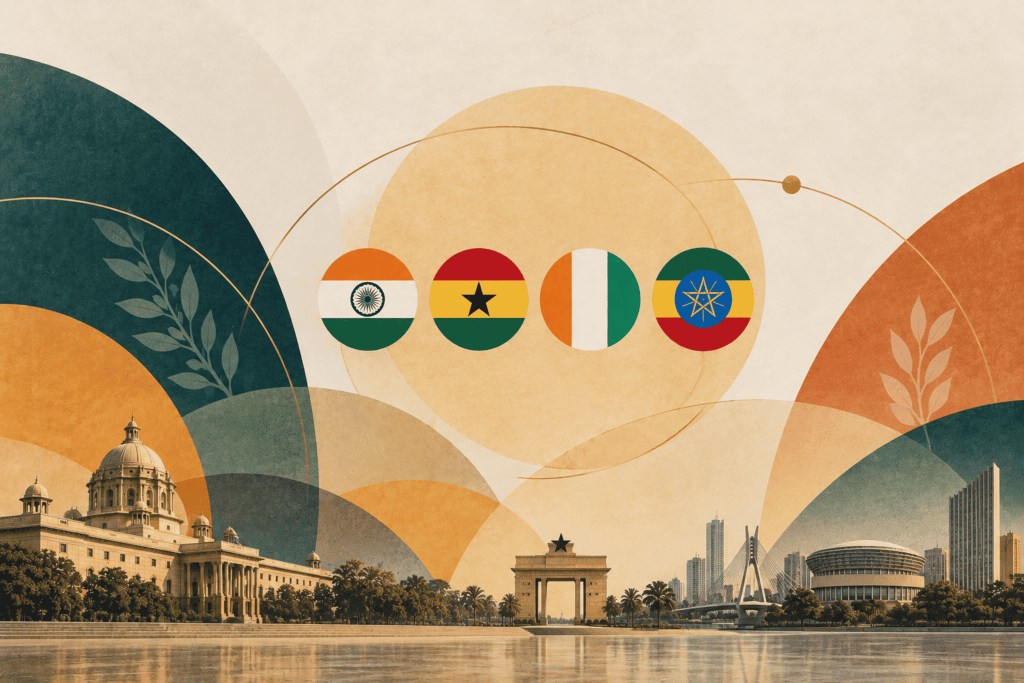
India today maintains strategic partnership frameworks with over 30 countries and groupings, arranged in a loose hierarchy of labels that range from a Strategic Partnership to Comprehensive Global and Strategic Partnership. As ThePrint recently noted, these labels are political rather than legally defined; some are dense and operational, others largely symbolic. Beyond these traditional partnership categories, India has also created a newer framework known as the Green Partnership. This explainer maps what these partnerships are, which countries they involve, what sits inside them, and why they have emerged as a distinct instrument in India’s diplomacy.
The Traditional Partnership Framework
India’s strategic partnership tiers stack roughly as follows: Strategic Partnership (the baseline, covering countries from Germany and Israel to Saudi Arabia and Egypt); Comprehensive Strategic Partnership (the United Kingdom, UAE, Australia, ASEAN, Indonesia, Singapore, Malaysia and others, with Vietnam now upgraded to an Enhanced CSP); Special Strategic Partnership (South Korea and, since May 2026, Italy); Special Strategic and Global Partnership (Japan); Special Global Strategic Partnership (France); Special and Privileged Strategic Partnership (Russia, alone); and the Comprehensive Global and Strategic Partnership (the United States, alone). The labels signal political weight, but the substance of any partnership is defined by what is actually carried out under it.
The Emergence of the Green Partnership
Green Partnerships are not a higher or lower tier within the strategic-partnership ladder. They are a parallel diplomatic instrument, organised not around overall bilateral weight but around the climate transition as the central area of cooperation. They are typically layered on top of an existing strategic partnership rather than replacing it: India and Germany retain a Strategic Partnership and have added a Green and Sustainable Development Partnership; India and Norway have done the same. In the framework set out by Xavier and Nachiappan, these sit on the bilateral track, one of four (multilateral, minilateral, trilateral, and bilateral) along which India now runs its global climate strategy, and the one on which New Delhi strategically links climate transition targets to investment, technology, infrastructure, and trade.
Their internal logic rests on a complementarity argument that Danish Prime Minister Mette Frederiksen articulated at the 2021 follow-up summit with India: Denmark has the skills in green technologies, India has the scale to deploy them. Nordic and Western European countries possess advanced expertise in offshore wind, green hydrogen, carbon capture, and green shipping; India offers a vast renewable energy market, a major shipbuilding order book, and ambitious clean energy targets that require external technology and capital.
The Four Green Partnerships
Denmark (2020). The template. On 28 September 2020, Indian Prime Minister Narendra Modi and Danish Prime Minister Mette Frederiksen agreed to elevate Indo-Danish relations to a Green Strategic Partnership during a virtual summit. The arrangement was formalised through a five-year Action Plan for 2021–2026 and operationalised through the India-Denmark Energy Partnership (INDEP), which has focused on offshore wind, energy modelling, integration of renewables, and capacity-building. A renewed Energy MoU was signed in May 2025, broadening cooperation to power system modelling, variable renewable integration, cross-border electricity trading, and EV charging. Denmark remains the most institutionally developed example in the category.
Germany (2022). The largest in financial terms. The Indo-German Green and Sustainable Development Partnership (GSDP) was signed in Berlin on 2 May 2022 between Prime Minister Modi and then-Chancellor Olaf Scholz. Under the GSDP, Germany committed at least €10 billion in new commitments by 2030, around 90 percent of which is structured as loans. The partnership covers just energy transition, green mobility, climate change mitigation and adaptation, agroecology, forest landscape restoration, biodiversity, circular economy, and sustainable urban development. In December 2025, Germany announced a further €1.3 billion in concessional commitments under the GSDP framework. The German Ambassador to India has described the GSDP as a partnership Germany has with no other country.
Norway (2026). The newest bilateral. In Oslo on 18 May 2026, India and Norway elevated their ties to a Green Strategic Partnership and signed twelve agreements and initiatives covering green shipping, clean energy, blue economy, Arctic and polar research, digital public infrastructure, AI, and space. The partnership is explicitly framed as a vehicle for the India-EFTA Trade and Economic Partnership Agreement, which entered into force in October 2025 and includes a $100 billion EFTA investment objective in India over fifteen years. Norway also joined the India-led Indo-Pacific Oceans Initiative, expanding the partnership’s maritime dimension. Secondary analysis suggests the agreement also opens space for cooperation on Article 6.2 of the Paris Agreement, the bilateral carbon market mechanism, though this is not named in the Prime Ministers’ joint press statement.
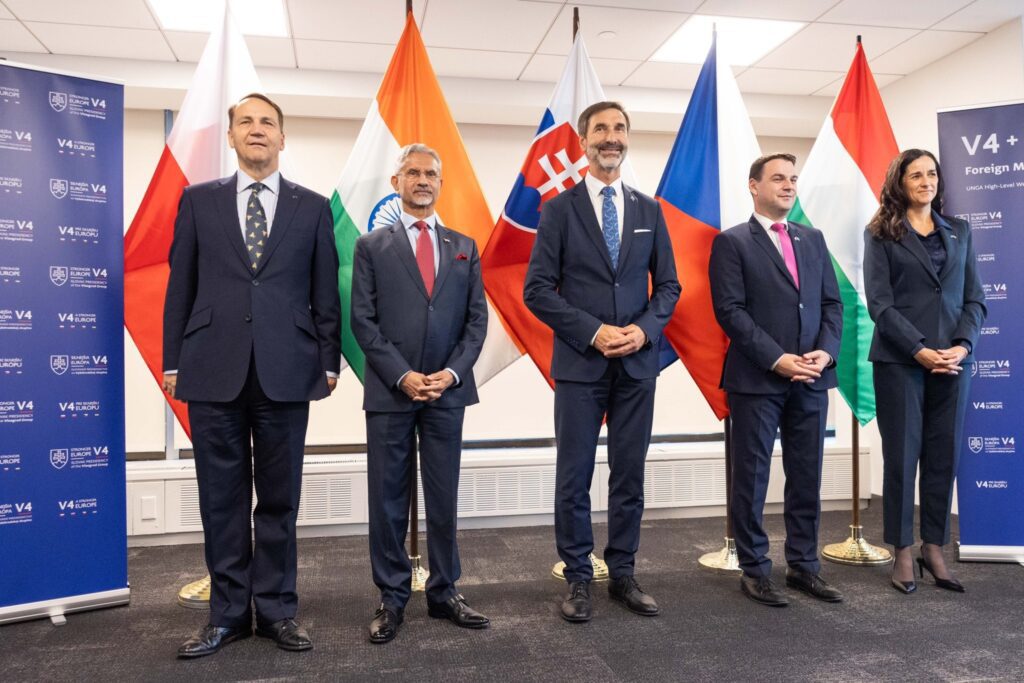
Nordic bloc (2026). The multilateral variant. The day after the bilateral, on 19 May 2026, India and the five Nordic countries (Denmark, Finland, Iceland, Norway, Sweden) at the third India-Nordic Summit elevated their collective relationship to a Green Technology and Innovation Strategic Partnership. The framework pairs Iceland’s geothermal and fisheries expertise, Norway’s blue economy and Arctic capabilities, Sweden’s advanced manufacturing, Finland’s telecom and digital technology, and Denmark’s cyber security and health tech with Indian scale. Prime Minister Modi noted at the Summit that investment from Nordic countries into India has grown by nearly 200 percent over the past decade.
What Makes Up a Green Partnership?
Across the four, the substantive contents converge around a recognisable set of areas: clean energy (solar, wind, grid integration), green hydrogen and ammonia, offshore wind, carbon capture utilisation and storage, green shipping and maritime decarbonisation, climate finance and concessional lending, sustainable urban development and green mobility, and joint research in polar and ocean sciences. The instruments are also recognisable: Joint Declarations of Intent, multi-year Action Plans, ministerial dialogues, sectoral Joint Working Groups, dedicated energy partnerships (such as INDEP with Denmark), and intergovernmental consultations. These are political-diplomatic frameworks rather than treaties under international law, and the headline financial figures (the German €10 billion, the EFTA TEPA’s $100 billion) are described in official documents as objectives rather than legally enforceable obligations.
Why This Category Has Emerged, and How It Fits into India’s Partnership Framework
The structural drivers are well established. India is the world’s third-largest energy consumer and is targeting 500 GW of non-fossil capacity by 2030. The Indian Renewable Energy Development Agency (IREDA) has estimated a financing requirement of around ₹30 lakh crore over FY 2024–2030 to meet India’s Nationally Determined Contributions under the Paris Agreement. Much of that capital and technology must come from abroad, and bilateral green frameworks offer a more reliable channel than the slower, often stalled multilateral climate negotiations.
The four formally branded Green Partnerships do not exhaust India’s thematic climate diplomacy. Adjacent to them sits a wider set of arrangements that pursue similar ends under different labels. The Leadership Group for Industry Transition (LeadIT) was launched by India and Sweden at the UN Climate Action Summit in 2019 and has since grown into a multi-country, multi-company coalition focused on heavy-industry decarbonisation; its bilateral arm, the India-Sweden Industry Transition Partnership, was launched at COP28 in 2023 and entered a new phase at the May 2026 India-Sweden Summit, with a four-year LeadIT 3.0 expected at COP31. The Japan-India Clean Energy Partnership (agreed by the two leaders in 2022) covers clean hydrogen, ammonia, CCUS, and biofuels through a ministerial energy dialogue. The India-EU Clean Energy and Climate Partnership (signed in 2016) is in its third phase (2025–28). Bilateral Green Hydrogen Task Forces exist with Australia and the UAE, and a clean hydrogen MoU has been signed with Saudi Arabia.
However, the growing number of such arrangements also raises coordination challenges. With a bilateral green partnership with Germany, another with Norway, a collective one with the Nordic bloc, and a separate clean energy and climate partnership with the EU as a whole, India is accumulating overlapping frameworks whose memberships and sectors substantially intersect. Xavier and Nachiappan caution that it remains unclear how the EU-level partnership aligns with the green partnerships India has signed with individual EU member states, and warn of growing overlap and redundancy. The challenge, on their reading, is less about signing new partnerships than about coordinating the ones that already exist.
Read together, the four Green Partnerships mark a wider shift: climate cooperation moving from a sub-theme inside conventional strategic partnerships to an organising principle around which entire bilateral frameworks are now being built.
Note: This explainer has been researched, edited, and fact-checked by India’s World staff and prepared with AI assistance.