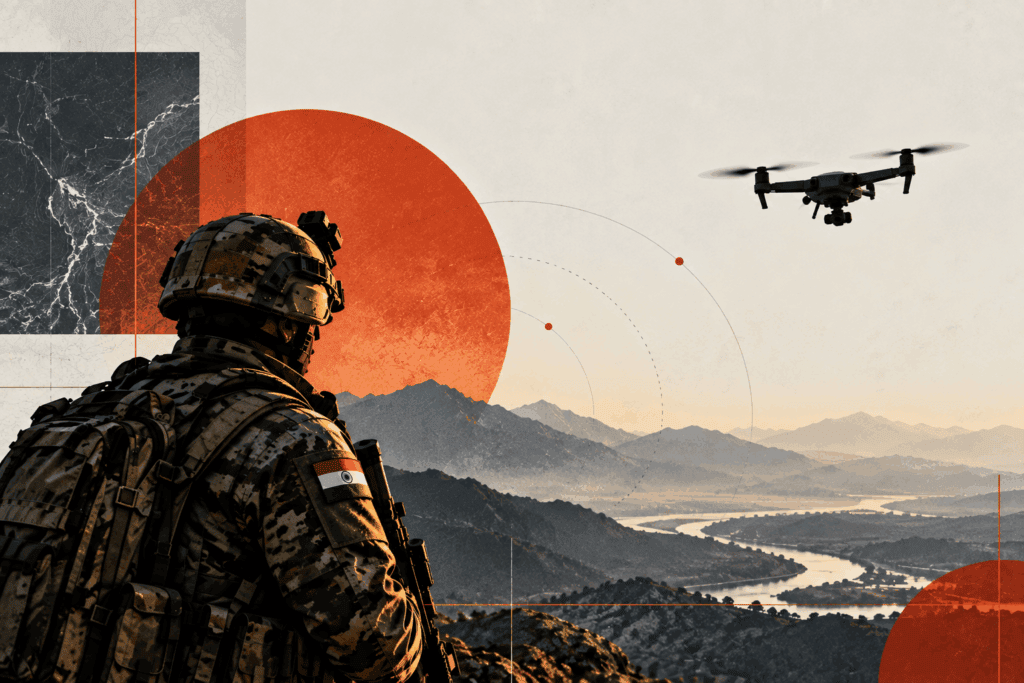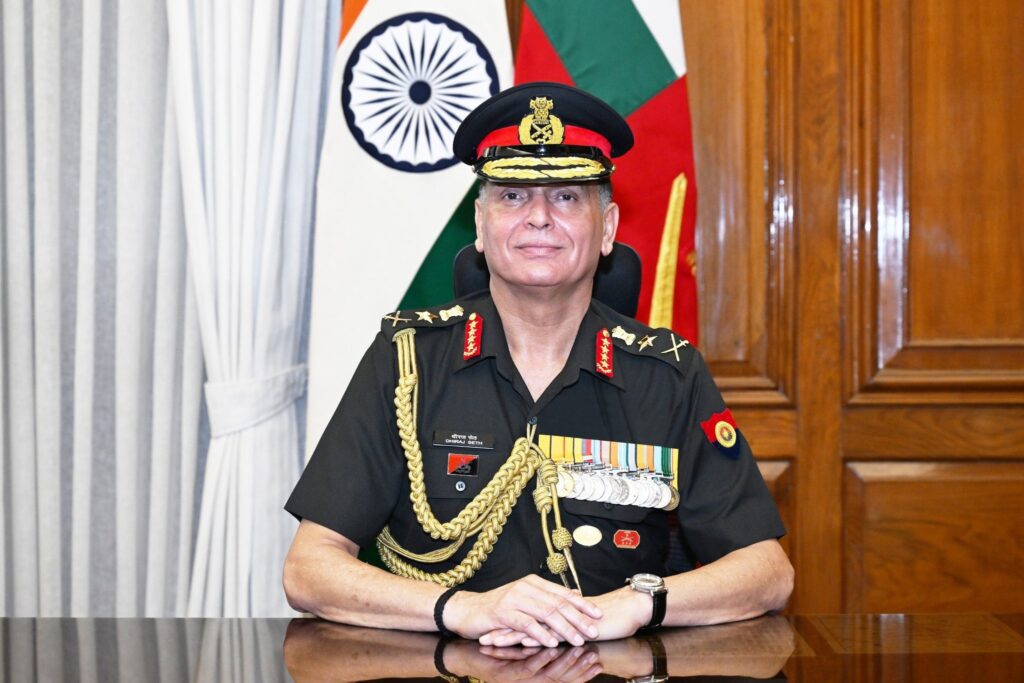
General Dhiraj Seth took charge as the Indian Army’s 31st chief on 30 June 2026, the first Armoured Corps officer in the job since 1997. Within a day he had distilled his priorities into an acronym, VIJAY. Choosing a career tank officer to lead a force still built around infantry and artillery is notable, but the acronym reads less as a personal stamp than as a statement of continuity: three of its five letters restate a modernisation agenda Gen Seth inherited. The other two, jointness and the soldier, rest on problems no chief has solved, and they differ from the first three in kind. Vigilance, innovation, and self-reliance advance through the Army’s own procurement and reorganisation; jointness and manpower policy turn on decisions taken above Army Headquarters, where agreement across the services and political backing are the binding constraints. Those two will define Gen Seth’s tenure to about August 2028.
Gen Seth was open about the borrowing, tracing VIJAY to two existing frameworks: Prime Minister Narendra Modi’s mantra for the forces, JAI, for jointness, atmanirbharta, and innovation, and Defence Minister Rajnath Singh’s declared decade of transformation, running from 2023 to 2032. “Jai leads to Vijay,” he told reporters. Both words translate as victory, and the acronym absorbs all three elements of the prime minister’s mantra, adding only vigilance and the soldier: an inheritance he reorders and extends rather than a doctrine he invents.
What VIJAY stands for
| Letter | Pillar | What it covers |
| V | Vigilance | Readiness across land, cyber, the electromagnetic spectrum, and information |
| I | Innovation | Faster doctrine, procurement, and technology absorption |
| J | Jointness | Integrated theatre commands across the three services |
| A | Atmanirbharta | Self-reliance in defence design and production |
| Y | Yoddha | The soldier, and the Agniveer manpower question |
An Inherited Agenda
The two letters most concerned with technology, vigilance and innovation, carry the least that is new. Vigilance, for a force holding the Line of Actual Control (LAC) with China and the Line of Control (LoC) with Pakistan, no longer means watching a frontier; it now covers cyber intrusion into command networks, electronic jamming, and information campaigns that run in what used to count as peacetime. Innovation, in Gen Seth’s usage, is mostly an argument about procurement speed, and the lesson he takes from Ukraine and West Asia is blunt: cheap drones and precision munitions now destroy platforms that cost orders of magnitude more, so advantage favours whoever rewrites doctrine and buys quickest, not whoever spends most. There is an edge to a tank officer making this case, since armoured vehicles are among the platforms drones have most exposed, and his stress on innovation reads as an admission that his own arm must adapt or lose relevance.
His record supports the claim: known as the tankman, Gen Seth ran capability development at Army Headquarters before becoming vice chief in April 2026, and the annual themes he inherits, technology absorption in 2024 and reform in 2025, already pointed this way. He has not only prescribed the shift but built it: commanding Southern Command, he validated the RUDRA all-arms brigade at Exercise Akhand Prahar in November 2025, folding armour, air defence, and indigenous drone and electronic-warfare systems under one commander, and used the exercise to argue for moving beyond the army’s Cold Start doctrine towards what he called a Cold Strike approach, built to hit without waiting to mobilise. Calling VIJAY a vision overstates the case; it is an agenda already in motion, now given a name.
The Jointness Problem
Jointness is where the vision meets an institution that has resisted it. Theatre commands are meant to place land, air, maritime, cyber, and space power under one commander for a given front, so that a war is fought as one campaign rather than three services running parallel ones. The scaffolding is largely built: the Department of Military Affairs and the post of Chief of Defence Staff in 2019 and 2020, the Inter-Services Organisations Act of 2023, and, in June 2025, authority for the CDS to issue joint orders binding on all three services, a lever Gen Seth’s predecessors never held. Yet not one integrated theatre command exists. The blueprint is reported to be more than 90% complete, with commands planned against China, against Pakistan, and for the maritime domain, the first slated for Jaipur, and it still waits on the defence ministry and the Cabinet Committee on Security after outlasting three chiefs.
The obstacle has never been the concept, and it is no longer the authority to act. Theatre commands require the army, navy, and air force to surrender control of assets to a single commander, and the air force has resisted folding its aircraft into a land-heavy structure it would not lead. The proposal now before the ministry answers part of that objection, handing the air force the Pakistan-facing western theatre, where its aircraft weigh most heavily, and the army the China-facing northern one. The deeper disagreement is doctrinal rather than territorial: the army wants aircraft assured to a theatre commander for close support on its own front, while the air force holds that its limited combat fleet is too scarce to tie to one theatre and works best under central control, free to move between deep strikes, air defence, and whichever front needs it most. Until that is resolved, no one can say what a theatre commander would actually command. Gen Seth’s standing to force the issue is unusual, since few officers have held two operational commands, as he did at the Jaipur-based South Western and the Pune-based Southern.
Self-Reliance Under Fire
Atmanirbharta stopped being a slogan the moment supply chains became a battlefield variable. Forces dependent on foreign suppliers ran short of ammunition in Ukraine, and an army that imports its shells, sensors, or software patches hands leverage to whoever sells them. Operation Sindoor in May 2025, India’s calibrated response to the killing of 26 civilians at Pahalgam that April, put Indian-made air defence, counter-drone systems, and loitering munitions into combat against Pakistan, and the government has read it as a verdict on indigenisation. Positive Indigenisation Lists now bar imports of named items, and the iDEX programme funds defence start-ups, but Gen Seth’s framing reaches past assembly to the harder target of designing what India still cannot make, from secure military chips to encrypted communications and drone-swarm software. There the constraint is time: design capacity trails manufacturing, defence research draws a thin share of a budget stretched by pay and pensions, and a system that arrives late or below standard leaves units with equipment that fails when it is needed.
The Agniveer Contradiction
Yodha, the last letter, exposes the vision’s sharpest internal contradiction. Gen Seth calls the soldier the force’s greatest strength, from the newest Agniveer to the oldest veteran. But the soldier VIJAY needs can read data feeds and run electronic systems under fire, a competence that takes years to build, and the recruitment model he inherited runs on the opposite logic: a four-year cycle that returns most soldiers to civilian life at roughly the point they master such systems.
Under the Agnipath scheme, soldiers serve four years and only about a quarter are kept on, a churn designed to lower the average age of the force and curb a pension bill that swallows much of the budget. It now works against the rest of VIJAY. A force absorbing drones, radar, and networked air defence cannot train soldiers for four years only to release three in four, and the services have said so, asking the government to raise retention to half across the board and to 60% in technical arms, pointing to the skills that carried Operation Sindoor. Because these intakes are now the only route into the ranks, the retention ceiling sets the force’s size and skill, and the first decisions fall in 2026 and 2027, on Gen Seth’s watch. Unlike the rest of VIJAY, this one he cannot settle from Army Headquarters; it needs money and a political decision to reopen a reform the government has defended.
None of this turns on the acronym but on measurable things: the share of indigenous equipment fielded along the LAC, whether the first theatre command stands up while Gen Seth holds the office, and how high the Agniveer retention ceiling is set. Each is checkable, and the decisions fall inside his tenure. The verdict will not. VIJAY is one chief’s segment of a transformation the government has timed to run past 2032 towards the future-ready force it promises for 2047, and whether the theatre commands and the manpower model hold will be settled long after Gen Seth has handed over, by whoever inherits the acronym next.
Note: This explainer has been researched, edited, and fact-checked by India’s World staff and prepared with AI assistance.