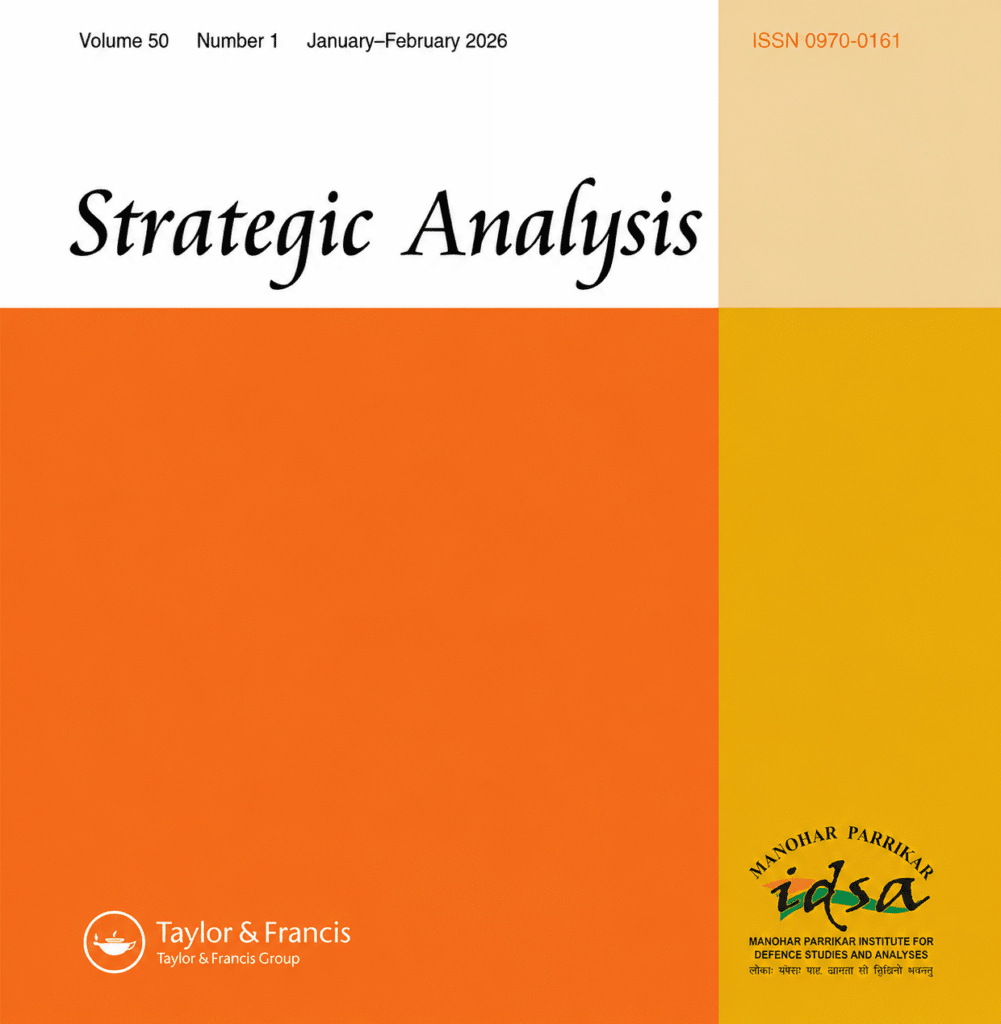
The archival article India’s Mutual Security Arrangements with Nepal, republished in Strategic Analysis (published online 1 June 2026), revisits Prof. S. D. Muni’s seminal 1971 study on the strategic foundations of India-Nepal security relations. Written in the aftermath of China’s takeover of Tibet and the 1962 Sino-Indian War, the article examines how India sought to institutionalise a framework of mutual security with Nepal in response to a transformed Himalayan strategic environment.
Prof. Muni argues that India’s security policy towards Nepal was shaped by geography and strategic necessity. With Tibet no longer functioning as a buffer after 1950, New Delhi increasingly viewed Nepal as an indispensable component of India’s northern defence. Drawing on Jawaharlal Nehru’s parliamentary statements, the article argues that India’s leaders regarded Nepal’s security as inseparable from India’s own, prompting efforts to bring Nepal within a broader security framework.
The article identifies five principal pillars of this framework. These included the continued recruitment of Gorkha soldiers into the Indian Army, the 1950 Treaty of Peace and Friendship and its accompanying security provisions, jointly manned intelligence posts along Nepal’s northern frontier, the deployment of the Indian Military Liaison Group to train and modernise the Nepal Army, and an arms assistance arrangement under which India became Nepal’s principal supplier of military equipment. Collectively, Prof. Muni argues, these arrangements constituted “a kind of unified defence system” between the two countries.
Beyond military cooperation, the article argues that India pursued complementary political and economic objectives to sustain this security architecture. New Delhi supported democratic institutions in Nepal, invested heavily in infrastructure and development projects, and encouraged close coordination in foreign policy. According to Prof. Muni, these policies were driven not only by developmental concerns but also by India’s belief that a stable, prosperous, and politically friendly Nepal would be less vulnerable to Chinese influence.
A substantial part of the article examines the crisis of 1969, when Nepal demanded the withdrawal of Indian personnel from its northern border posts and questioned aspects of the existing security framework. Prof. Muni argues that this episode did not represent a rejection of bilateral security cooperation but rather an attempt by Nepal to modify its institutional form while preserving its strategic substance. The subsequent negotiations, including the withdrawal of Indian personnel and the creation of alternative mechanisms for military coordination and intelligence sharing, demonstrated the willingness of both sides to adapt their relationship.
Prof. Muni attributes these tensions to three interrelated factors. The first was Nepal’s growing nationalism and its search for an independent identity, which made visible symbols of Indian military presence politically contentious. The second was Nepal’s domestic politics, where competing political actors frequently invoked India as part of their struggle for legitimacy. The third was China’s expanding diplomatic, economic, and strategic engagement with Nepal, which encouraged Kathmandu to pursue a more balanced foreign policy. Despite these pressures, Prof. Muni concludes that “the geographical and strategic determinism that bound the two countries together… remained substantially the same.”
The article concludes with a critique of India’s approach towards Nepal. Prof. Muni argues that New Delhi often underestimated Nepal’s psychological and political sensitivities and occasionally projected “an air of superiority” in bilateral relations. He therefore calls for a more flexible and accommodating policy, arguing that India “should be content to see that her various interests are adequately safeguarded under whatever system Nepal may devise”, rather than attempting to shape Nepal’s domestic political order.
More than five decades after it was first published, Prof. Muni’s analysis remains highly relevant to understanding contemporary India-Nepal relations. Current debates over revisiting the 1950 Treaty of Peace and Friendship, Nepal’s balancing of ties between India and China, expanding Chinese connectivity projects in the Himalayas, and recurring concerns over sovereignty continue to reflect many of the structural dynamics identified in the article. Read in today’s context, Prof. Muni’s observation that the “geographical and strategic determinism” linking India and Nepal has endured despite changing political circumstances offers an important historical lens for interpreting the bilateral relationship. Equally significant is his argument that lasting strategic cooperation depends on accommodating Nepal’s sensitivities over sovereignty while sustaining mutual trust, a lesson that remains pertinent for policymakers on both sides of the border.