Sanae Takaichi’s first Delhi visit as Japan’s prime minister produced 16 formal outcomes and three joint statements spanning defence, supply chains, energy, and finance.
Sanae Takaichi’s arrival in Delhi on 1 July, her first visit to India as Japan’s prime minister, produced 16 formal outcomes and three joint statements at the 16th India-Japan Annual Summit, alongside around $12.5 billion in fresh Japanese investment pledges from 150 firms and more than 129 memorandums of understanding at the accompanying Joint Economic Forum. She and Prime Minister Narendra Modi have so far signed a Joint Declaration on Economic Security Cooperation, a Joint Statement on Energy Resilience, and a Joint Statement on Artificial Intelligence, alongside memoranda on critical minerals, batteries, biogas, and pharmaceuticals. While earlier summits centred on the Mumbai-Ahmedabad bullet train, defence cooperation, or Quad diplomacy. This summit shifted the focus to supply-chain security, reflecting the vulnerabilities exposed over the past year, particularly dependence on China for critical inputs and on West Asia for energy.
The Joint Declaration on Economic Security Cooperation formalises a working track that began after the third two-plus-two ministerial in August 2024, when both sides opened a dialogue on economic security including strategic trade and technology. Japanese firms have expanded their investment in India more slowly than in Southeast Asia for at least a decade; the summit’s instruments are meant to close that gap.
The Summit’s Strategic Core
The declaration is paired with a Fact Sheet 2.0 cataloguing company-level tie-ups in semiconductors, critical minerals, IT, clean energy, and pharmaceuticals. It frames the partnership around “strategic autonomy and indispensability”, terms that describe Chinese leverage over supply chains without naming Beijing. The accompanying joint statement calls the two countries “natural and indispensable partners” and reorganises the summit agenda around economic partnership, energy resilience, and defence.
The trade base has not caught up with the diplomatic ambition. Two-way commerce sits at about $27.5 billion, and the ¥10 trillion investment target set in Tokyo last year, close to $68 billion over a decade, remains a projection: Japanese investment in the nine months to December 2025 came to $3.2 billion, well below the annual pace the target implies. The summit’s new instruments are meant to accelerate that flow by giving Japanese firms clearer entry channels and settlement infrastructure that reduces currency risk.
Defence moved past the symbolic. The two governments reached agreement in principle on the remaining technical details of the Unified Complex Radio Antenna (UNICORN) system for Indian warships, the first India-Japan defence co-development project, which has been in progress since the Memorandum of Implementation signed in November 2024. Modi described it as “the first co-development project in the defence sector” and said it would “open a new chapter in our defence technology partnership”. The move rests on Takaichi’s April decision to end Japan’s ban on lethal-weapons exports and a defence budget rising toward 2% of GDP, which together allowed Japanese defence firms to enter arrangements previously closed to them. A fourth two-plus-two ministerial meeting is scheduled for Tokyo before year-end.
What the Summit Delivered
The 16 outcomes fall into five categories, each targeting a specific dependency both governments want to reduce. The pattern favours breadth over a single flagship: no one project carries the weight of the bullet train, and the number of parallel workstreams is calibrated to survive the slower pace of at least some of them.
- Technology and artificial intelligence. A Joint Statement on Cooperation in the Field of Artificial Intelligence was paired with three research memoranda that place Indian and Japanese institutions on shared projects rather than trading finished products: SarvamAI with Preferred Networks on foundation models, IIT Bombay’s BharatGen initiative with Japan’s National Institute of Informatics, and Japan’s RIKEN with the National Centre for Biological Sciences and C-CAMP in Bengaluru.
- Energy and clean fuels. A Joint Statement on Energy Resilience opened cooperation on strategic petroleum reserves for the first time, and Takaichi endorsed India’s membership of the International Energy Agency. The India-Japan Cooperative Biogas for Growth (CBG) Initiative supports India’s target of establishing 1,000 biogas and organic-fertiliser plants, routed through the dairy-cooperative network. A batteries memorandum committed both sides to build a battery supply chain that does not run through China.
- Critical minerals and pharmaceuticals. Memoranda on critical-mineral exploration, e-waste recycling, and pharmaceuticals and medical devices target the two input dependencies of most concern in Delhi and Tokyo: rare-earth processing and active pharmaceutical ingredients, both of which run predominantly through Chinese suppliers.
- Mobility and infrastructure. A Next Generation Mobility Partnership covers railways, shipbuilding, ports, and logistics, and casts India, in the declaration’s phrase, as a “Make in India for the World” manufacturing hub. Shinkansen technology remains the anchor of the rail component, but the framework runs considerably wider than the bullet train alone.
- Finance and settlement. The two governments laid the groundwork for direct yen-rupee settlement of bilateral trade and exchanged letters between India’s International Financial Services Centres Authority (IFSCA) and Japan’s Financial Services Agency. Together these steps aim to remove the dollar leg from a growing share of transactions and to open Indian banking to Japanese account-holders in the diaspora.
The China Factor
The economic security declaration does not name China, and it does not need to. Its priorities reflect Beijing’s recent use of economic coercion, non-market practices, and export restrictions on critical minerals. Officials from both governments were more explicit in their briefings than the text itself. The declaration remains deliberately indirect because India and Japan continue to trade extensively with China and have little interest in formalising confrontation.
The vulnerabilities the summit seeks to address are clear. India still depends heavily on Chinese suppliers for active pharmaceutical ingredients, making alternative production and joint manufacturing a strategic priority. China also dominates global rare-earth processing, giving added significance to the new agreements on mineral exploration and e-waste recycling. Japan’s participation in the second phase of India’s semiconductor mission reflects the same effort to diversify critical supply chains.
None of these initiatives will alter the balance overnight. Decades of Chinese industrial capacity cannot be replicated through a handful of agreements. Their significance lies elsewhere: they begin the long process of reducing strategic dependence while signalling that both governments are prepared to support companies willing to invest ahead of the market.
Building Economic Resilience
The push toward local-currency trade grew out of the 2026 Iran war’s disruption to the Strait of Hormuz, through which around a fifth of the world’s oil trade passes. The closure lifted crude prices from March onward and drained India’s foreign-exchange reserves as the Reserve Bank of India defended the rupee. The Joint Statement on Energy Resilience opened cooperation on strategic petroleum reserves, added joint work on shipping clean fuels, and committed Japan to backing India’s long-sought entry to the International Energy Agency.
The local-currency settlement system is the more consequential response to that pressure. It would let firms on both sides settle bilateral trade directly in yen and rupees, allow Japanese account-holders to bank in India, and remove the dollar intermediary from a growing share of transactions. For a central bank spending reserves to defend the rupee, an active settlement channel offers structural relief a further round of memoranda cannot provide.
Clean energy carried the same logic into a specific project. The ACME-IHI green ammonia plant in Odisha, a 405,000-tonne-a-year facility underwritten by roughly $3 billion in Japanese Contract for Difference price support, will ship low-carbon fuel to Japanese buyers from 2030. Japan secures a stable supply of a decarbonised input; India receives the investment, the plant, and the export.
Turning Promises into Investment
Japan has pledged large sums to India for over a decade; the on-ground footprint has moved little. Around 1,400 Japanese companies operate in the country, roughly half in manufacturing, close to the number in 2018. Thailand hosts about 6,000; Singapore about 4,500. A country both governments describe as a top partner trails two smaller economies on the count that matters most: how many Japanese firms have set up factories, offices, and payrolls.
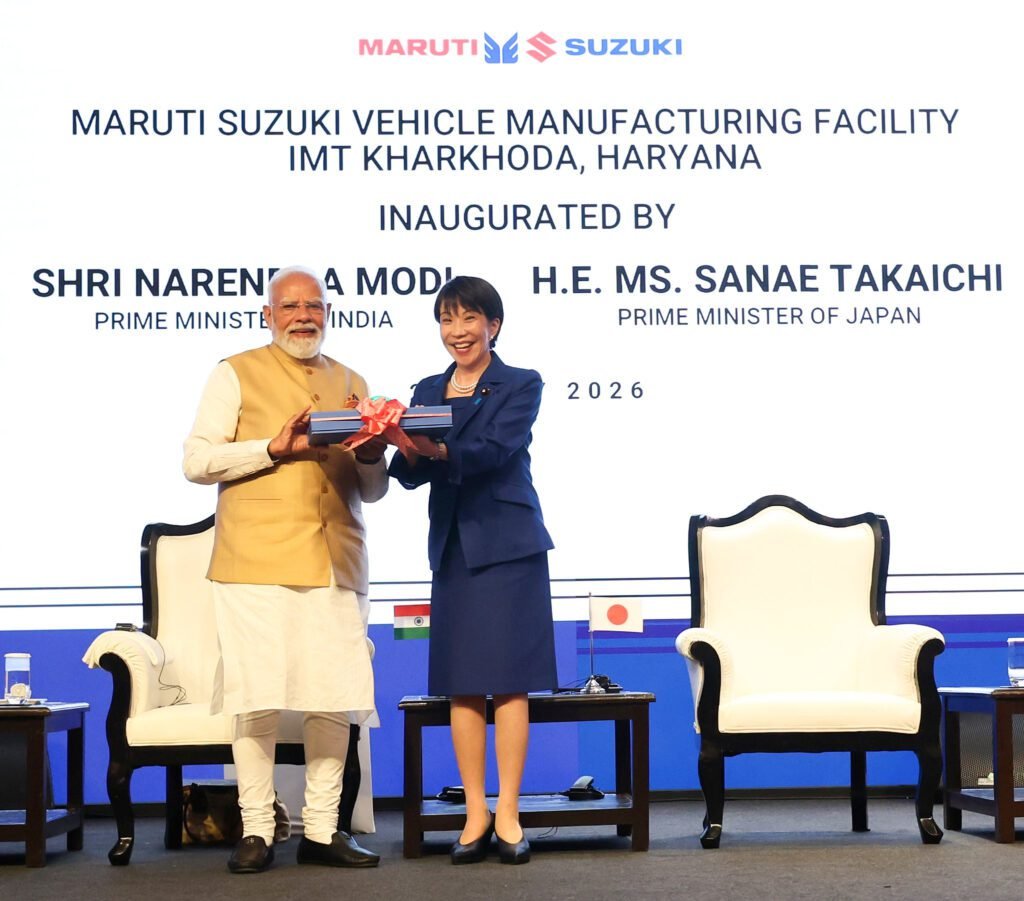
The firms already in India tell a more encouraging story. In a JETRO survey conducted before the summit, 81.5% said they planned to expand operations, the highest expansion intent recorded among all major global markets covered. Suzuki, whose new ₹35,000 crore Kharkhoda plant Modi and Takaichi jointly inaugurated, accounts for over 61% of parent Suzuki Motor Corporation’s global output and exports 18 models to more than 100 countries. The summit’s target is not the companies already here. It is the mid-sized Japanese firms that could enter India but have chosen Southeast Asia.
The instruments announced this week target that reluctance. The Comprehensive Economic Partnership Agreement, more than fifteen years old and underused, is set for an expedited review. Modi announced a Japan Business Week to be run from the Prime Minister’s Office, at which officials will hear investor grievances directly. That structure implicitly acknowledges that the obstacles lie in Indian permitting, land acquisition, and state-level clearances rather than in the trade treaty itself.
Japan’s own delivery record on India projects sets the ceiling on optimism. The Mumbai-Ahmedabad bullet train, about 81% funded by a Japan International Cooperation Agency soft loan at 0.1% interest over 50 years, has slipped repeatedly from its original 2023 target, with costs rising from ₹1.08 lakh crore (about $13 billion in 2017 dollars) to close to ₹2 lakh crore after land-acquisition delays. Only the 47-kilometre Surat-Bilimora section is targeted for August 2027; full commercial service between Mumbai and Ahmedabad has been pushed to 2029 or later. Southeast Asia’s pull, driven by faster permitting and cheaper land, has kept mid-sized Japanese firms away from India regardless of diplomatic signals from Tokyo and Delhi.
From Commitments to Delivery
A key test of the summit’s outcomes will be the proposed Japan Business Week. If the Prime Minister’s Office uses the initiative to resolve the permitting, land acquisition, and regulatory bottlenecks that Japanese investors have highlighted for years, more firms may choose India over Southeast Asia. The 75th anniversary of India-Japan diplomatic ties in 2027 offers a natural milestone for assessing progress. Three indicators will matter: the first shipments from the Odisha green ammonia plant, the launch of yen-rupee trade settlements, and tangible progress on the joint defence co-development project. Ultimately, success should not be measured by the number of agreements signed at the next summit in Tokyo, but by whether the number of Japanese companies operating in India grows well beyond 1,400 and whether more of them establish export-oriented manufacturing.
Note: This explainer has been researched, edited, and fact-checked by India’s World staff and prepared with AI assistance.