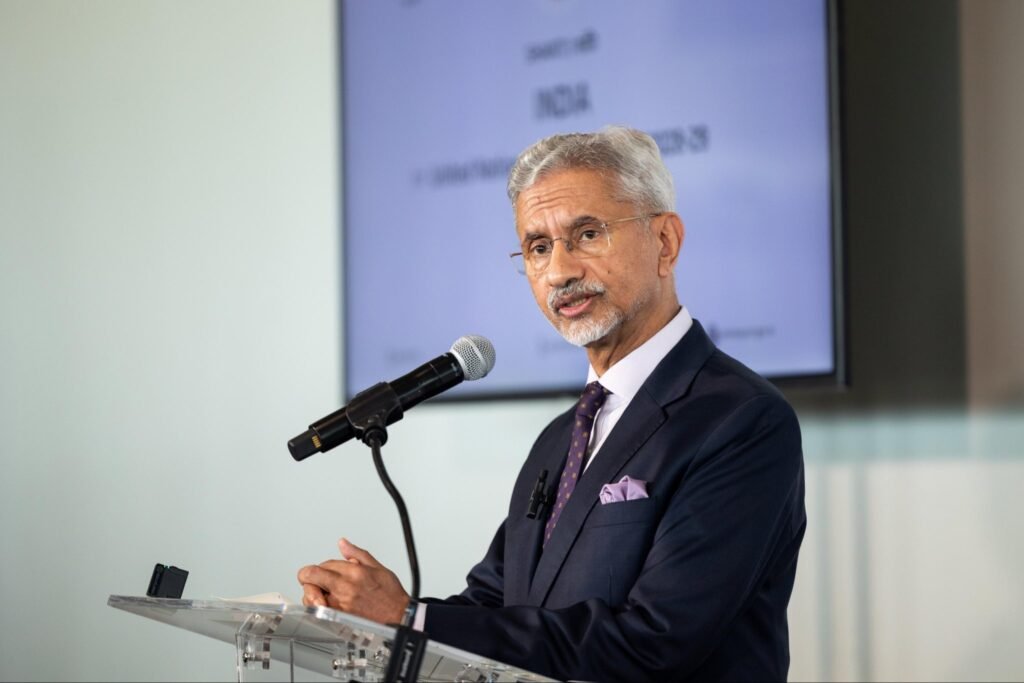
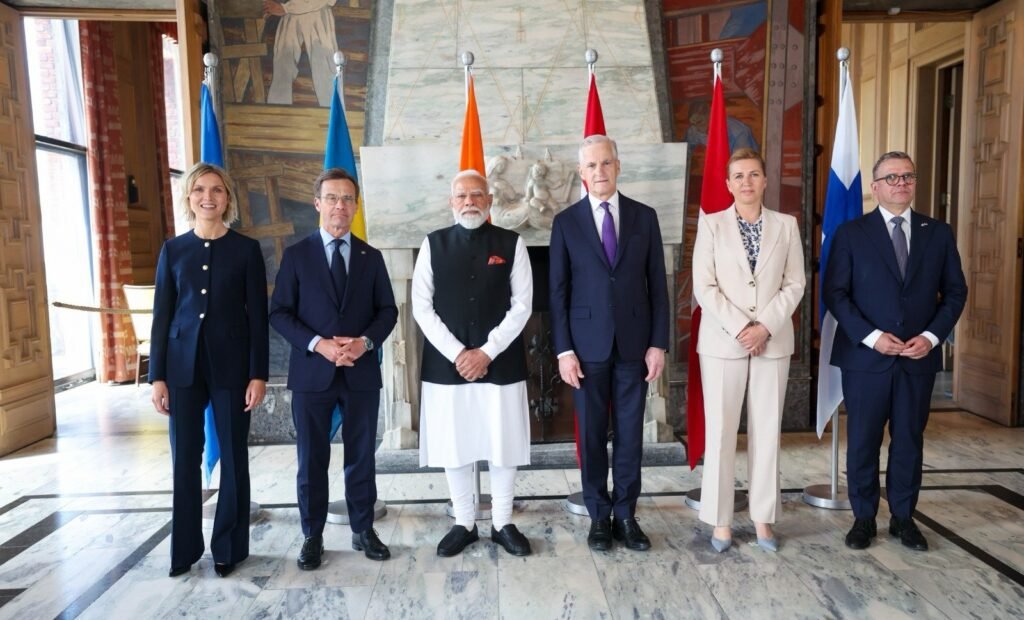
The India-Nordic Summit is a multilateral heads-of-government forum that brings together the prime minister of India and the leaders of Denmark, Finland, Iceland, Norway, and Sweden under one roof. It is a relatively young diplomatic architecture—the first edition was held in Stockholm in April 2018, followed by the second in Copenhagen in May 2022. The third concluded in Oslo on 19 May 2026, as recorded in the joint statement issued by India’s Ministry of External Affairs (MEA), making it first visit of an Indian Prime Minister to Norway in 43 years since Indira Gandhi travelled there in 1983. In a single day in the Norwegian capital, Modi held bilateral meetings with five Nordic heads of government, before the multilateral summit convened at Oslo’s City Hall.
The format’s logic is straightforward. Individually, these five nations are small to mid-sized economies, but collectively they represent one of the most innovation-dense, sustainability-advanced, and high-income regions in the world. For India, engaging them as a bloc concentrates diplomatic bandwidth. For the Nordics, it provides structured access to the world’s most populous country and one of its fastest-growing large economies.
What Did the First Two Summits Actually Deliver?
The Stockholm 2018 summit set the architectural terms. Its joint statement emphasised innovation, digital transformation, and clean energy, framing Nordic expertise in maritime solutions, port modernisation, and smart cities as complementary to India’s flagship programmes: Make in India, Startup India, and Digital India. All five Nordic countries formally endorsed India’s candidacy for a permanent seat on a reformed United Nations (UN) Security Council. The summit also welcomed the Nordic Sustainable Cities Project, aimed at supporting India’s Smart Cities Programme, and reaffirmed the shared commitment to the Paris Agreement and the 2030 Agenda for Sustainable Development.
The Copenhagen 2022 summit deepened the agenda, adding Arctic affairs as an explicit cooperation track following the release of India’s Arctic Policy. Modi invited Nordic sovereign wealth funds to invest in India—an early signal of intent that would eventually crystallise into the European Free Trade Association (EFTA) investment framework. Both summits were architecturally productive: they created the language, the political will, and the institutional invitation for what came next. Critics, however, correctly noted that neither summit produced a binding trade or investment mechanism. They were frameworks in search of a treaty.
Why Oslo Is Different: Three Structural Changes
The 2026 summit takes place against a fundamentally different backdrop. Three factors—a live trade architecture, a newly concluded mega-FTA, and an acute energy shock—transform what might otherwise have been a third round of diplomatic reiteration into a strategically urgent conversation.
First, the India-EFTA Trade and Economic Partnership Agreement (TEPA) is no longer a promise. Signed in New Delhi on 10 March 2024 after 16 years of negotiations across 21 rounds, TEPA entered into force on 1 October 2025. Two of the five Nordic nations—Iceland and Norway—are EFTA members, alongside Switzerland and Liechtenstein. The agreement’s headline number is striking: the EFTA states have committed under Article 7.1 to mobilise $100 billion in foreign direct investment (FDI) into India over 15 years, aimed at creating one million direct jobs. This is the first FTA signed by India to include legally binding commitments on investment and employment creation—not aspirational language, but an enforceable framework. EFTA extended concessions on 92.2% of its tariff lines, covering 99.6% of India’s exports. Engineering goods exports to EFTA were already up 18% year-on-year to $315 million in FY 2024–25, signalling early traction. A dedicated India-EFTA Desk was made operational by Invest India in February 2025 as a single-window investment facilitation mechanism focused on renewable energy, life sciences, and digital transformation.
Second, the India-EU Free Trade Agreement (FTA) was concluded on 27 January 2026 at the 16th India-EU Summit in New Delhi, announced by Modi alongside European Commission President Ursula von der Leyen and European Council President António Costa. Both sides described it as the “mother of all deals”. The agreement creates a combined market of approximately 2 billion people, accounting for roughly 25% of global GDP. Bilateral goods trade between India and the EU stood at $136.5 billion in 2024–25, with both sides targeting $200 billion by 2030. India will reduce or eliminate tariffs for 96.6% of EU exports. The EU reciprocates across nearly 99% of India’s shipments by trade value. Tariffs on EU automobiles entering India are to fall from 110% to as low as 10%. For Indian exporters, zero-duty access to the EU’s textile and apparel market is a landmark gain for a sector employing tens of millions. The FTA awaits formal ratification by the European Parliament, but its conclusion fundamentally resets the European trade context for the Oslo summit. When Modi and the Nordic prime ministers agreed at Oslo to leverage both the India-EU FTA and the live TEPA to expand trade, investment, and technology linkages, they were doing so against concrete, enforceable legal scaffolding, not aspiration.
Third, and most urgently, the Strait of Hormuz crisis has injected raw strategic anxiety into the energy conversation. In early 2026, following US and Israeli military operations against Iran, Iranian forces declared the Strait “closed” from 4 March 2026, disrupting the passage through which roughly 20% of the world’s seaborne oil trade normally flows. The International Energy Agency (IEA) described this as the greatest global energy security challenge in history. Brent crude surged from $72 per barrel on 28 February to $112 by 27 March 2026. For India, the exposure is acute: the IEA confirms India as the world’s third-largest oil importer and consumer, with import dependence reaching 89.1% as of March 2025. India lost over 40% of its crude oil flows following the Hormuz closure, leaving oil marketing companies absorbing losses of up to ₹1,000 crore per day. BMI, part of Fitch, forecast India’s GDP growth would slow to 6.7% in fiscal 2026/27, down from 7.7% the previous year, largely due to the oil shock. With 60% of India’s liquefied petroleum gas (LPG) demand met by imports, most transiting the Strait, the crisis hit household cooking fuel first, producing supply queues and delayed deliveries across the country. This concentrated structural vulnerability is precisely why Nordic energy alternatives—offshore wind, green hydrogen, geothermal, carbon capture—carry urgency at Oslo that they did not carry in 2018 or 2022.
What Oslo Actually Produced
Against this backdrop, the eight key outcomes announced at Oslo are qualitatively different from the previous two summits. The headline, confirmed in the joint statement issued by the MEA, is the elevation of India-Nordic ties to a “Trusted Green Technology and Innovation Strategic Partnership”, a formal upgrade in the diplomatic classification of the relationship. Modi articulated the logic at the joint press conference: Nordic expertise in sustainability combined with India’s scale should produce trusted global solutions. He specified precisely how. Iceland’s expertise in geothermal and fisheries; Norway’s in the blue economy and Arctic navigation; Sweden’s in advanced manufacturing and defence; Finland’s in telecom and digital technologies; Denmark’s in cybersecurity and health—all paired with India’s engineering talent.
On trade and investment, the MEA joint statement confirmed that leaders agreed to leverage both TEPA and the India-EU FTA to expand trade, investment, and technology linkages, with EFTA countries reiterating the $100 billion investment target. The energy cooperation agenda gained structural significance against the Hormuz backdrop: the statement called for accelerated work on renewable energy, green hydrogen, carbon capture and utilisation, and critical minerals. India and Norway signed 12 bilateral agreements on 18 May, setting a target to double bilateral trade by 2030. India and Finland announced the joint hosting of the World Circular Economy Forum in Gandhinagar, Gujarat, in September 2026. Modi noted that trade with the Nordic bloc has grown fourfold over the past decade, while Nordic investment in India has risen by around 200%, with combined India-Nordic trade standing at $19 billion.
In space, the MEA joint statement welcomed a Framework Agreement between the Indian Space Research Organisation (ISRO) and the Norwegian Space Agency on the peaceful uses of outer space, while Sweden proposed contributing a payload to India’s Venus Orbiter Mission, a concrete expression of high-technology partnership moving beyond memoranda into mission-sharing. On defence, Nordic firms were formally invited to explore India’s defence industrial corridors, where 100% FDI is available in select sectors. Arctic affairs featured prominently. The Nordic leaders formally welcomed India’s observer status at the Arctic Council and called for deeper joint research on polar climate and environmental science, a track that sits at the intersection of scientific cooperation and long-term energy geography. Finally, the joint statement reiterated Nordic support for India’s candidacy for permanent membership in a reformed UN Security Council, a position consistent across all three summits, but now voiced within a geopolitical context in which India’s non-aligned strategic weight carries considerably more global purchase.
What to Watch
The Oslo summit is the first of the three to take place with functioning legal trade architecture already in place. That is not a small distinction. The 2018 and 2022 summits were, necessarily, investments in diplomatic capital for future harvest. Oslo begins to harvest. The TEPA investment desk is live. The India-EU FTA awaits ratification but its terms are set. The Hormuz crisis has removed the comfortable assumption that Middle Eastern energy diversification can be deferred. The next India-Nordic Summit will be hosted by Finland, as confirmed in the MEA joint statement. The question between now and then is whether the green technology partnership and the Hormuz-accelerated energy diversification agenda translate from framework into project-level execution—the step that Indian diplomacy has historically struggled with most in multilateral settings.
Note: This article has been researched, edited, and fact-checked by India’s World staff and prepared with AI assistance.