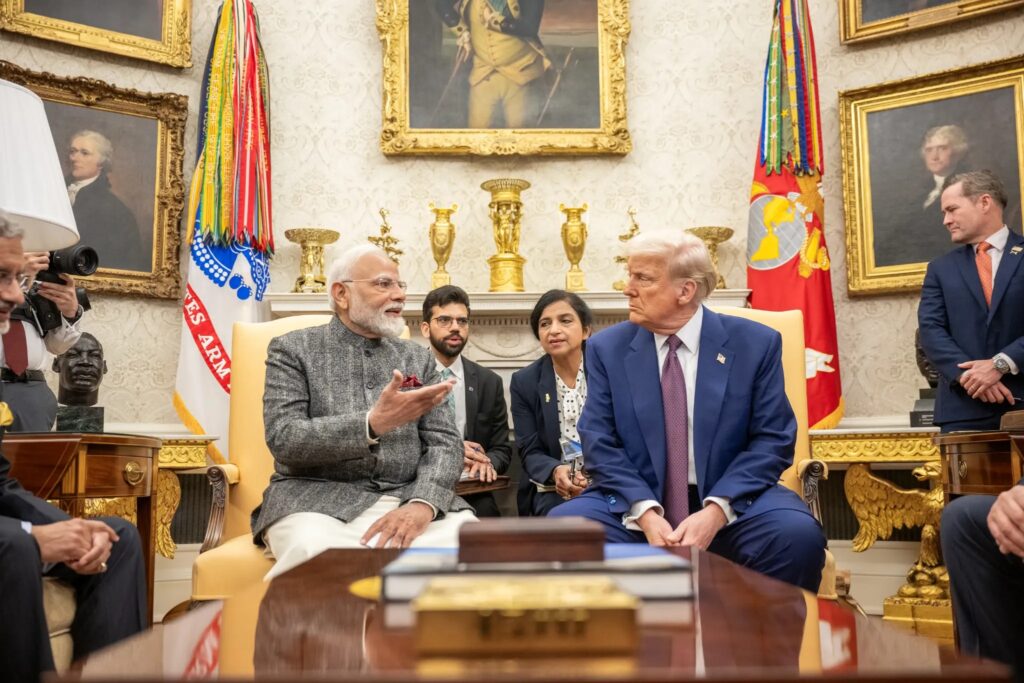
Not a day passes in New Delhi’s strategic circles without an anxious conversation about the United States, notwithstanding the energetic young American ambassador’s charm offensive, his affable smiles, and his experiments with dosa. In the world of Donald Trump, there is fresh anxiety every morning, at least some of it felt in Delhi. Right now, most of it is pointed at Pakistan, for Washington has warmed to Rawalpindi once again. The optics of it sting the faint-hearted in Delhi: the visits, the praise, the access, the slow rehabilitation of a military establishment Delhi spent two decades trying to isolate. Few in Delhi cared to talk about Prime Minister Sharif’s signature on the peace deal between Washington and Tehran, not because we missed it, but because saying it aloud would hurt.
The Great American Betrayal
Let’s go with the word “betrayal”. Trump’s America has harmed Indian interests, hurt Indian pride, and insulted its people more often than any administration in living memory. The new warmth towards Pakistan feels like one more wound from a partner we thought was on our side. The bitterness is understandable. But it is also, I think, largely misplaced.
To be fair, our discomfort over US-Pakistan ties is real, and the betrayal is genuinely felt here. However, that feeling of hurt is reputational and political rather than structural. And hence, not as consequential as we make it out to be. Pakistan has used a rare diplomatic opening to varnish its reputation, as it does from time to time. Yet, it changes very little about the actual balance of power in South Asia, which remains in India’s favour, whatever the Americans choose to do. Indians have watched this film before, and more than once: the 1980s, when Pakistan was the frontline state and Washington’s conduit for the Afghan jihad; the Pressler years and the on-again, off-again sanctions; the post-2001 rehabilitation, when Pakistan made itself indispensable – almost overnight – to America’s war on terror.
Actually, the Pakistan–US–India game of smoke and mirrors began further back still, when the infamous (and now decommissioned) USS Enterprise steamed towards us in December 1971. On each occasion, Washington’s affection for Rawalpindi tested our nerves, and on each occasion, we kept our own policy intact. We know America’s Pakistan playbook, and we know how to live with the effects of US-Pakistan romance, because it has always been a friendship with benefits rather than a true alliance.
We weathered the worst of even the best years of US-Pakistan relations for one reason. Our Pakistan policy was never Americanised, never made dependent on Washington. It was domestically owned, domestically driven and, yes, domestically political too. What Washington had not dictated, Washington could not revise. When the Americans drew close to Pakistan, we absorbed the cost and carried on, because what was being bruised was our comfort and our ego, nothing we could not get over. This is the great underappreciated strength in the way we handle Pakistan: Washington was never fundamental to it, despite its favouring Pakistan over India for the most part.
An American mood swing on Pakistan, Trump’s included, is therefore an old problem with a known answer. If you are still with me, hold that thought, because it is the key to everything that follows, even though this article is not about Pakistan.
A Relationship Born Out of Threat, Sanctions and Anxiety
Today, what truly deserves our attention is China, and the geopolitical architecture that has shaped our China policy for a quarter of a century. China is India’s principal contradiction: among its top trading partners, a next-door neighbour, and a problem we must answer one way or another.
However, to understand the China story, we first have to understand the contemporary origins of our America story better.
New Delhi’s closeness with Washington began neither as a calculated strategic choice nor a happy experience. Rather, it was born of anxiety, insecurity, and a fear of isolation, and much of it was a function of the American pressure at the dawn of this century. The 1990s were, for us, a deeply troubling decade. We had lost the Soviet Union almost overnight, the patron that underwrote our security, replenished our defence inventory, and gave us the warm feeling of being an important global power. Additionally, we were close to bankruptcy and looked, for a moment, like a basket case, with our reserves down to a few weeks of imports, our gold pledged to raise emergency loans, the crisis forced open an economy we had kept closed for four decades. We needed Western investment, technology, and access to markets as a matter of survival rather than preference. But Washington was more interested in disciplining India than engaging it.
India is an order-dependent power. We rose, and are still rising, inside a stable international order of which the United States was the keystone
And in those very years when we were turning towards the West out of necessity, Washington was pressing us the hardest, and where it hurt most. Senior American officials in the Clinton Administration told us what to do on some of our most important national security questions: Kashmir, Pakistan, and nuclear weapons. As a result, America was the unwelcome guest we had little power to ignore.
India’s 1998 nuclear tests triggered US sanctions and a fresh round of isolation. Yet they also forced a deeper engagement with Washington, one that eventually dismantled what Delhi called “nuclear apartheid” and brought India into the global nuclear mainstream. Over time, our reasons for staying in the relationship had outgrown the lifting of sanctions and hardened into something structural and broader. Economic liberalisation pulled us further towards Western capital and technology, available nowhere else. At the same time, the collapse of the Soviet Union had exposed the risks of a near-total reliance on Russia for defence and technology.
Then there was the China question, the one great pressure point that drew Delhi and Washington together. The numbers were sobering: India’s GDP in 2001 stood at about $485 billion against China’s $1.34 trillion. Beijing had only begun to unsettle the two capitals, yet even that was enough to pull India into Washington’s orbit. As C. Raja Mohan put it, India had decided to cross the Rubicon.
Things moved quickly thereafter. There was, of course, never a US-India alliance on paper, and perhaps we did not need one, because the logic behind convergence was strong and real. Washington was building an Indo-Pacific strategy with China and India in mind; we were building a China policy with China and the US in mind; and the two projects aligned naturally without ever being declared anything more than a partnership. So we worked with Washington on the regional balance of power, on the Indo-Pacific architecture, on the minilaterals and on the broad shape of the international order, to meet the China challenge, without openly saying so.
Two things are worth considering here. First, the India-US relationship was shaped less by warmth and more by threat and pressure. Second, the most consequential relationship of our last quarter century was the by-product of a shared anxiety about a third party.
Beneath all this sits a deeper structural fact that explains the depth of the Delhi-Washington convergence. India is an order-dependent power. We rose, and are still rising, inside a stable international order of which the United States was the keystone. This order gave us both the stability and the room to grow. The nuclear accommodation, American capital and technology, the open sea lanes, the balancing weight against an adversary far larger than ourselves; these were the cushion that an American-led order placed beneath our ascent. Over time, we grew comfortable basing our rise on it, even forgetting that it was there. We got used to freeriding on the hyperpower or a US-led system.
The Convergence and Non-Convergence
Our debate about strategic autonomy tends to miss a crucial point about what made it possible, or, put differently, about how we used the convergence with America to cultivate and practise it. Look at the pattern of the last twenty-five years, and the point becomes clearer. Wherever the question concerned our own neighbourhood and our own general approach to the world, we refused to heed American counsel: on Pakistan, on Afghanistan, on terrorism, on human rights, on democracy promotion, or on our domestic politics. The Americans held their views, we held ours, and we acted on ours. Wherever the question concerned the strategic shape of the wider world, we converged: on China, on the regional balance of power beyond South Asia, on the Indo-Pacific, on India’s place in the global order. It made sense to have a bigger power on our side to offset the negative influence of a big power next door.
I dwell on this pattern because it tells us something that the autonomy debate prefers to ignore. Our trouble was never that we lacked the capacity for an independent foreign policy; we have practised one for decades, even when our interests and America’s parted company. Our trouble is that while we kept our own counsel in the backyard, we borrowed Washington’s eyes for the wider world, and for China above all. We did not buy American eyes like its allies did, but we borrowed them as partners with mutual interests would do. It is the borrowed sight that is now failing. We want different things today.
Table 1. What converged, and what did not, between the US and India
| The backyard, where we kept our own counsel | The wider world, where we borrowed Washington’s eyes |
| Pakistan | China |
| Afghanistan | The regional balance of power beyond South Asia |
| Terrorism, and how to fight it | The Indo-Pacific |
| Human rights | India’s place in the global order |
| Democracy promotion | Meeting the China challenge |
The Misplaced Assumptions
The convergence, and the borrowed worldview that came with it, rested on a handful of assumptions, and they are slipping one after another. The assumption that America would actively help India become a major global power is now in doubt—if ever that was a serious belief. The US Deputy Secretary of State, Christopher Landau, told a Delhi audience this March that Washington would not repeat with India the mistake it believes it made with China, of opening its markets to a competitor that would one day outpace it. The assumption that America would push back against China partly because India and America were friends has been shattered, for Washington’s quarrel with Beijing was never waged for our benefit; we were merely the beneficiaries of its by-products. By deterring China in the region Washington was helping itself, not us.
The assumption that our interests and our values converged was always overstated. As two argumentative democracies, India and the US sparred regularly over Pakistan, human rights, humanitarian intervention, unilateralism and how India governs itself. Still, we lived with the gap in values and the sermons that came with it because the convergence of interests held. Now even that is in question.
Yet another assumption, that the five-million-strong Indian diaspora in the US would be a fixed deposit we could draw on through every storm, looks more and more like wishful thinking. One, because the diaspora cares about us more in good times than in bad. Put differently, the Indian diaspora lobbies hardest when relations are good, but becomes quiet when they sour. Two, because the Indian state has never managed to instrumentalise the diaspora for strategic ends. And three, because the diaspora itself is now in considerable trouble, powerless to do anything for us even if it wished to. It appears today that the Indian state is doing more for the Indian diaspora in the US than the diaspora is doing for India.
Table 2. The assumptions behind the convergence, and where they stand today
| The assumption | Where it stands now |
| America would actively help India become a major global power | In doubt, and said aloud by a senior US official in Delhi this March |
| America would push back against China partly on India’s behalf | Shattered; the quarrel was never waged for our benefit |
| Interests and values converged | Values always oversold; now even the convergence of interests is in question |
| The diaspora would be permanent ballast for the relationship | More wishful thinking than ballast; the diaspora looks increasingly powerless |
The Difference Between America and China
Let me set down a comparison that may sound uncomfortable, and ask you to focus on the point rather than the provocation. A decade ago, India’s most consequential great-power relationships, with China and with the United States, sat in entirely different frames. Today, that distance is narrowing. Take a look at the following table.
Table 3. The current story of India’s relationship with China and the US
| China | United States | |
| Fundamental character | Structural rival | The partner on the big questions |
| Border | Contested, under active pressure | A distant power, no territorial dispute |
| External pressure | Geopolitical pressure, territorial intrusion, the squeeze in our neighbourhood | Tariffs, sanctions threats, public bullying over Russian oil purchase |
| Pakistan | Arms and shields it; the partnership turned against us | Arms it; the partnership turned against us; now the warmer of the two |
| India’s neighbourhood | Aims to squeeze us across South Asia | Divergence sharpening, over Bangladesh and the Indian Ocean |
| Trade | Large and robust; neither side hurries to dismantle it | In difficulty, in both goods and services |
| Climate and development | Broadly aligned, on differentiated responsibility and the Global South’s case | Recurrent friction, sharper as Washington retreats from climate commitments |
| Unilateral sanctions | Shares our objection to them as an instrument | Wields them against us, over Russian oil and more |
| Payment and financial architecture | A shared interest in alternatives to dollar dependence | The holder of the system we are trying to insure against |
| Normative discourse | Does not lecture us on how we run ourselves | Sermonises on democracy, human rights, how India governs |
| Strategic convergence | None | The mainstay of the relationship, now under the scanner |
| Indo-Pacific | The adversary in theatre | Convergence real, but thinner than it was |
While I am concerned about our relationship with the US, as you should be too, I do not want us to lose sight of the fundamental reality. China is, in the end, a rival. It occupies Indian land, sits astride a contested border, probing it occasionally, arms and shields Pakistan, who in turn attacks us, squeezes us across South Asia, ensures that we don’t become part of the high table of global governance, and works patiently to keep us boxed inside the subcontinent and cut us to a size it finds convenient. It wants us to be insecure and unstable, and it does not seek a conversation among equals. And yet, it sustains a large and robust trade with us that neither side is in any hurry to dismantle.
The US was supposed to be the opposite of all this: the partner on the big questions, the source of capital, technology, and legitimacy, someone who stands by us in a crisis and ushers us to the global high table. Consider, then, what is happening to that relationship now. The trade leg is in difficulty, in goods and services both. The convergence on China, which was the mainstay of the whole relationship, is under the scanner. On Pakistan, the divergence is glaring, for both Washington and Beijing arm Pakistan, and both maintain strategic partnerships with Rawalpindi that are turned against us. At this moment, it is Washington, not Beijing, that is the warmer of the two, and what bothers us more. Regional divergences are sharpening, from Bangladesh to the Indian Ocean. Even the Indo-Pacific, the one theatre of genuinely clean convergence, shows thinner alignment than before. When one party is interested, and the other is not, the convergence erodes.
Put together, a deeply uncomfortable reality emerges, perhaps a shadow of the future. Suppose the US abandons the logic of strategic convergence with India and turns instead to a transactional posture: tariffs, sanctions, the occasional insult, tighter visa regimes for Indian labour, pressure on Delhi, and the arming of our adversaries. The functional distance between the way Delhi thinks about Washington and the way it thinks about Beijing then begins to narrow. Once the policy planners and strategic thinkers start thinking this way, the divergence theory becomes a policy option.
If autonomy rests on capacity, ours has lagged behind our size and our ambition for decades. The obvious question is why we never built it
More significantly, perhaps, we cannot take on China by ourselves, and if Washington is increasingly transactional in what it offers, as is indeed the case, the question we must ask is this: why pick that fight on someone else’s behalf? If you follow the logic far enough, it produces a rationale for a working accommodation with Beijing, a pragmatic equilibrium in which we manage China rather than confront it on Washington’s behalf. Or even on our own behalf?
I am tracing where today’s incentives lead, not recommending a destination for a de-Americanised Indian grand strategy. The lesson is simple: we must stop needing a patron to make our strategic calls, whichever patron it happens to be, whether the Soviet Union once, the United States now, or another power in future. As the convergence thins, so does the logic of anchoring Indian strategy within the American order.
Hypothetically speaking, if you take China out of the equation, Washington’s incentive to court India weakens, as does New Delhi’s need for an external balancer for a regional problem. Indeed, with no China problem to manage, drawing too close to Washington would not solve a problem so much as create one, handing Beijing a reason to treat India as an American outpost rather than an independent power. So the same China factor that brought Indian and American interests together could just as easily drive them apart if the China factor disappears.
The argument that India and the US are “natural allies,” a refrain of the past twenty-five years, is a platitude. Natural allies in what sense, and towards what end? The relationship routinely spoke the language of shared democracy and values – a lot of which the two sides disagreed on – but it was built on the grammar of a shared wariness of China.
Let me be more precise about the pillars that actually held the Indo-US partnership up. Four things, in my view, were key, in descending order of importance. The first is China. Second, India’s desire to be mainstreamed into the global order. Third, growing trade. And finally, the diaspora. Let’s unpack them quickly.
China has always been the foundation of the relationship, and this foundation is now thinning, for the reasons already given. The second pillar was India’s desire to be integrated into the global order. This mattered enormously when we were emerging from isolation in the 1990s, but a country that’s already inside the order, even if partly, has less need of a doorman than a country still outside it. What Washington can offer us today is a fraction of what it offered two decades ago. Do we really want to try so hard to be part of an order whose foundations are shifting?
Trade was the third pillar, and here the comparison with China is sobering rather than reassuring. Our trade in goods with China is not far off from our trade in goods with the United States. This challenges the assumption that commerce binds us uniquely to Washington. And even our trade in services, long the stronger leg, now looks shakier than it has in years. The diaspora is the fourth, and its strategic utility has always been overstated: it lobbies hardest when relations are good, becomes quiet when they sour.
Of course, I am not discounting the fact that China is a military challenge for India, which the US is not, just as I am not overplaying the argument that there are a bunch of areas where India and China share interests, including the global climate governance.
No Autonomy Without Capacity
I have argued in my writings that our debate about strategic autonomy is misframed. We treat autonomy as a political posture to be declared and then defended, when, in reality, autonomy is a function of national power, of the capacity to produce, deploy, replace and sustain in the domains that decide geopolitical outcomes. Hedging buys us time; only material capacity buys us autonomy. Autonomy, in the end, is materially built rather than politically announced.
If autonomy rests on capacity, ours has lagged behind our size and our ambition for decades. The obvious question is why we never built it. The answer, I have come to think, lies at least partly in the very convergence I have been describing.
The strategic convergence with the US gave us the feeling of capacity without the labour of building it. A good part of our geopolitical agency depended on capacity borrowed from Washington.
We enjoyed a measure of security in the Indo-Pacific without building a domestic naval capacity that could secure those waters on our own; our desire and occasional efforts to balance against China were underwritten in part by American power and assurances; admission to the order, with the technology and capital and legitimacy that came with it, on terms a friendly Washington was content to extend. Strategic comfort, I am afraid, is the enemy of strategic capacity. There is a term for it in international relations—freeriding. We had the size, and we had the ambition, but we lacked the felt need to build the power, because the strategic convergence with the US kept assuring us that we did not quite need it yet. And this is not India’s failing alone; look at some of America’s European partners who find themselves in a worse quandary.
That, to my mind, is the true cost of the Americanisation of our grand strategy. It is not that Delhi bent to American will or was a supplicant to Washington—it was not. But the convergence lulled us into comfort. That false comfort is now slowly lifting, and we are finding it hard to accept.
How to De-Americanise India’s Grand Strategy
The global order is coming apart, and the uncertainty and instability will only get worse. To argue that de-Americanisation in such a harsh milieu will be a clean and costless exercise in liberation would be analytically dishonest. Giving up the geopolitical cushion Washington provided will be neither costless nor painless.
And yet, we have no say over whether the American-led order persists; it is dissolving regardless of what Delhi would prefer. We also have no say over whether the US continues to focus on China and considers it as a rival. An order-dependent power, caught in the whirlwind of a disordering world, must take back its grand strategic agency.
The prudent course, then, is to walk out of the American shadow on our own, before Washington makes that call. The signs are already there. We must stop letting yesterday’s convergence write tomorrow’s strategy, for a country that lets another’s anxieties set its priorities will one day be blindsided. And it is to build the unglamorous foundations today on which autonomy can actually rest tomorrow: the navy, the propulsion, the semiconductors, the critical minerals, the defence-industrial base, and energy security. Remember, strategic autonomy is not a popular speech we make in our own defence; it is a capacity we either possess or do not.
None of this is a case for breaking up with Washington, and we must make sure that it does not get to that stage. It is important to keep a great-power relationship with the United States, interest-based, transactional, where transaction is on offer, and cooperative where our interests genuinely meet. We must engage as genuine partners, not as one shaping the other’s grand strategy.
The same principle should govern the relationship with Beijing: a pragmatic equilibrium managed on its own merits, never a quarrel inherited from someone else, for a nation that borrows its enemies will, sooner or later, borrow its fate too. But that is a story for another essay.
This moment also requires some self-reflection. For nearly a quarter of a century, our grand strategy has been shaped by its convergence with Washington. As a result, our grand strategic questions once appeared to answer themselves and rather effortlessly. Now we must go and find them, and this ensures that our relationship rests on choice rather than dependence.
This is how grand strategies are made.