In June 2026, India’s World published an essay by its Editor, Happymon Jacob, arguing that India’s grand strategy should be “de-Americanised“. The essay contended that New Delhi has increasingly viewed the world through a strategic framework shaped by Washington and that changing geopolitical realities call for a reassessment of those assumptions. To broaden the discussion, India’s World invited five distinguished scholars and practitioners to engage with Jacob’s central argument. Published over the coming weeks, these essays offer diverse perspectives on the future of India’s grand strategy. In this first contribution, former Foreign Secretary Nirupama Rao argues that the debate should move beyond de-Americanisation towards a grand strategy rooted in India’s own geography, history, and national interests.
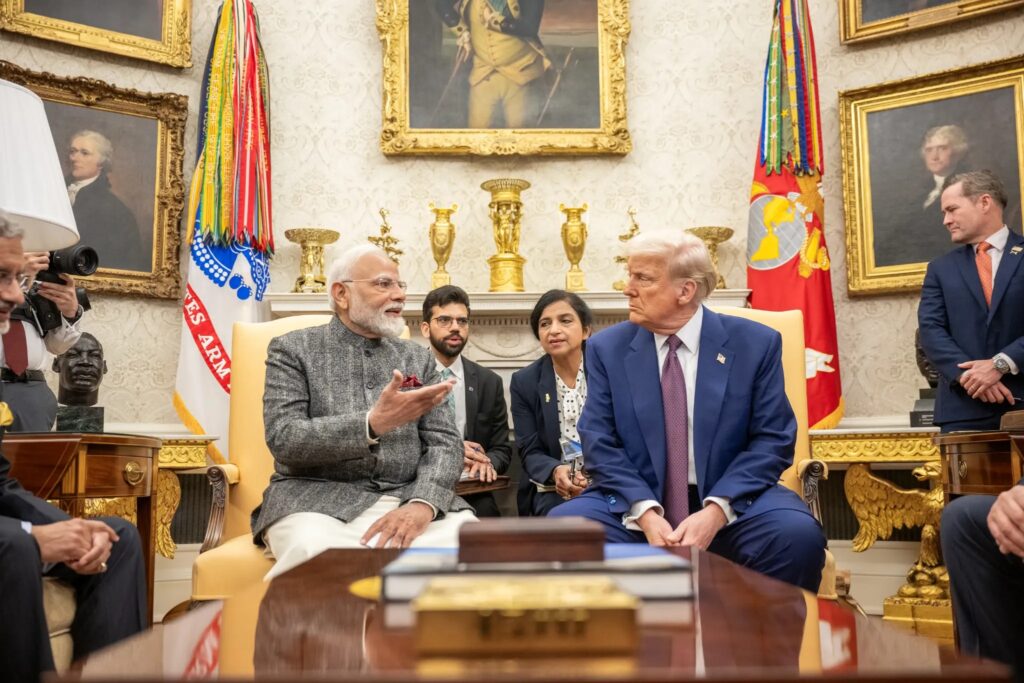
The recent debate sparked by Happymon Jacob’s call to “de-Americanise” India’s grand strategy is both timely and necessary. If the turbulence in India-US relations under President Trump has taught us anything, it is that no durable grand strategy can rest on assumptions about the permanence of another country’s priorities.
But the answer is not simply to de-Americanise.
The answer is to re-Indianise. A more demanding intellectual exercise because it requires us to define India’s place in the world on its own terms rather than in reaction to either Washington or Beijing.
For nearly three decades, China was the strategic glue holding India and the US together. It was an important convergence, but it was never a sufficient one. The Indo-Pacific became the organising framework of the relationship because both countries saw value in preserving a favourable balance of power in Asia.
Yet recent events demonstrate its limits. The Trump administration has recalibrated its foreign policy around narrower national interests. The Quad has faded in salience. The renaming of INDOPACOM back to PACOM, the growing American engagement with Pakistan, the changing approach to Iran, and a broader transactionalism in US diplomacy all suggest that Washington is no longer organising its foreign policy primarily around the Indo-Pacific concept.
That does not invalidate the Indo-Pacific. It merely reminds us that no strategic framework can substitute for continuously reassessing national interests.
Perhaps the Indo-Pacific was not an oversold stock so much as an incomplete prospectus. China brought India and the US closer together, but China alone was never enough to sustain the relationship. Where I part company with some recent arguments is on the suggestion that India merely borrowed America’s perception of the China threat.
India’s concerns about China long predate the Indo-Pacific. They arise from history itself. The unresolved boundary dispute, Tibet, China’s nuclear and missile cooperation with Pakistan, repeated military crises along the Line of Actual Control, and, finally, Galwan are products of India’s own experience. They were not imported from Washington.
Nor is it convincing to argue that Beijing does not regard India as a strategic competitor. China’s enduring strategic investment in Pakistan, its efforts to constrain India’s regional role, its expanding presence across the Indian Ocean, and its behaviour on the Himalayan frontier point to a more complex reality than Chinese commentary often acknowledges.
The challenge, therefore, is not to replace an American lens with a Chinese one. It is to think with Indian eyes.
What, then, should India’s grand strategy be?
I would argue that India’s defining characteristic is neither continental nor maritime alone. It is omnidirectional.
Few countries occupy such a unique geopolitical position. India looks west towards the Gulf, Africa, and Europe. It looks east across Southeast Asia into the Pacific. It sits astride the Indian Ocean while remaining anchored in continental Asia through the Himalayas.
Long before modern geopolitics coined expressions such as the Indo-Pacific, India occupied precisely this central position. One of the ancient names associated with Indian civilisation was Madhya Desha—the middle country. Not the “Middle Kingdom” in the Chinese imperial sense of civilisational hierarchy, but a civilisational crossroads where multiple worlds met.
That geographical inheritance remains India’s greatest strategic asset. India should therefore resist becoming a frontline state in someone else’s rivalry. Its strength lies in connecting rather than dividing regions.
Its diplomacy should simultaneously engage Washington, Beijing, Moscow, Tokyo, Brussels, the Gulf, Africa and Southeast Asia. Its maritime strategy should encompass both the Indian and Pacific Oceans without allowing either to eclipse the other. Its continental strategy must recognise that stability across Eurasia increasingly shapes India’s security, whether through Central Asia, West Asia, or the Himalayan frontier.
Equally important, India’s grand strategy must rest on national capability rather than borrowed power. Strategic autonomy has never meant equidistance. Nor has it meant neutrality.
It means preserving independent judgment while building sufficient economic, technological, and military strength to expand India’s freedom of action. No amount of diplomatic alignment can compensate for weaknesses in manufacturing, technological innovation, critical minerals, energy security, or defence production.
The recent strains in India-US relations underline precisely this lesson. Countries ultimately respect capability more than declarations. The present debate should therefore move beyond the language of de-Americanisation.
The US will remain one of India’s most important strategic partners. China will remain India’s most consequential long-term challenge. Both propositions can be true simultaneously.
The task is not to define India through either relationship. It is to define both relationships through India. Ultimately, grand strategy is not about choosing between America and China. It is about choosing India.
It is about an India confident enough to cooperate where interests converge, compete where necessary, disagree without insecurity, and refuse to become captive to any external framework.
That requires neither nostalgia for non-alignment nor dependence on alignment. It requires something far older and far more enduring: an Indian worldview rooted in India’s own geography, history, civilisation and interests.
That, more than de-Americanisation, is the strategic conversation India now needs.