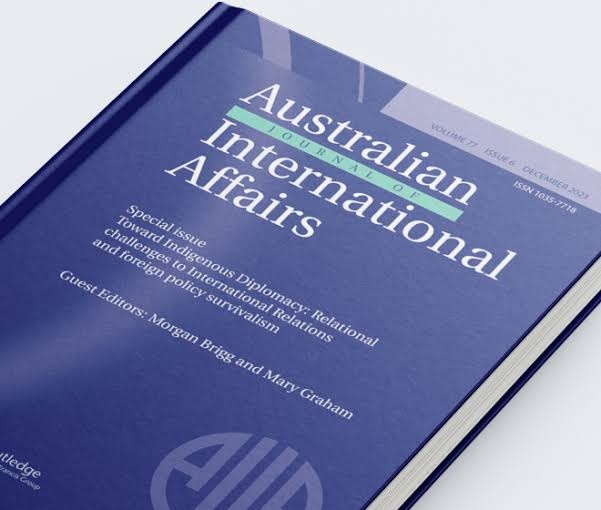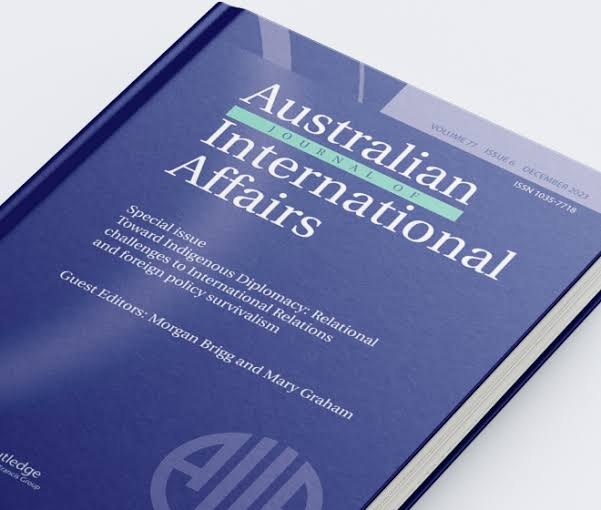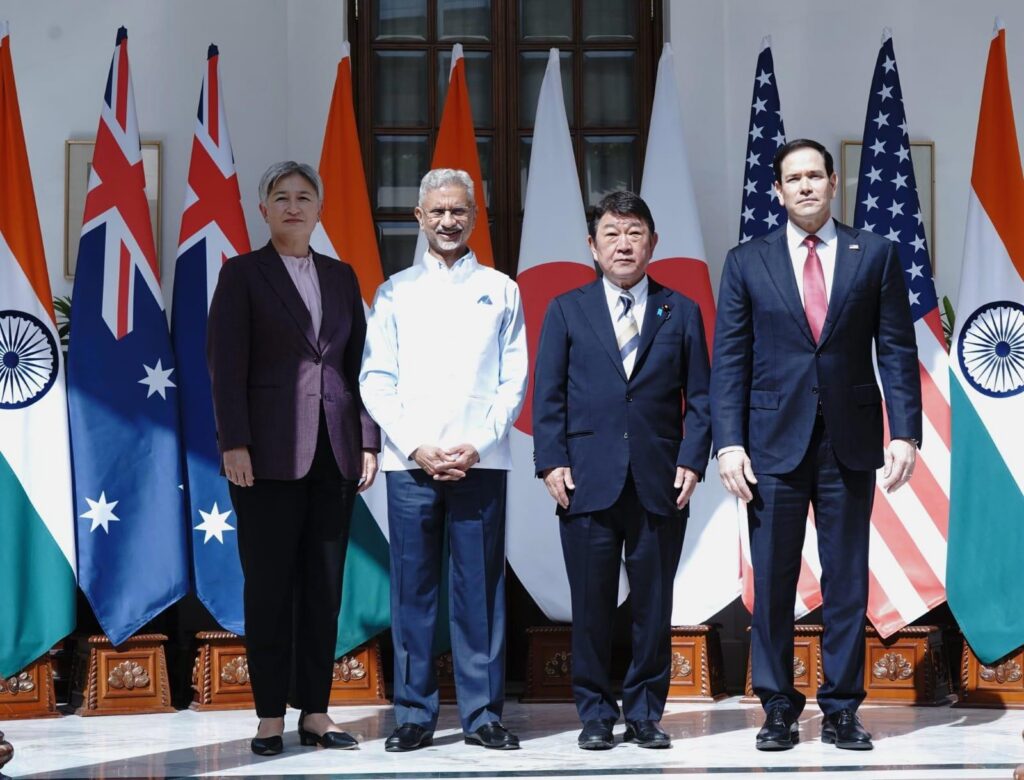
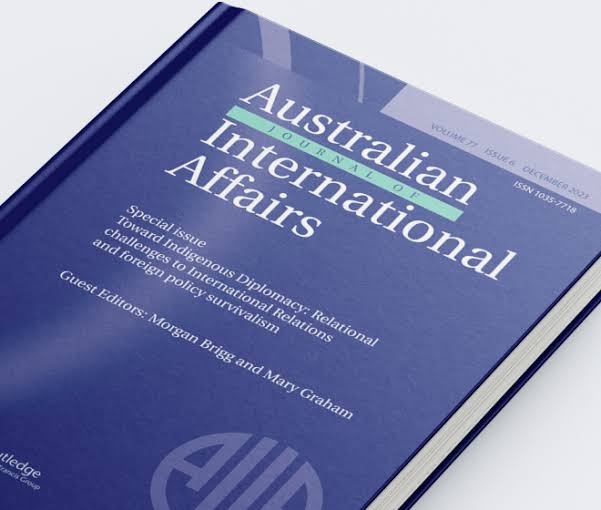
In “A Success Story of Hybrid Institutional Balancing in the Indo-Pacific: A History Lesson of the Quad, 2018–2024”, published in the Australian Journal of International Affairs on 4 September 2026, Anshu N. Chatterjee examines how the Quadrilateral Security Dialogue (Quad) developed an institutional response to China’s growing economic and military assertiveness in the Indo-Pacific. The article argues that the grouping combined economic and security instruments to address its members’ vulnerabilities while countering Beijing’s regional ambitions. Drawing on Kai He’s framework of integrated institutional balancing, Chatterjee explains how the Quad used inclusive and exclusive arrangements to reduce economic dependence on China, strengthen regional defence cooperation, and uphold the liberal rules-based order. She also examines how these efforts shaped Beijing’s response, particularly its renewed engagement with India, Japan, and Australia in 2024.
Chatterjee begins by examining the difficulties regional powers faced in responding to China’s growing influence. Beijing’s position in global manufacturing and supply chains gave it considerable economic leverage, which it used alongside military pressure and low-level warfare around disputed territories and maritime routes. India and Australia faced a particular dilemma. Both had substantial economic ties with China but were increasingly concerned about its regional ambitions. Their economic dependence also limited the scope for direct confrontation. The framework explains how states navigate these competing pressures through institutional arrangements. It identifies two considerations shaping their choices: economic interdependence and changes in the regional distribution of power. These produce two forms of institutional balancing. Inclusive arrangements seek to bind and constrain a state through shared rules and agreements, while exclusive arrangements seek to isolate it. The Quad combined both approaches. Its informal structure was particularly useful because, as Chatterjee writes, “the absence of a formal treaty served as an asset”, allowing members to coordinate without surrendering their strategic autonomy.
The economic dimension of this approach gained urgency following two developments in 2020: China’s restrictions on Australian exports after Canberra called for an independent investigation into the origins of COVID-19, and the Galwan Valley clash between Indian and Chinese forces. Both exposed the risks of economic dependence on Beijing. Quad members responded through a combination of bilateral arrangements and wider coordination, using investments, trade agreements, and technology partnerships to diversify supply chains and strengthen industrial capacity. Chatterjee discusses Japanese investment in India’s lithium-refining capacity; the India-Australia Economic Cooperation and Trade Agreement (ECTA), signed in April 2022; Tokyo’s infrastructure investment in India; and the India-US Initiative on Critical and Emerging Technology (iCET), launched in 2023. Deeper trade with Taiwan gave India and Australia preferential access to critical technologies, while Taiwan gained alternative production sites. These arrangements served different member interests: India and Australia could strengthen their industrial capacities and reduce vulnerabilities, while Japan and the United States gained alternatives to Chinese supply chains. The Quad’s 2022 pledge to seek more than $50 billion in infrastructure assistance and investment across the Indo-Pacific over five years similarly offered an alternative to the Belt and Road Initiative (BRI), through transparent financing arrangements and debt-management reforms. Chatterjee stresses that efforts to reduce dependence did not mean Quad members could abandon economic engagement with China. Their balancing strategy operated alongside continued trade with Beijing.
The article also examines how the Quad extended cooperation into maritime security and defence. India’s Malabar naval exercises provided a platform for coordination, while Australia’s return in 2020, its first participation since 2007, signalled collective support at a time when India and Australia were facing Chinese pressure. Logistics-sharing arrangements further strengthened cooperation. In 2022, the Quad introduced the Indo-Pacific Partnership for Maritime Domain Awareness (IPMDA), intended to improve maritime information-sharing with regional countries. Its cooperation also extended to bilateral and trilateral arrangements with members of the Association of Southeast Asian Nations (ASEAN), including the US-Japan-Philippines trilateral dialogue in 2024. These activities focused on addressing piracy, illegal fishing, and challenges to maritime boundaries under the United Nations Convention on the Law of the Sea (UNCLOS). Chatterjee argues that anchoring this maritime cooperation in UNCLOS, to which China is a signatory, allowed the Quad to counter Beijing’s assertiveness without direct confrontation.
Beijing responded through both military and institutional means. Alongside increased naval activity and criticism of the Quad, China introduced alternative initiatives to strengthen its regional position. The Global Development Initiative (GDI), launched in 2021, followed the Quad’s commitments on pandemic recovery, sustainable development, and climate change. The Global Security Initiative (GSI), announced in 2022, sought to position China as a regional security provider and counter the Quad’s security and technology agenda. Chatterjee interprets these initiatives as part of Beijing’s effort to dilute the grouping’s influence. China’s approach towards individual Quad members also changed in 2024. Beijing agreed on patrolling and disengagement arrangements with New Delhi in eastern Ladakh, hosted Japan’s national security adviser for de-escalation talks, and held high-level discussions with Australia. Chatterjee sees these overtures as a calculated attempt to weaken the Quad’s cohesion, particularly by exploiting concerns about the possibility of a less committed and more inward-looking Washington. China’s economic stagnation, the overextension of the BRI, and its need to maintain access to markets and resources also contributed to this shift.
The article is particularly relevant to understanding India’s participation in the Quad. Rather than treating the grouping principally as a security arrangement directed against China, Chatterjee shows how its economic and institutional dimensions accommodate India’s concerns about economic dependence, defence asymmetry, and strategic autonomy. This also helps explain why India and Australia, despite their earlier hesitancy over the Quad, became central to its development. The article’s contribution lies in bringing economic interdependence into the analysis of minilateral security cooperation. Its argument that flexible arrangements can constrain great-power behaviour “without a costly armed escalation” offers a useful framework for understanding the Quad’s development. Chatterjee’s account also speaks to the grouping’s present uncertainty: she argues that its preliminary success was disrupted by the change of administration in Washington, and that the second Trump administration’s ineffective unilateral tariff measures ultimately underscored the Quad’s strategic value. She links the weakening of the grouping to Beijing’s suspension of some re-engagement efforts, especially with India. Her causal claim that the Quad produced Beijing’s 2024 diplomatic shift should be read with care, however, since she also identifies China’s domestic economic pressures and uncertainty over American policy as important factors. A further qualification is that several economic examples are bilateral agreements between Quad members, rather than agreements concluded by the Quad as a group; Chatterjee treats them as elements of a wider, cumulative balancing strategy. This complements Kadiyala’s assessment above: uncertainty in Washington places pressure on both the US-India partnership and the wider regional arrangements intended to balance China.