India and Australia sit on opposite flanks of the Indian Ocean, share membership of the Quad, and face a common strategic challenge in China’s growing assertiveness across the Indo-Pacific. Yet for much of the post-independence period, the relationship underperformed its geography. After the 1998 Pokhran nuclear tests, Australia suspended defence cooperation, froze military exchanges, and sent Indian officers training at its defence colleges home. That this week, during Prime Minister Narendra Modi’s visit, Canberra invited an Indian military instructor to serve at the Australian Defence College captures what has been called “one of the most remarkable bilateral transformations in contemporary history”.
What drives the convergence is structural alignment, not sentiment. India absorbed the lesson of the 2020 Galwan clashes, Australia endured Chinese economic coercion, and both now treat supply-chain diversification and defence self-reliance as priorities. The Indian diaspora in Australia, now the country’s largest overseas-born group, provides the people-to-people foundation. The economic relationship has accelerated since the Economic Cooperation and Trade Agreement (ECTA), concluded in 2022, delivered a 55% increase in bilateral trade.
The Visit
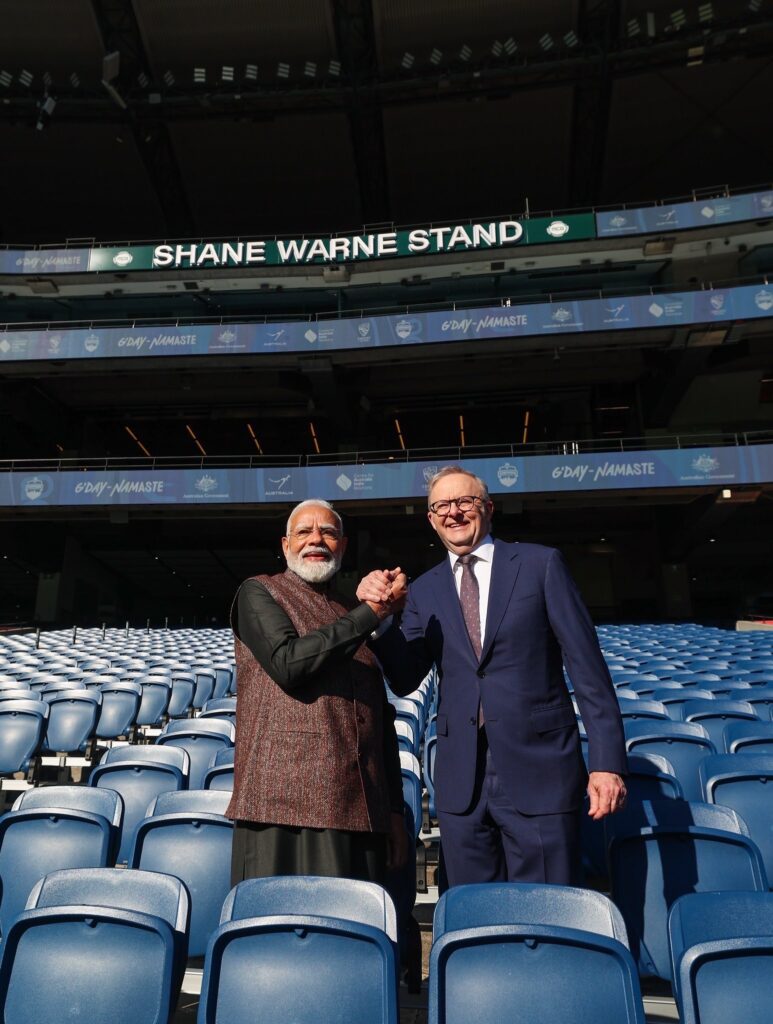
Against this backdrop, Prime Minister Modi arrived in Melbourne on 8 July 2026 for the third India-Australia Annual Summit, hosted by Prime Minister Anthony Albanese at Government House, the second leg of Modi’s three-nation tour (Indonesia, Australia, and New Zealand). The day began with the CEOs Forum and an Economic Roadmap Business Reception, followed by one-on-one and delegation-level talks. A community reception at Marvel Stadium drew nearly 25,000 members of the Indian diaspora. On the second day, both leaders visited the Melbourne Cricket Ground (MCG) to unveil a Sports Collaboration Roadmap, and Modi met the leader of the opposition, Angus Taylor. The summit produced 19 bilateral outcomes.
Defence and Maritime Security
The centrepiece was the Joint Declaration on Defence and Security Cooperation (JDDSC), replacing the 2009 Joint Declaration on Security Cooperation. The 2026 version expands the partnership’s scope: it commits both sides to increasing the complexity of defence exercises, accelerating interoperability, expanding aircraft deployments from each other’s territories, and deepening personnel exchanges. It also introduces a new line of effort, exploring cooperation in recruiting for skilled defence workforces, signalling the operational depth both militaries now envisage.
Foreign Secretary Vikram Misri described the declaration and the accompanying Maritime Security Collaboration Roadmap as recognition that “the partnership must evolve to meet changing strategic circumstances”. That language carried a specific context: Albanese raised China’s recent intercontinental ballistic missile launch into the South Pacific during the bilateral discussions. Modi’s response, per Misri, framed the Indo-Pacific as a space where both countries would “intensify cooperation” to maintain peace and stability.
The maritime roadmap provides for enhanced information sharing, capability development, and operational coordination. The Indian Coast Guard and Australia’s Maritime Border Command signed a memorandum of understanding (MoU) on maritime law enforcement and domain awareness. And the placement of an Indian military instructor at the Australian Defence College in 2028–29, coupled with Australia’s hosting of the fourth General Rawat India-Australia Young Officers’ Exchange Programme, institutionalises a training relationship that once did not exist.
The Uranium Breakthrough
The most symbolically charged outcome was the finalisation of the administrative arrangement enabling Australian uranium exports to India. Australia once refused to sell uranium to India over its non-signature of the Non-Proliferation Treaty. Even after a civil nuclear cooperation agreement in 2014, exports stayed blocked over unresolved reporting and accounting protocols. Misri said “very intense discussions over a period of almost two years” were needed to resolve safeguards procedures. What has been finalised is the framework; commercial contracts between private Australian mining firms and Indian counterparts must follow, with no disclosed timeline.
The timing adds weight. India’s Parliament passed the SHANTI Act in December 2025, opening the nuclear sector to private participation and targeting 100 GW of installed capacity by 2047, up from roughly eight GW today. Misri called the uranium arrangement “a major shot in the arm” for that ambition. Australia reiterated support for India’s membership of the Nuclear Suppliers’ Group (NSG).
A Joint Statement on Energy Security reinforced the broader energy architecture, reaffirming commitments to reliable supply amid Middle East disruptions and recognising each country’s role in the other’s energy mix: India as a supplier of downstream petroleum products, Australia of coal and liquefied natural gas. A Rooftop Solar Training Academy, operationalised at Pandit Deendayal Energy University in Gandhinagar, aims to train 2,000 women and youth as solar technicians under the PM Surya Ghar Yojana.
Technology, Cyber, and Supply Chains
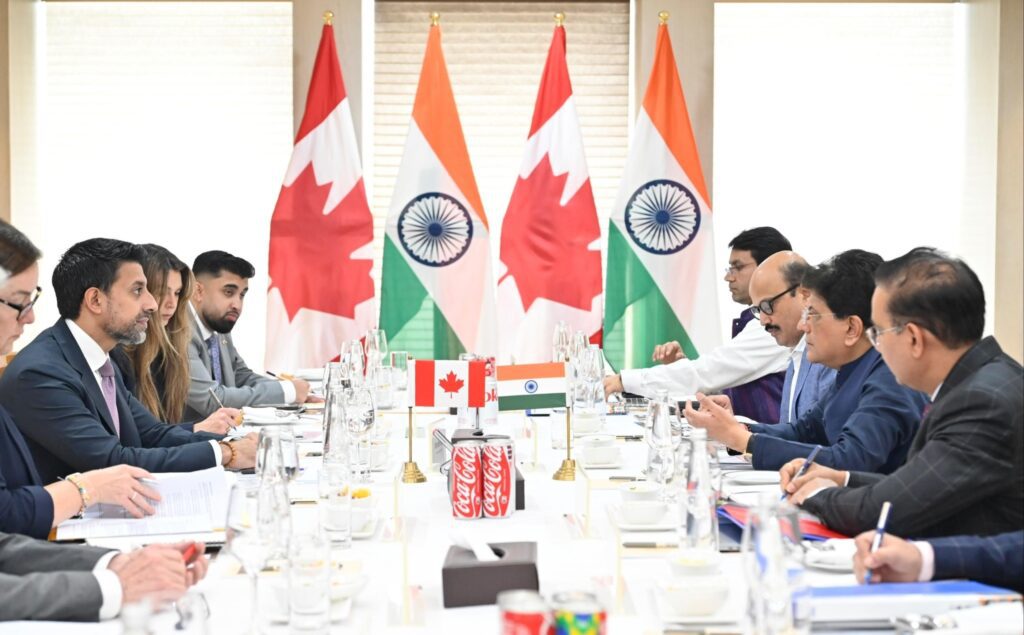
The summit launched the Australia-India Partnership on Cyber, Critical Technologies and Supply Chains (PACTS), replacing the 2020 Framework Arrangement on Cyber and Cyber Enabled Critical Technology Cooperation. PACTS is structured around five pillars: supply chain resilience (including trusted vendor frameworks and semiconductor supply-chain protection), critical technology (AI, space, telecom, and biotech), cybersecurity, digital resilience (focused on scaling India’s Digital Public Infrastructure across the Indo-Pacific), and defence research collaboration. Governance sits at the deputy national security adviser level on the Indian side and the Deputy Secretary of the International and Security Group in the Australian prime minister’s department, reflecting an effort to move from declaratory intent to project-level coordination. The Australia-Canada-India Technology and Innovation (ACITI) Partnership MoU adds a trilateral dimension. An MoU between GeoScience Australia and the Geological Survey of India (GSI) targets advanced exploration methodologies and modernisation of GSI infrastructure.
Trade and Investment
The ECTA’s 55% boost to bilateral trade is real, but the bigger prize remains elusive. Both leaders committed to expediting the Comprehensive Economic Cooperation Agreement (CECA), which would extend coverage to services, investment, and technology cooperation. The CECA was not concluded, and the joint statement reaffirmed commitment without announcing a timeline. Former High Commissioner Gopal Baglay, writing in The Hindu, noted the shared ambition to raise bilateral trade from $33 billion in 2025 to $100 billion by 2030. At the CEOs Forum, AustralianSuper announced a $500 million investment into India’s National Investment and Infrastructure Fund.
Education, Skills, and People-to-People
The education architecture acquired institutional form. Flinders University received a Letter of Intent to establish a campus in Bengaluru; Victoria University received a Letter of Approval for its Gurugram campus. Western Australia’s TAFE will collaborate with India’s Ministry of Skill Development and Entrepreneurship to set up a Centre of Excellence in Mining Equipment, Technology and Services (METS) at the National Skill Training Institute in Bhubaneswar, Odisha. A Letter of Intent between the National Council for Vocational Education and Training (NCVET) and Australia’s Skills Quality Authority (ASQA) targets co-development of occupational standards. The Satyajit Ray Film and Television Institute in Kolkata signed an MoU with Griffith Film School, Brisbane, for joint projects in cinema. A $10 million allocation for the Centre for Australia-India Relations’ Maitri grants will support people-to-people engagement. On student mobility, Foreign Secretary Misri noted that while “some of the processes have become a bit more onerous”, Australian authorities assured that opportunities for genuine Indian students remained open.
Science, Culture, and Sports
The Council of Scientific and Industrial Research (CSIR) signed two agreements: one with IP Australia granting access to India’s Traditional Knowledge Digital Library (TKDL), designed to prevent the misappropriation of traditional knowledge in patent applications, and another with the University of Melbourne for collaborative research in drug target identification and faculty exchange. Three Tamil Nadu-origin cultural artefacts, a stone Nandi sculpture (11th–12th century), a bronze trident with Bhadrakali (11th century), and a basalt six-headed Karttikeya (12th century), will be voluntarily repatriated from Australian institutions.
The India-Australia Sports Collaboration Roadmap, unveiled at the MCG, identifies capacity building, sports science research, women in sport, and major event cooperation as priorities. With India hosting the 2030 Commonwealth Games in Ahmedabad, Australia the 2032 Brisbane Olympics, and New Delhi harbouring ambitions to host a future edition of the Olympic and Paralympic Games, the roadmap targets a decade of structured cooperation: high-performance centre development in India drawing on Australian expertise, Para sport collaboration, coach exchange programmes, and joint university research on athlete performance analytics, injury prevention, and wearable technology. The sporting exchange extends beyond elite competition. Kabaddi and kho kho are to gain greater visibility in Australia, while Australian Rules football and basketball will find more opportunities in India. The roadmap also targets the sports industry itself, promoting cooperation in equipment manufacturing, broadcasting, event management, and sports technology startups. The inaugural Big Bash League (BBL) match in India is scheduled for Chennai in December 2026, with both cricket boards encouraged to make annual BBL matches in India a commitment.
What to Watch
The joint statement positioned the summit within a wider regional canvas. Both leaders endorsed the Quad, reiterated support for ASEAN centrality, and flagged cooperation through the Australia-India-Indonesia trilateral and the Indian Ocean Rim Association (IORA) under India’s chairship. Australia reiterated support for India’s permanent membership of a reformed UN Security Council (UNSC), and both countries backed each other’s non-permanent UNSC bids (India for 2028–29, Australia for 2029–30). On terrorism, the statement condemned the Pahalgam and Bondi Beach attacks and called for action against UN-proscribed entities “without any double standards”. Both leaders discussed the Middle East and Ukraine, calling for dialogue and protection of civilians. Modi recognised Australia’s COP31 presidency.
The breadth of the 19 outcomes invites the familiar question of follow-through. The CECA was not concluded. Critical minerals remained in the zone of strategic intent rather than specific mine-to-market projects. The uranium arrangement is a framework; commercial contracts and supply timelines are yet to come. Defence cooperation advanced through declarations and roadmaps but produced no procurement deal.
Yet the visit reveals something that cannot be easily dismissed. The institutional architecture, from PACTS at the deputy national security adviser level to the JDDSC’s commitment to expanded deployments from each other’s territories, is acquiring a density that constrains future backsliding. India and Australia are no longer building a relationship from scratch; they are filling in the operational detail of a strategic framework both sides now treat as permanent. India today “intends to be a shaping power”, and the Melbourne summit represents one component of that ambition. Whether the architecture translates into capacity or remains well-drafted scaffolding will depend on the quality of implementation in the months ahead.
Note: This explainer has been researched, edited, and fact-checked by India’s World staff and prepared with AI assistance.