In June 2025, Prada sent leather sandals down its Milan runway for $1,400 a pair, describing them simply as “leather sandals.” They were near identical to the Kolhapuri chappal, a handcrafted sandal from Maharashtra and Karnataka with roots tracing back to the 12th century and an Indian Geographical Indication (GI) tag of its own. Months later, some fashion brands and online retailers began marketing dupatta-style scarves, a garment worn across South Asia for centuries, as a “Scandinavian scarf,” stripping them of name and origin. Chintz, calico, madras, and dungarees: all entered English with Indian origins quietly removed.
These are not novel controversies. They are the latest turn of a pattern more than a century old. On 6 January 1903, Lady Mary Curzon, Vicereine of India, walked into the Hall of Private Audience in Delhi’s Red Fort wearing a dress that contained an empire’s contradiction. Indian artisans at the workshop of Kishan Chand had embroidered its skirt with overlapping peacock feathers in zardozi gold thread; the panels were then shipped to Paris, where the House of Worth assembled them into a European silhouette, before the finished dress, weighing about 4.5 kilograms, was returned to India for the 1903 Delhi Durbar, the pageant marking the coronation of Edward VII as Emperor of India. Historian Nicola Thomas argues the peacock motif deliberately referenced the Mughal Peacock Throne that had once stood in that very room. Indian craft, symbolism, and labour were assembled into a European form, credited to a French house.
What happened at the Durbar has happened, in variations large and small, ever since. To understand why, it is necessary to return to the period when India was not merely a source of inspiration, but one of the world’s foremost producers of textiles.
From Exchange to Extraction
Before any of this, India was the place fashion travelled from, not toward. Mughal Bengal alone supplied the bulk of the textiles the Dutch East India Company imported from Asia, and Bengali muslin was famously fine enough to pass through a ring. In 1700, India accounted for roughly 24–25% of world GDP, comparable to Western Europe combined. Unable to replicate Indian chintz, calico, and muslin at scale, Europe responded with protectionist laws: the Calico Acts of 1700 and 1721 banned Indian cotton textiles from sale in Britain, giving domestic manufacturers time to catch up by legislation rather than by matching Indian craftsmanship.
The turning point began with the Battle of Plassey in 1757 and was consolidated when the East India Company secured the Diwani (revenue-collection rights) of Bengal in 1765. Over the following decades, British machine-made cotton textiles came to dominate Indian markets, while India’s share of global industrial output fell from a quarter in the mid-18th century to about 2% by the early 20th century.
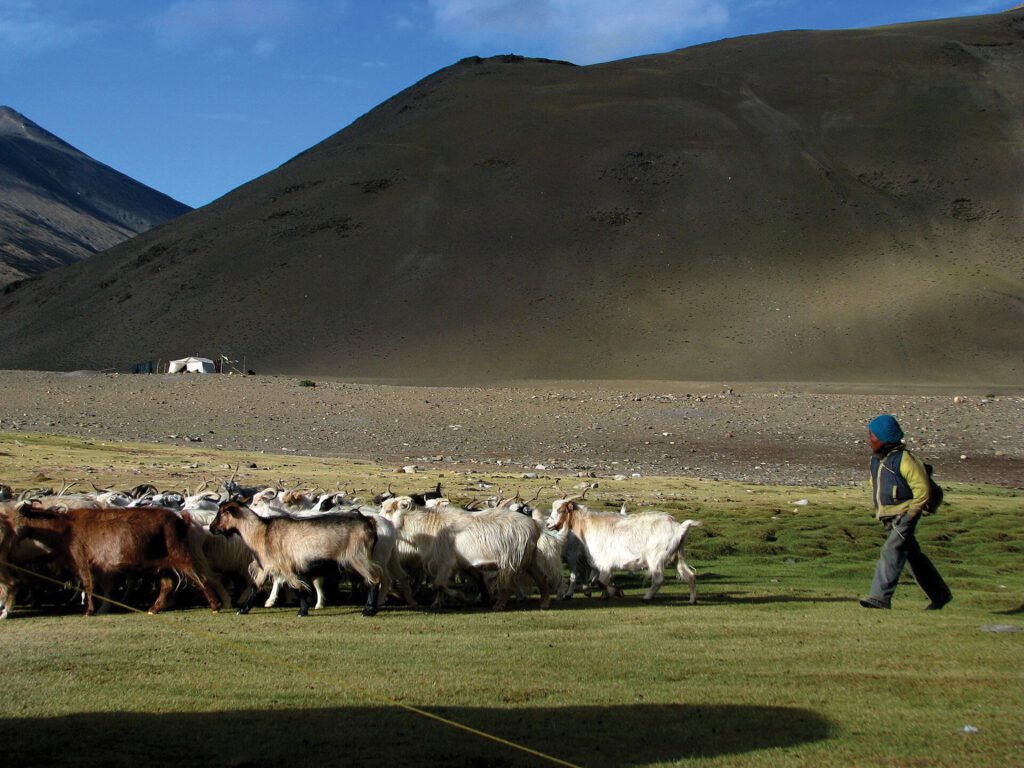
Even the way Britain learned to copy Indian design was institutional. In the 1860s and 1870s, the British India Office assembled more than 30,000 hand-cut Indian textile samples into “trade museums,” explicitly to help British manufacturers study and reproduce Indian fabrics, with no benefit to the weavers whose work was copied. Paisley illustrates the mechanism best. The boteh motif, woven by Kashmiri artisans into shawls spun from the wool of Himalayan goats, reached Britain in the early 19th century, creating what Encyclopædia Britannica describes as “insatiable” demand. Production in the Scottish town of Paisley grew so dominant that the shawls, and eventually the motif itself, took the town’s name. As National Museums Scotland notes, the design “has its origins in India, emanating from the valley of Kashmir,” yet the Kashmiri weavers who originated it received neither credit nor compensation.
Reclaiming Cloth
Khadi shows the opposite mechanism: cloth deliberately reclaimed as a weapon against the economy that had extracted it. The Indian National Congress had passed a resolution favouring Indian-made goods as early as 1891; the 1905 partition of Bengal turned the boycott of English cloth into the independence movement’s sharpest tool. After 1915, Gandhi turned that boycott into something more totalising. Plain, hand-spun cotton became what Nehru later called “the livery of India’s freedom,” coarse enough to erase visible markers of caste and class. The spinning wheel Gandhi popularised became potent enough that the colonial government moved to suppress the khadi movement directly, one of the rare instances in this history where Indians reclaimed a textile before others could commercially appropriate it.
The end of colonial rule did not end the unequal circulation of cultural capital. Indian textiles were no longer extracted through imperial monopoly, but Indian aesthetics increasingly entered global fashion through Western luxury houses that retained control over branding, visibility and profit.
Borrowing After Empire
After 1947, Western fashion kept borrowing, with Yves Saint Laurent’s 1982 India collection among the most cited examples, even as Indian designers built international platforms of their own. The underlying structure remained asymmetric: a Western fashion house could present “India-inspired” work without Indian collaborators and often receive greater global attention than the Indian designers whose traditions informed it.
When Culture Becomes Costume
The acknowledgement that followed came with its own friction, because what luxury fashion now borrowed was no longer just pattern and weave but religious symbol. These cases exist on a spectrum: inspiration can become commercial appropriation, and appropriation can become erasure of origin.
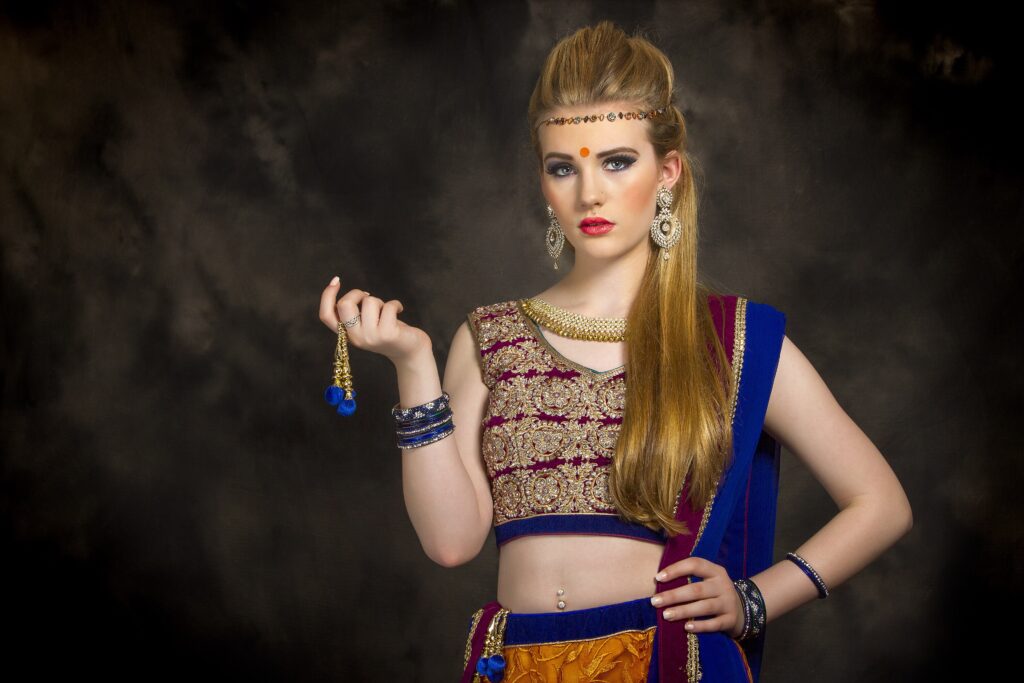
In December 2011, Karl Lagerfeld explicitly cited Lady Curzon as his inspiration for Chanel’s Paris-Bombay collection, casting a model resembling her; the show put sari-esque drapes and bindis on predominantly white models. The bindi carries specific religious and marital meaning in Hindu tradition, here reduced to decoration. From 2013, a string of celebrities wore bindis stripped of context, prompting #ReclaimTheBindi, Indian women asserting ownership by posting their own photographs.
The clearest example of how appropriation exists within a broader history of harm is the Sikh turban. In February 2018, Gucci sent models down its Milan runway wearing the dastaar; the following year, it sold an “Indy Full Turban” for $790. The Sikh Coalition criticised the move, arguing that the turban is “not a fashion accessory to monetise, but a religious article of faith.” This controversy sits within a longer history of misunderstanding, where the turban has often been read not as a marker of Sikh identity but as foreign or threatening.
A 2013 Stanford/SALDEF study found that 70% of Americans could not identify a Sikh man from an image. That same misidentification contributed to the killing of Balbir Singh Sodhi after 9/11, and later hate attacks against Sikhs. The week Gucci’s turbans appeared in Milan, a Sikh environmentalist had his turban ripped off outside the British Parliament in a hate attack, his attacker shouting, “Muslim go back home.” Runway and street are not the same place, but they share a geography of ignorance, one exploiting it for profit, the other for violence.
The Prada Kolhapuri sandals that open this essay are the clearest recent example of the arc playing out in full. Days into that controversy, Dior unveiled a $200,000 haute couture overcoat embroidered using mukaish, a Lucknow metallic-thread technique once reserved for Mughal royalty, completed by twelve Indian artisans over thirty-four days, with no mention of mukaish or India anywhere in Dior’s official materials. Ralph Lauren followed months later with a “Bandhani-inspired” wrap skirt, carrying no reference to India or Gujarat.
From Kishan Chand’s workshop to Dior’s runway, the structure of the transaction has barely changed.
Reclaiming the Narrative
India has also become more assertive in protecting and presenting its own traditions. The Geographical Indications Act, 1999, and the Traditional Knowledge Digital Library represent legal attempts to safeguard both place-based products and traditional knowledge. At the same time, Indian designers and artists increasingly occupy global platforms on their own terms. Rahul Mishra’s Paris couture collections openly foreground Indian artisanship, while Diljit Dosanjh’s appearance at Coachella demonstrated that Indian cultural identity no longer needs Western mediation to command international attention.
Beyond Inspiration
Every story in this essay, from the peacock dress to the Kolhapuri chappal to the dastaar, ultimately asks three questions. Who creates culture? Who receives credit for it? Who profits from it?
For most of this history, the answers split along colonial lines: Indian artisans created, while French maisons, British manufacturers, and later luxury brands controlled naming, visibility, and profit. The Geographical Indications regime and the Traditional Knowledge Digital Library show that recognition can alter this imbalance, while contemporary designers and performers demonstrate that visibility no longer belongs exclusively to Western institutions.
Cultural exchange has always shaped fashion, and it always will. The question is not whether traditions travel, but whether they travel with acknowledgement. For centuries, Indian textiles, motifs, and craftsmanship transformed global fashion even as the people who created them disappeared from the story. Reclaiming that story is not about ending cultural exchange. It is about restoring attribution, visibility, and dignity to the communities that have long been written out of fashion’s global history.