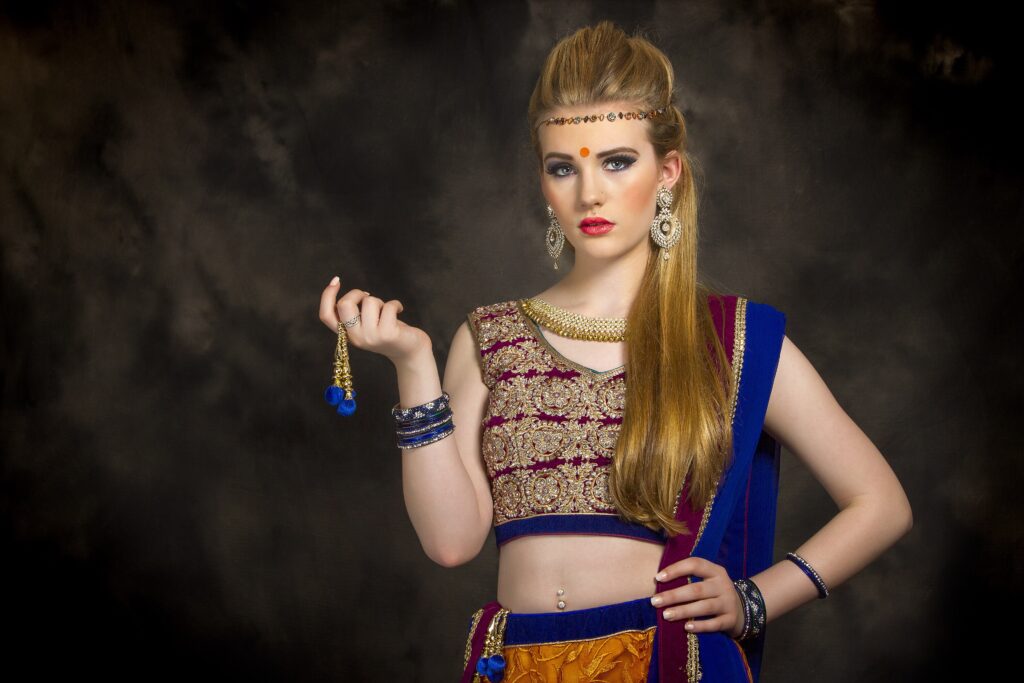

Fashion has long borrowed from India, and acknowledging that influence is the first step toward repaying a long-overdue debt of recognition. The steady rise of Indian fashion models signals a long-overdue recognition by the global advertising industry—a seat at the table among fashion’s most influential players.
When I started to work as a fashion model, after being scouted in my second semester of college at Delhi University, the “slow death” of homogeneity and a “fast rise” of unique faces was already rapidly underway. It was the spring of hope—while actors were still heavily dominating magazine covers, the Indian fashion industry was having its renaissance moment in 2016. A handful of Indian-origin models were seen on the global runways, and back home, for talent like myself, a lot of exciting learning awaited. Over the years, after having worked with a multitude of big-name publications, designers, and brands, I quickly understood that models lend context to culture and, quite literally, give it a face. I still find one common thread to persist—the need to show up, take space, and continue the conversation. If the buzz slows down, the hive loses momentum. In this metaphor, the bees are homegrown talent. Their visibility sustains the ecosystem.
Fashion rarely exists in isolation. It thrives through its dialogue with adjacent creative disciplines. While it is often notoriously glorified by the media and conveniently crafted towards a tabloid readership, the collision of the creative worlds lends to a broader cultural shift. Film lends itself to literature, sports intersects with clothing, music to drama, architecture inspires silhouettes, and poetry becomes couture—all find convergence at some level of the craft.

Perhaps the most important shift is that India is no longer being viewed solely through the lens of tradition. Fashion is helping present India as a country where heritage and modernity coexist, where creativity drives economic and cultural influence, and where local craftsmanship can shape global trends. The ubiquity of the “sari drape”, the Kohinoor cut, Banarasi brocade, and a Jaipur rug are no longer simply markers of Indian tradition; they have become part of fashion’s global vocabulary. What began as a local craft has evolved into an international language of design. These have also been run through the cyclical nature of trends to truly establish themselves as mainstays of the Indian fashion export. In this sense, fashion has become a powerful tool of cultural diplomacy— building connections, fostering understanding, and strengthening India’s presence on the world stage. Local at heart, global in spirit.
Fashion is helping present India as a country where heritage and modernity coexist, where creativity drives economic and cultural influence, and where local craftsmanship can shape global trends
The industry’s influence is amplified through its constant dialogue with adjacent creative fields. As a model, I have found myself dressed in collections that require a high level of artistry. Wearing the works of master couturiers has taught me the very essence of creative translation. What can be thought of can also be said—the medium of dissemination may take varying forms—a visual drawn, a melody composed, text transcribed or movement rehearsed through synchronisation. This is very common in the world of fashion. I see this collision of worlds occur every day—for example, the House of Schiaparelli, whose lion-head bodice was inspired by Inferno, the first part of The Divine Comedy, the 14th-century epic poem by Dante Alighieri; and Issey Miyake, the Japanese master couturier whose designs drew inspiration from origami. Indian designers that I have worked closely with, including Tarun Tahiliani, Sabyasachi, Manish Malhotra, Gaurav Gupta, Anita Dongre, among many others, have all excelled in their careers by creating a specific visual language for their designs. The inspiration is boundless, time and resources are finite, and execution is the ultimate link between ideation and final consumption.

In this fast-changing landscape, with hypervisibility often being seen as a derivative of relevance, I have found it both rewarding and challenging to navigate self-expression as an Indian model working across borders. With a growing global audience, I try to make my voice, beyond the runway and ads alone, that of a South Asian fashion “interlocutor”. When I first moved abroad and did my first round of international runway shows, commonly known as Fashion Week, one of the questions I was asked most frequently wasn’t about my work, but about where I was from, followed by a series of qualifiers: “Which part?” “Are you fully Indian?” “What’s the fashion scene like there?” When I would say Assam and even remote Arunachal Pradesh, it wouldn’t just be met with awe but also confusion. It is also rewarding in being using my identity as a superpower to proudly distinguish where I am from, despite the geographical over explanation it demands. I usually catch myself zooming into Northeast India on Google Maps—pointing at the tiny strip of land, a brother state to Assam: Sikkim, which opens up to the rest of the Northeast, and waiting for a faintly audible gasp from the listener.
These interactions reminded me that, for many, I was their closest encounter with contemporary India. I realised then that every fitting, every backstage conversation, and every campaign became an opportunity to replace assumption with familiarity. Representation wasn’t confined to the runway. It continued long after the show ended. More often than not, the challenge is overwhelming, knowing that visibility often invites categorisation. There is a constant negotiation between being recognisably Indian and resisting the expectation of representing India in singular, familiar ways. My work has become less about fitting an identity and more about expanding it. And so in many ways, my identity has become more malleable—not necessarily as a conscious attempt at “doing” but more so a “becoming”—a constant evolution.
In today’s world, niche cultural identities have become the new social currency
However, that conversation belongs to far more people than those standing in front of the camera. The fashion industry is an ecosystem comprising designers, brands, stylists, pattern-makers, tailors, embroiderers, weavers, photographers, art directors, production teams, and countless artisans whose work often remains unseen. Together, they shape how India is perceived abroad. Through editorials, documentaries, social media, and cultural collaborations, they present an India that is diverse, contemporary, and confident in its own voice.

Balancing global expectations with a deeply personal identity is not about branding myself; it is about ensuring that diversity continues to have a visible, resonant presence. At the many social events I attend in New York and elsewhere in the world, a deeply personal sense of style becomes a conversation starter. At a recent event with the Italian luxury brand Tod’s at its Bond Street store in London, I wore a “bandhgala” suit designed by Rahul Mishra as part of an exclusive collaboration that was being presented. Therein lies the power of a “trust fall” for both these brands—when you let creatives come together, cultural differences can turn into connection and continuity.
In today’s world, niche cultural identities have become the new social currency. In many ways, it has also given me a sense of perspective. I also find there to be a semblance of sanity in doing so—it removes the “I” towards a “we”: a collective effort to expand how we all get seen, get heard and the way in which these stories travel. That is what fashion has always been to me—a way by which assumptions can be challenged, and how identity becomes legible across borders.
From the final image that appears in an advertising campaign, which is the stage of the process I most often inhabit, to the countless “behind the scenes” processes such as the fittings, castings, press attendances, and conversations that precede it, every step contributes another thread to a much larger tapestry. With that visibility comes responsibility. The onus ultimately remains on brands and institutions not only to celebrate craftsmanship, but to recognise, credit, and ethically compensate the communities and cultures from which they draw inspiration. If this hive is to keep thriving, its future depends on conscious storytelling and ethical reciprocity from the ground up. It thrives because more voices, more histories and more identities are finally being heard, affirmed, and valued. Our role is not only to occupy a seat at the table, but to make that table larger than we found it.