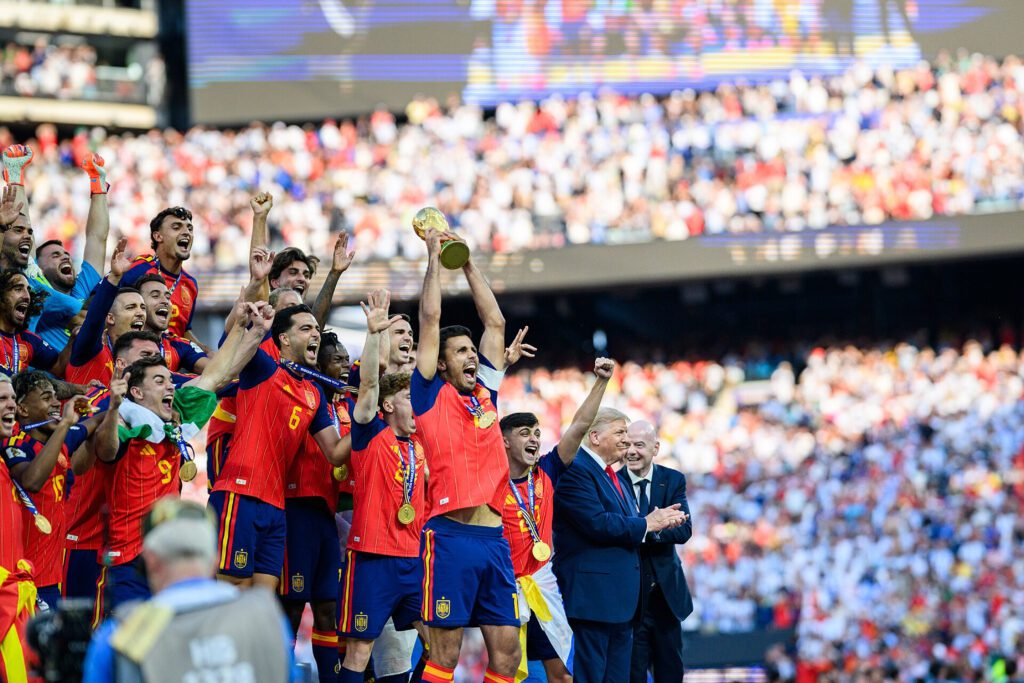
The world’s biggest sporting event is no longer insulated from global politics. The 2026 World Cup revealed how international conflict, political ambition, and FIFA’s commercial interests have come to shape the beautiful game, raising questions about its credibility and future.
Midway through extra time, as 67th-ranked Cape Verde—the smallest country to ever reach the football World Cup’s knockout stages—scored their second goal, a stunning equaliser against the number-one-ranked and defending champions Argentina, one of the tournament’s favourites, there was a phase of heightened anxiety amongst those watching. Could this island nation, an archipelago off the coast of West Africa with a population of barely 500,000, be on the cusp of causing one of the biggest upsets in the sport’s history? Playing in Miami, in fact, where Argentina’s talismanic captain Lionel Messi, the game’s greatest player of all time, plays his club football these days. A late push from the South American giants won them the Round-of-32 encounter 3–2, but it was the Africans who won hearts globally. Their fearless, spirited run through the campaign will long remain in people’s collective imagination as a symbol of hope and joy.
An unanticipated experience and emotion for many, given the widely held apprehensions over this World Cup, jointly hosted by Mexico, Canada, and, of prime concern—a Donald-Trump-governed United States (US). World Cups tend to become more than just a sporting event. They’re known to reflect the raw, real state of the world, including the underlying dynamics at play within, and between, nations. This one certainly did.