The Cabinet-approved scheme seeks to expand domestic production. Building a competitive industry will depend on more than factory capacity.
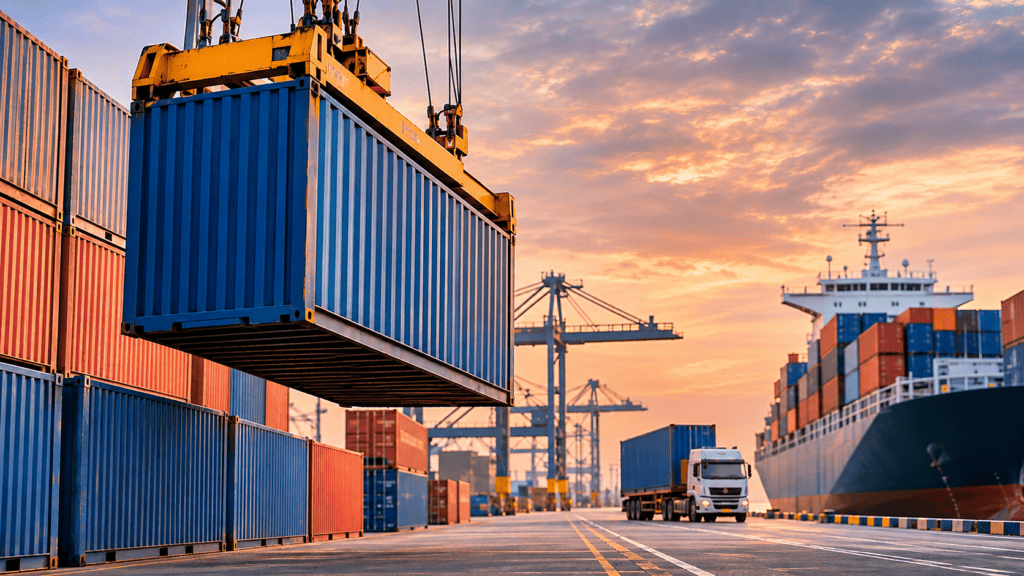
An export shipment can be delayed, even when goods are ready and a vessel booked, if an empty container is unavailable. Because standardised containers move cargo between ships, trains, and trucks without repacking, their supply affects exporters’ ability to dispatch goods and the cost of doing so. India imports nearly two million empty containers each year, according to the Ministry of Ports, Shipping and Waterways. Most of the world’s containers are made in China. The Union government wants to change India’s position in this market through a ₹10,000-crore programme approved by the Cabinet on 28 October 2026.
From Budget to Approval
The Budget announcement, the August background note, and the October Cabinet decision were successive stages of the same initiative, although the name and implementation details evolved. On 1 February, Finance Minister Nirmala Sitharaman announced a Scheme for Container Manufacturing in the Union Budget 2026–27. The Budget proposed an allocation of ₹10,000 crore over five years to create a globally competitive container manufacturing ecosystem. It established the policy commitment but did not specify the final incentive rates or eligibility conditions.
On 11 August, the Ministry of Ports, Shipping and Waterways issued a background note on the proposed Container Manufacturing Assistance Scheme (CMAS). The note described support for new factories, expansion of existing units, operational assistance, testing, skilling, and capacity building. It also set out the objective of raising annual manufacturing capacity to 7.5 lakh twenty-foot equivalent units (TEUs), though the scheme itself had yet to be approved.
The Union Cabinet approved the programme on 28 October under the name Container Manufacturing Promotion Scheme (CMPS). The Cabinet approval retains the ₹10,000-crore outlay. The Ministry’s detailed note sets the implementation period as financial year (FY) 2027–28 to FY 2039–40: three years for setting up facilities, followed by ten years of production support. The approved programme therefore has a 13-financial-year timetable, compared with the five-year period stated in the original Budget proposal and August background note. The name changed at each stage: the Budget called it the Scheme for Container Manufacturing; the August note used CMAS; the Cabinet approved CMPS.
The Import Gap
Shipping containers come in two common sizes, 20 feet and 40 feet. Capacity is measured in TEUs: a 20-foot container equals one TEU, while a 40-foot container equals two. Standard dimensions and safety requirements allow the same container to be used across different modes of transport. The scale of maritime trade explains why container availability matters. UN Trade and Development (UNCTAD) says maritime transport moves more than 80% of goods traded worldwide by volume. The Ministry’s October backgrounder says about 95% of India’s trade by volume and 70% by value moves by sea. These figures cover all maritime trade, of which containerised cargo is only a part. The Ministry projects container traffic to rise from about 24 million TEUs in 2024 to 175 million by 2047.
India’s dependence is visible in two measures. The Ministry estimates that India imports nearly two million empty containers annually, including for domestic requirements and for repositioning. The Ministry’s October note puts existing domestic manufacturing capacity at about 70,000 TEUs a year. These numbers are not directly comparable: one is an annual count of imported empty containers, while the other is manufacturing capacity measured in TEUs. Actual production has also been lower than this capacity figure. In a March 2026 reply to the Lok Sabha, the Ministry said the highest domestic production recorded up to that point was approximately 24,000 TEUs in FY 2023–24. The 70,000-TEU figure in the October announcement is therefore a current capacity estimate.
Production is highly concentrated internationally. The US Congressional Research Service, in a report updated on 26 August 2026, says China makes 95% of global shipping containers. The concentration gives Chinese manufacturers scale and an established supplier base, and Indian producers face a cost disadvantage. In February, Hasmukh Viradiya, managing director of APPL Containers, said that containers made in India were 30–40% more expensive than Chinese-made units, citing higher material costs and fewer production facilities. The figure is an industry estimate from one manufacturer.
Import dependence is most costly when routes are disrupted or freight markets tighten. The pandemic produced a severe container shortage. Geopolitical tensions and shipping diversions can again affect where empty boxes are available. Domestic factories could add another source of supply, but they cannot solve shortages caused by containers being in the wrong port or inland location, so repositioning will still matter.
What the Scheme Pays For
The Cabinet-approved ₹10,000-crore outlay is divided between four budgetary components. The largest, ₹8,891 crore, is for Operational Expenditure Assistance. Eligible manufacturers receive support for containers made to global shipping standards and sold. The Ministry lists assistance of ₹49,500 for a 20-foot container, ₹86,625 for a 40-foot container, and between ₹37,125 and ₹74,250 for a specialised 20-foot container. The stated purpose is to narrow the cost gap with imported products. A further ₹859 crore is allocated to Interest Subvention Assistance. It provides a 3% annual interest subsidy on eligible term loans taken to establish greenfield facilities or expand existing plants. Greenfield projects must have an annual capacity of at least one lakh TEUs. Brownfield projects must add at least 25,000 TEUs of annual capacity and be commissioned within three years of in-principle approval, while meeting global container standards.
The scheme sets aside ₹150 crore for common testing and certification facilities, including dynamic longitudinal impact testing. Another ₹100 crore is earmarked for scheme management, administration, monitoring, and capacity building. Eligible manufacturers may also obtain land at major ports at 25% of the notified lease rate. Operational support is tied to domestic sourcing: manufacturers must meet a minimum local-content requirement of 70% until FY 2031–32, rising to 90% from FY 2032–33. This condition is central to the scheme’s stated aim of developing domestic suppliers alongside factories that assemble finished containers.
The Supplier Challenge
A container factory needs more than steel sheets and welding equipment. The Ministry identifies specialised steel, corner castings, wooden frames, and paints as industries expected to benefit from higher production. Corner castings are fittings at the container’s corners used for lifting, securing, and stacking. A report on the scheme notes that flooring materials, protective coatings, locking mechanisms, and other hardware are also required, and that some are imported. The scheme’s local-content thresholds are intended to increase the role of Indian suppliers in this chain. Much depends on whether Indian suppliers can expand quickly enough to meet the new requirements at competitive prices. The government’s list of ancillary industries points to areas that need further development. Without components at the required scale, quality, and price, manufacturers may struggle to meet rising local-content thresholds while retaining cost competitiveness. The rules for calculating and verifying local content will matter.
Testing is another practical constraint. An export container must comply with applicable International Organization for Standardization (ISO) specifications and the International Convention for Safe Containers (CSC). A shortage of testing capacity or delays in inspection could hold up finished units before they enter shipping fleets. The ₹150-crore allocation is intended to support common facilities, but the capacity and availability of those facilities will be as important as the money allocated to them.
India has tried to create a container industry before. In September 2023, it was reported that a proposed ₹11,000-crore production-linked incentive scheme, then under Cabinet discussion, was likely to be put on hold. The report cited a global container glut, falling exports, and a slow recovery in supply chains, a sign of how quickly container demand can change with the global trade cycle.
Demand and Execution
Manufacturers will need buyers as well as financial support. The Ministry expects demand from the replacement of the global container fleet, the proposed Bharat Container Shipping Line (BCSL), and new ports such as Vadhavan and Galathea Bay. A memorandum of understanding for the BCSL was signed in February 2026, bringing together public-sector shipping, port, and finance entities. The line could provide demand for Indian-made containers, but the scheme does not guarantee manufacturers a purchase order. There is already an early commercial example: on 3 July, Maersk unveiled an India-manufactured export-import container at the Maersk-CONCOR Inland Container Depot in Dadri, Uttar Pradesh. According to Maersk’s announcement, the unit passed the company’s structural and dimensional tests under ISO 1496 and received full CSC safety approval. Maersk also placed an order with DCM Shriram Group for 1,000 additional containers. The order points to initial commercial demand, though the industry has yet to show it can supply containers at the scale envisaged by the scheme.
At the Cabinet briefing, Information and Broadcasting Minister Ashwini Vaishnaw was reported as setting an ambition for India to account for 15–20% of global container manufacturing. That figure is a stated aspiration, distinct from the scheme’s formal capacity target of 7.5 lakh TEUs a year. The government estimates around 3,000 direct jobs, more than 50,000 indirect jobs, and economic output of about ₹75,000 crore by FY 2039–40. Whether these projections materialise will depend on investment, local suppliers, testing capacity, and repeat orders from shipping lines.
The 7.5-lakh-TEU target would expand India’s annual manufacturing capacity substantially, but it would not make the country independent of imported containers. Nor would it, by itself, guarantee lower logistics costs. Success turns on whether India can make containers consistently, to international standards, and at prices that attract buyers. The Maersk order provides an early indication that this is possible, and the Cabinet-approved scheme is an attempt to turn that initial capability into an industry.
Note: This explainer has been researched, edited, and fact-checked by India’s World staff and prepared with AI assistance.