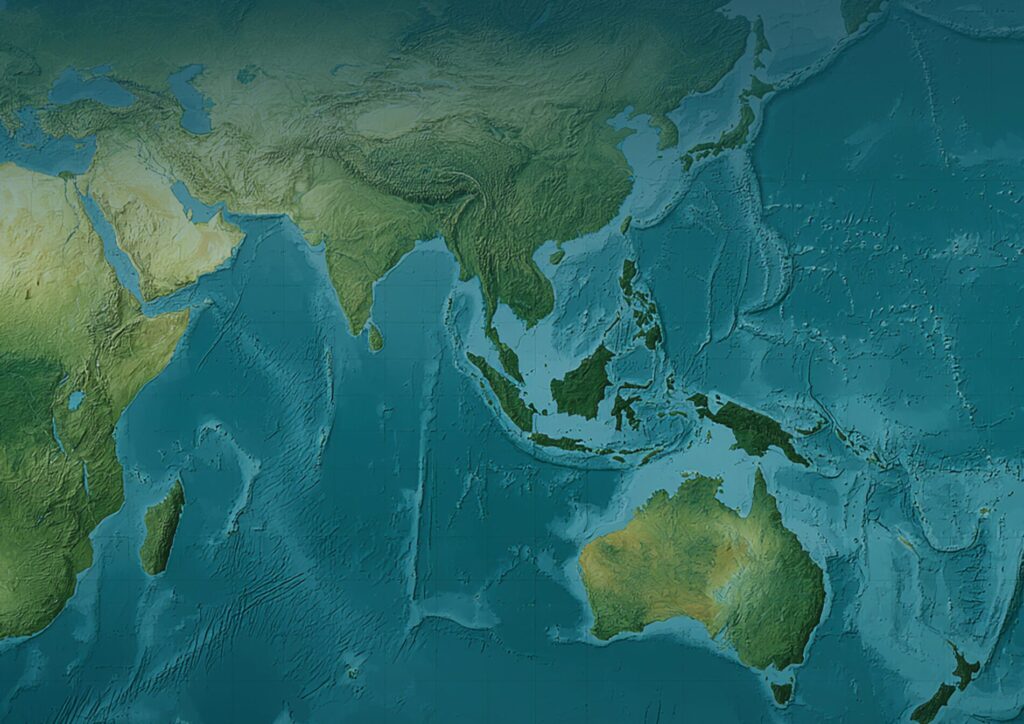
For centuries, the Indian and Pacific Oceans were linked through vibrant maritime trade networks, connecting the ports of the Indian subcontinent with those of Southeast Asia, East Asia, the Arabian Peninsula, and East Africa. Guided by the monsoon winds, Arab, Indian, Chinese, and Southeast Asian merchants carried not only spices, silk, and precious goods, but also religions, cultures, technologies, and ideas that shaped the region’s civilisations. Today, these waters remain one of the world’s busiest maritime highways, carrying around 60% of global maritime trade and nearly two-thirds of global seaborne oil shipments. It is little surprise, then, that this maritime space has emerged as the geopolitical centre of gravity of the twenty-first century. As strategic competition intensifies, countries have developed distinct visions for engaging with the region. Whether it is the Indo-Pacific, Asia-Pacific, Free and Open Indo-Pacific (FOIP), or MAHASAGAR, the terminology reflects competing strategic priorities and different conceptions of regional order. The following snapshot shows how major powers describe the region and what those choices reveal about their strategic vision.
India
Strategy: Indo-Pacific Oceans Initiative (IPOI) and MAHASAGAR
Preferred vocabulary: Indo-Pacific
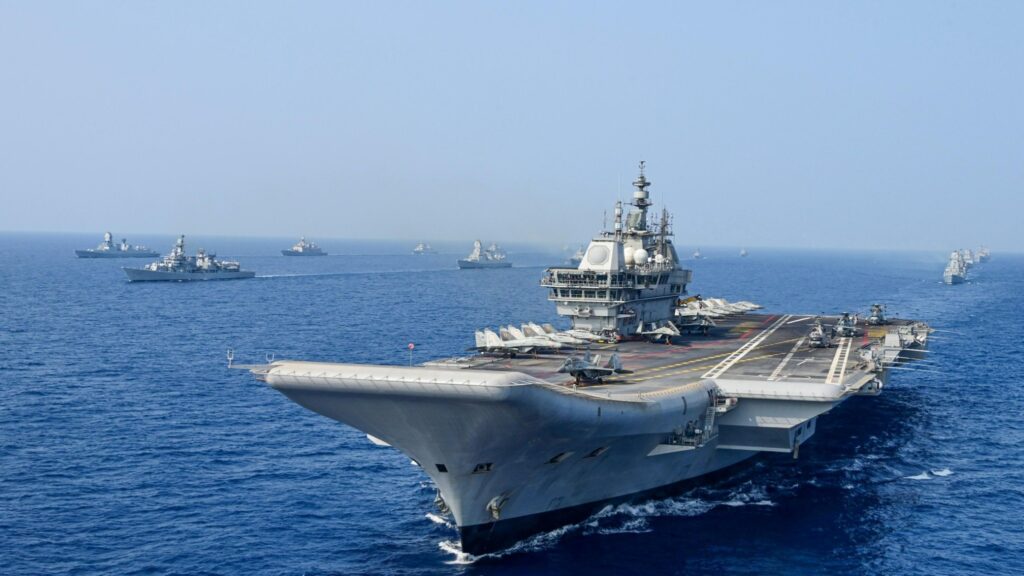
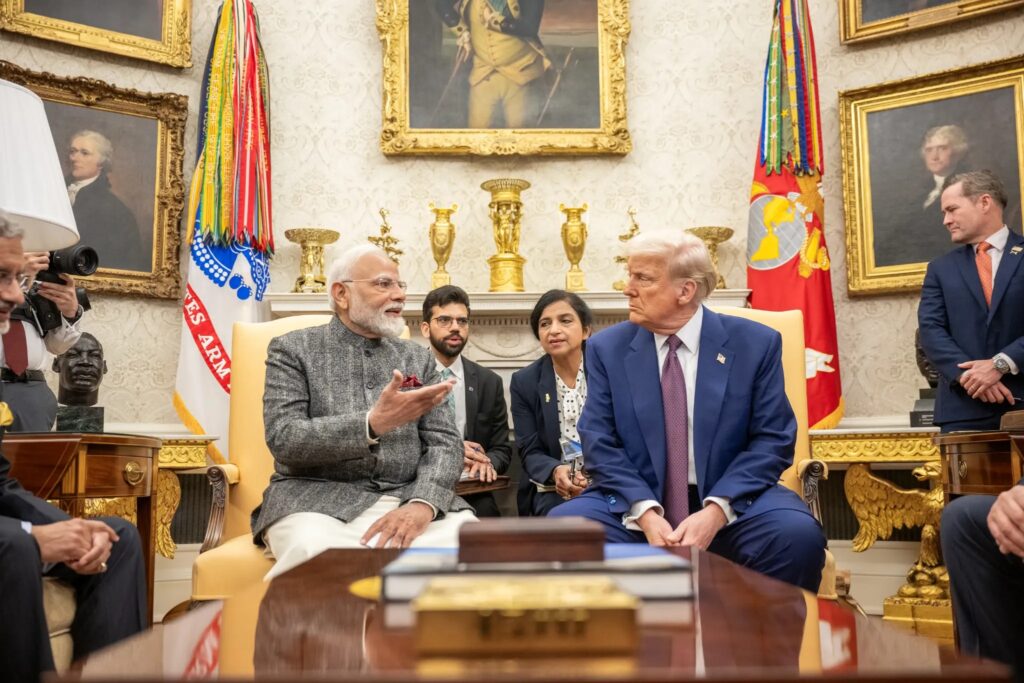
India sees the Indian and Pacific Oceans as one interconnected strategic space. Since Prime Minister Narendra Modi’s 2018 Shangri-La Dialogue speech, the Indo-Pacific has become the organising principle of India’s maritime strategy. In 2019, India launched the Indo-Pacific Oceans Initiative (IPOI), while in 2025 it introduced MAHASAGAR (Mutual and Holistic Advancement for Security and Growth Across Regions), broadening its maritime vision to include capacity-building, connectivity, and inclusive maritime cooperation.
Key message: An open, inclusive, and multipolar maritime order.
Japan
Strategy: Free and Open Indo-Pacific (FOIP)
Preferred vocabulary: FOIP
Japan gave the Indo-Pacific its defining strategic vocabulary. Shinzo Abe’s 2007 “Confluence of the Two Seas” speech laid the intellectual foundations, and Tokyo formally adopted Free and Open Indo-Pacific (FOIP) in 2016. Today, Japan presents FOIP as a framework built on freedom of navigation, rule of law, quality infrastructure, resilience, and economic security.
Key message: A rules-based regional order built around shared values.
United States
Strategy: U.S. Indo-Pacific Strategy
Preferred vocabulary: Indo-Pacific
The Trump administration formally adopted the term “Indo-Pacific” in 2017, replacing the long-standing “Asia-Pacific” in official strategic documents, and recognising India’s central role in regional geopolitics. The Biden administration retained the concept while broadening it beyond military competition to include technology, supply chains, infrastructure, and partnerships through the Quad, AUKUS, and ASEAN.
Key message: A free, open, connected, secure, and resilient Indo-Pacific.
Australia
Strategy: Australia’s Indo-Pacific approach
Preferred vocabulary: Indo-Pacific
Australia was among the first countries to adopt the term officially in its 2013 Defence White Paper. Canberra views the Indian and Pacific Oceans as a single strategic theatre and prioritises maritime security, regional resilience, and alliance cooperation.
Key message: Stability through a rules-based maritime order.
France
Strategy: France’s Indo-Pacific Strategy
Preferred vocabulary: Indo-Pacific
With overseas territories and nearly two million citizens in the region, France considers itself an Indo-Pacific power rather than an external actor. Paris focuses on maritime security, climate action, strategic autonomy, and partnerships while avoiding an explicitly anti-China posture.
Key message: A sovereign European presence in the Indo-Pacific.
European Union
Strategy: EU Strategy for Cooperation in the Indo-Pacific
Preferred vocabulary: Indo-Pacific
The EU’s 2021 strategy emphasises sustainable connectivity, digital governance, green transition, maritime security, and resilient supply chains rather than military competition.
Key message: Strategic engagement without bloc politics.
United Kingdom
Strategy: Indo-Pacific Tilt
Preferred vocabulary: Indo-Pacific
As part of its post-Brexit “Global Britain” vision, the UK adopted an “Indo-Pacific Tilt” in the 2021 Integrated Review, deepening defence and economic engagement through AUKUS, the CPTPP, and regional partnerships.
Key message: Greater British engagement east of Suez.
South Korea
Strategy: Strategy for a Free, Peaceful and Prosperous Indo-Pacific
Preferred vocabulary: Indo-Pacific
Initially cautious, Seoul formally adopted an Indo-Pacific strategy in 2022. It deliberately avoids framing the concept as anti-China, instead emphasising economic security, critical technologies, supply chains, climate cooperation, and ASEAN centrality.
Key message: Inclusivity without confrontation.
ASEAN
Strategy: ASEAN Outlook on the Indo-Pacific (AOIP)
Preferred vocabulary: Indo-Pacific
Rather than endorsing the strategic competition associated with some Indo-Pacific narratives, ASEAN adopted its own ASEAN Outlook on the Indo-Pacific (AOIP) in 2019. The AOIP prioritises dialogue, inclusivity, development, and ASEAN centrality.
Key message: Cooperation over confrontation.
China
Strategy: Belt and Road Initiative (BRI), Global Development Initiative (GDI), Global Security Initiative (GSI)
Preferred vocabulary: Asia-Pacific
China rejects the Indo-Pacific as an artificial geopolitical construct designed to contain its rise. Instead, Beijing continues to speak of the Asia-Pacific, while promoting the Belt and Road Initiative and its newer Global Initiatives as alternative frameworks for regional cooperation.
Key message: Economic integration, not military blocs.
Russia
Strategy: Greater Eurasian Partnership
Preferred vocabulary: Asia-Pacific
Russia remains sceptical of the Indo-Pacific concept, arguing that it divides the region into competing blocs. Moscow instead promotes the Greater Eurasian Partnership and continues to use Asia-Pacific in official discourse.
Key message: Multipolar Eurasia over Indo-Pacific geopolitics.
North Korea
Strategy: No dedicated regional strategy
Preferred vocabulary: Rejects Indo-Pacific
Pyongyang does not offer an alternative regional framework but consistently condemns the Indo-Pacific Strategy as an American-led military project linked to the Quad, AUKUS, and trilateral cooperation among the US, Japan, and South Korea.
Key message: Opposition to US-led alliance structures.