States have been making security arrangements with one another for centuries. In ancient Greece, the Peloponnesian League, led by Sparta, brought together city-states in a military alliance by the sixth century BCE, while the Delian League, formed under Athenian leadership in 478 BCE, united Greek states against the Persian threat. The logic was already recognisable: states that felt vulnerable alone could become more secure by pooling their military strength with others. European powers later refined this practice through shifting coalitions and balance-of-power politics. After the Napoleonic Wars, the Concert of Europe sought to preserve peace through cooperation among the Great Powers. By the eve of the First World War, Europe had hardened into rival alliance groupings, most prominently the Triple Alliance of Germany, Austria-Hungary and Italy and the Triple Entente of Britain, France and Russia.
The experience of two world wars transformed the idea of the security alliance. Instead of relying primarily on temporary coalitions formed for particular wars, states increasingly sought permanent arrangements built around collective defence. The devastating experience of two world wars, the emergence of the Soviet Union as a dominant power in Eastern Europe and the division of Europe into rival political blocs gave this idea a new urgency. The question was no longer simply how states could win a war together, but how they could deter one from occurring in the first place.

NATO became the most successful and enduring expression of this new model. Its immediate origins lay in the Brussels Treaty of March 1948, through which Britain, France, Belgium, the Netherlands and Luxembourg committed themselves to mutual defence. British Foreign Secretary Ernest Bevin pushed for a broader Western security arrangement, while negotiations with the United States and Canada eventually produced a transatlantic pact. The Berlin Blockade of 1948, the communist takeover in Czechoslovakia and growing Western fears of Soviet expansion strengthened the case for an American security commitment to Europe. On 4 April 1949, 12 countries signed the North Atlantic Treaty, or Washington Treaty, in Washington, D.C., creating NATO. US Secretary of State Dean Acheson was among the principal architects of the negotiations. The founding members were Belgium, Canada, Denmark, France, Iceland, Italy, Luxembourg, the Netherlands, Norway, Portugal, the United Kingdom and the United States.
At the heart of the new alliance was Article 5, under which an armed attack against one member would be considered an attack against all. NATO was created principally to deter Soviet aggression and contain the expansion of Soviet power in Europe, but its institutional design helped it outlive the Cold War itself. Unlike many earlier or contemporary pacts, it developed permanent political and military structures, integrated defence planning and common command arrangements. It expanded from its original 12 members to 32, with Finland and Sweden joining in 2023 and 2024. Article 5 has been invoked only once, following the 11 September 2001 attacks on the United States. Today, Russia’s war against Ukraine has once again placed territorial defence, deterrence and collective military preparedness at the centre of the alliance.
NATO, however, was only one part of a much larger history of collective security. The Cold War produced rival and regional arrangements such as SEATO, the Baghdad Pact/CENTO and the Warsaw Pact, while other frameworks emerged in the Pacific, the Americas, the Arab world and the post-Soviet space. Some disappeared when the circumstances that produced them vanished; others survived by adapting to new strategic realities. ANZUS, the Rio Treaty, the Arab League’s Joint Defence Treaty, the CSTO, the GCC’s defence arrangements and the Five Power Defence Arrangements represent different versions of the same enduring idea: that states may be safer together than alone. The Makkah Joint Defence Agreement, signed by Pakistan, Saudi Arabia and Türkiye in August 2026, is the latest addition to this long and often turbulent history of security alliances. Its collective-defence provision deliberately echoes the principle that has become synonymous with NATO.

The following are some of the major security pacts and collective-defence arrangements that emerged in the decades after the Second World War—some enduring, some transformed, and some now consigned to history.
Rio Treaty
The Inter-American Treaty of Reciprocal Assistance, better known as the Rio Treaty or TIAR, was signed in Rio de Janeiro on 2 September 1947, making it one of the earliest post-Second World War collective-defence arrangements. It sought to establish a common security framework for the Western Hemisphere, before NATO came into existence.
The treaty emerged as the United States and its neighbours were beginning to construct a more formal post-war security architecture. It subsequently became an important component of the inter-American system alongside the Organization of American States (OAS), founded in 1948.
The Rio Treaty was invoked during several Cold War crises, but its limitations became particularly visible during the 1982 Falklands/Malvinas War. Argentina invoked the treaty, but the United States supported Britain, demonstrating how the strategic interests of an alliance’s members could override a formal collective-security commitment.
The treaty remains in force among a reduced group of parties, but its political and strategic importance has declined considerably. Unlike NATO, it survived without becoming the central security institution of its region.
Brussels Treaty / Western Union
Before NATO, five Western European countries created their own collective-defence arrangement. On 17 March 1948, Belgium, France, Luxembourg, the Netherlands and the United Kingdom signed the Treaty of Economic, Social and Cultural Collaboration and Collective Self-Defence, commonly known as the Brussels Treaty. It established the Western Union and committed its members to mutual assistance in the event of armed attack.
The pact emerged amid growing fears of Soviet expansion and was partly a response to the communist takeover in Czechoslovakia in February 1948. Britain, in particular, wanted a stronger Western European security structure while recognising that European states alone lacked the military capacity to deter the Soviet Union.
The Brussels Treaty became an important stepping stone toward NATO. The United States was initially reluctant to enter a peacetime military alliance, but the Vandenberg Resolution of June 1948 helped clear the way for American participation in a collective-defence system. The Western European states ultimately joined the wider transatlantic arrangement created by the North Atlantic Treaty in 1949.
The Western Union therefore did not simply disappear; its defence functions were incorporated into the emerging NATO system. Its later institutional successor, the Western European Union, survived until 2011.
Arab League Joint Defence Treaty
The Treaty of Joint Defence and Economic Cooperation between the States of the Arab League was signed in Cairo on 17 June 1950, creating an early Arab collective-defence framework. Among its original signatories were Egypt, Iraq, Jordan, Lebanon, Saudi Arabia, Syria and Yemen.
Its collective-defence language was strikingly similar to the principle that would become associated with NATO. The treaty provided that armed aggression against one or more member states would be considered aggression against all. It also established a Permanent Military Commission, tasked with preparing joint defence plans and coordinating the armed forces of member states.
The arrangement was designed to give Arab states a mechanism for collective military action while preserving their sovereignty. In practice, however, political divisions among Arab governments repeatedly limited its effectiveness. Arab states did cooperate militarily during major conflicts, but the treaty never produced a permanently integrated Arab military structure comparable to NATO.
The treaty remains part of the Arab League’s institutional framework, but its history illustrates a recurring problem in collective defence: a common treaty does not necessarily produce a common strategic outlook.
ANZUS
The Australia, New Zealand and United States Security Treaty (ANZUS) was signed in San Francisco on 1 September 1951 and entered into force in 1952. It emerged from the security anxieties of the early Cold War and the experience of Australia and New Zealand fighting alongside the United States in the Pacific during the Second World War.
Unlike NATO, ANZUS did not create an integrated military command. Its members committed themselves to consultation and to acting through their constitutional processes in response to common dangers. Australia and New Zealand subsequently fought alongside the United States in Korea and Vietnam, although the treaty itself was never formally invoked for those conflicts.
The trilateral relationship changed dramatically in the 1980s. New Zealand’s nuclear-free policy led to a dispute over visits by US naval vessels, and in 1986 Washington suspended its security obligations toward New Zealand under the treaty. The treaty itself was not terminated. Australia–US defence cooperation continued and became increasingly close, while New Zealand maintained a separate defence relationship with Australia.
ANZUS therefore survives, but its practical expression is very different from the trilateral alliance originally envisaged.
SEATO
The Southeast Asia Treaty Organization (SEATO) emerged in the aftermath of the Korean War, the communist victory in China and the French defeat at Dien Bien Phu. Eight countries signed the Southeast Asia Collective Defense Treaty, or Manila Pact, in Manila on 8 September 1954: Australia, France, New Zealand, Pakistan, the Philippines, Thailand, the United Kingdom and the United States. It entered into force in February 1955.
Despite its name, most of its members were outside Southeast Asia. Its principal purpose was to contain communist expansion in the region and provide a political framework for collective action.
SEATO, however, never developed NATO’s integrated military machinery. It had no standing army or comparable permanent military command, and its collective response provisions relied heavily on consultation and national decisions.
Pakistan eventually concluded that the organisation offered it little protection in its confrontation with India and withdrew in 1973. With the end of the Vietnam War, much of SEATO’s original strategic rationale disappeared.
The organisation was formally dissolved on 30 June 1977, becoming one of the clearest examples of a Cold War alliance that failed to outlive the strategic circumstances that created it.
Baghdad Pact / CENTO
The Baghdad Pact began with a mutual-cooperation agreement between Iraq and Türkiye, signed in Baghdad on 24 February 1955. Britain joined in April, followed by Pakistan in September and Iran in November. Although Washington did not formally join, it participated in several of the pact’s committees and maintained close military and political links with the organisation.
The pact was part of the Western strategy of containing Soviet influence by creating a security belt along the Soviet Union’s southern flank. Washington saw Türkiye and Pakistan as particularly important links between NATO’s southern flank and the Middle East and South Asia.
But the members did not share identical strategic priorities. The 1956 Suez Crisis damaged British prestige in the region, while the 1958 Iraqi revolution brought down the monarchy and led Iraq to withdraw from the pact. After Iraq withdrew in 1959, the remaining members reorganised the pact as the Central Treaty Organization (CENTO).
CENTO never developed NATO’s integrated military command or armed forces. Over time, it became more useful for economic and technical cooperation than collective defence. The Iranian Revolution of 1979 brought the organisation’s principal regional pillar down, while Pakistan also withdrew that year.
CENTO formally disbanded in 1979.
Warsaw Pact
The Warsaw Treaty Organization, commonly known as the Warsaw Pact, was established on 14 May 1955, just days after West Germany joined NATO. The Soviet Union, Albania, Bulgaria, Czechoslovakia, East Germany, Hungary, Poland and Romania signed the treaty. Moscow presented it as a collective-defence response to NATO and West German rearmament.
On paper, the members pledged mutual assistance and collective defence. In practice, the alliance was dominated by the Soviet Union and became an important instrument of Moscow’s control over Eastern Europe. Albania withdrew in 1968 as its relationship with Moscow deteriorated.
The Pact began to unravel when communist governments across Eastern Europe collapsed in 1989. East Germany left ahead of German reunification, while other members dismantled their military cooperation.
Its military structures were dissolved in February 1991, and the organisation formally ceased to exist in July 1991.
The Warsaw Pact’s fate contrasted sharply with NATO’s. Both were products of the same Cold War confrontation, but when that confrontation ended, one alliance adapted while the other disappeared with the political system that had sustained it.
Five Power Defence Arrangements
The Five Power Defence Arrangements (FPDA) were established on 1 November 1971, as Britain withdrew much of its military presence east of Suez. Australia, Malaysia, New Zealand, Singapore and the United Kingdom agreed to consult one another if Malaysia or Singapore faced external armed aggression or the threat of it.
The FPDA is deliberately different from NATO. It does not contain an automatic collective-defence obligation. Its central commitment is consultation, rather than a promise that all five countries will automatically go to war together.
Yet the arrangement developed substantial practical military cooperation. It established an integrated air-defence system and evolved into a framework for regular exercises involving the five countries’ air, naval and land forces. Over time, its activities expanded beyond their original focus to encompass the wider strategic environment of the Indo-Pacific.
Its longevity is partly explained by its modest design. Rather than attempting to create a large permanent alliance, the FPDA has concentrated on interoperability, training and the ability of its members to operate together.
More than five decades after its creation, it remains active. It demonstrates that a security arrangement does not necessarily need NATO-style treaty obligations to produce meaningful and durable military cooperation.
GCC Defence Framework
The Gulf Cooperation Council (GCC) was established in Abu Dhabi on 25 May 1981 by Bahrain, Kuwait, Oman, Qatar, Saudi Arabia and the United Arab Emirates. Although the GCC was created as a broader political, economic and security organisation, defence cooperation became increasingly important after the Iranian Revolution of 1979, the Iran–Iraq War and Iraq’s invasion of Kuwait in 1990.
The Peninsula Shield Force, established in 1984, became the GCC’s principal joint military formation.
The GCC has never developed into a NATO-style integrated alliance. Political differences among its members have repeatedly complicated deeper military integration. The 2017–2021 Gulf diplomatic crisis, when Saudi Arabia, the UAE and Bahrain joined Egypt in isolating Qatar, demonstrated how divergent political interests could affect intra-GCC security cooperation.
Nevertheless, the GCC defence framework remains active.
CSTO
The Collective Security Treaty Organization (CSTO) grew out of the security vacuum created by the collapse of the Soviet Union. Its foundation was the Collective Security Treaty, signed in Tashkent on 15 May 1992 by several former Soviet republics. The CSTO was subsequently established as a formal international organisation in 2002.
Its collective-defence principle resembles NATO’s Article 5: aggression against one member is regarded as aggression against all, with members committed to providing assistance, including military assistance. It has developed joint exercises, military cooperation and rapid-reaction capabilities.

The CSTO demonstrated that it could act collectively when its members agreed to do so. In January 2022, CSTO forces were deployed to Kazakhstan at the government’s request during a period of severe unrest.
But its cohesion has been increasingly questioned. Armenia, a founding participant in the 1992 treaty and a CSTO member, has progressively distanced itself from the organisation, arguing that it failed to provide adequate support amid its conflict with Azerbaijan.
The CSTO remains active and Russian-led, with Russia, Belarus, Armenia, Kazakhstan, Kyrgyzstan and Tajikistan formally belonging to it. Its experience nevertheless illustrates the gap that can exist between a treaty commitment and a genuinely shared strategic outlook.
Makkah Joint Defence Agreement
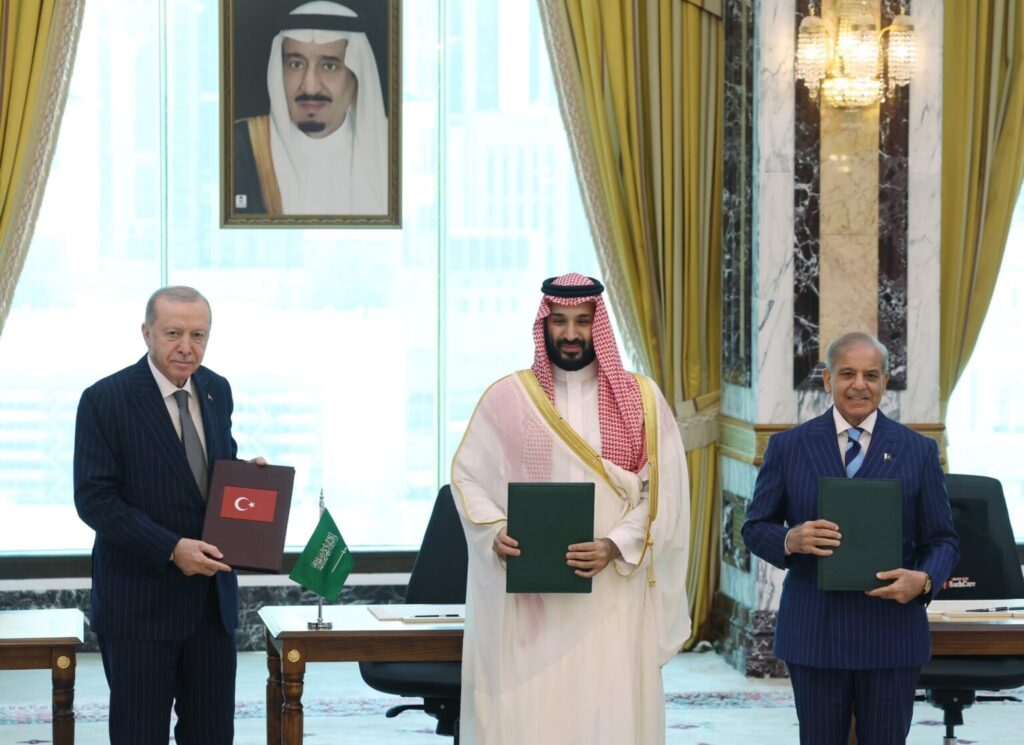
The Makkah Joint Defence Agreement was signed in Makkah on 7 August 2026 by Saudi Crown Prince and Prime Minister Mohammed bin Salman, Turkish President Recep Tayyip Erdoğan and Pakistani Prime Minister Shehbaz Sharif. The agreement states that an armed attack against any one of the three countries will be regarded as an attack against all three, directly echoing the collective-defence logic associated with NATO’s Article 5.
The pact builds on longstanding defence relationships among the three states. Pakistan brings a large military and nuclear capability; Türkiye brings one of NATO’s largest armed forces and a substantial defence industry; and Saudi Arabia brings considerable economic resources and strategic weight in the Gulf.
At the first meeting of its Strategic Political and Defence Committee in Istanbul on 31 August 2026, the three countries agreed to establish a permanent secretariat in Saudi Arabia, initially headed by a Pakistani secretary-general for three years. They also agreed to deepen defence-industry cooperation, joint technology development and production.
The Makkah Pact is still at the beginning of its institutional life. Whether it becomes a durable alliance or another short-lived experiment in collective defence will depend on whether its political commitment develops into sustained military cooperation, interoperability and strategic cohesion.