The term “Indo-Pacific” is usually associated with its twenty-first-century revival by Japanese and Australian strategists. Yet six decades earlier, it was already being used to frame a different strategic question. On 11 September 1965, a seminar convened by the Defence Studies Project of the Australian Institute of International Affairs at the Australian National University asked whether the Commonwealth of Nations carried collective security responsibilities across the Indian and Pacific Oceans. Among its participants was M. S. Rajan, Professor of Commonwealth Studies at India’s Indian School of International Studies.
This timeline traces that largely forgotten debate through the political, institutional and military choices that followed—from Britain’s withdrawal east of Suez and the emergence of new security arrangements to the United States’ formal adoption of the term in 2018 and its symbolic partial retreat in June 2026. Together, these milestones reveal how the Commonwealth first debated the Indo-Pacific as a strategic space, but never became the institution that organised it.
Convening the Question (1963–1966)
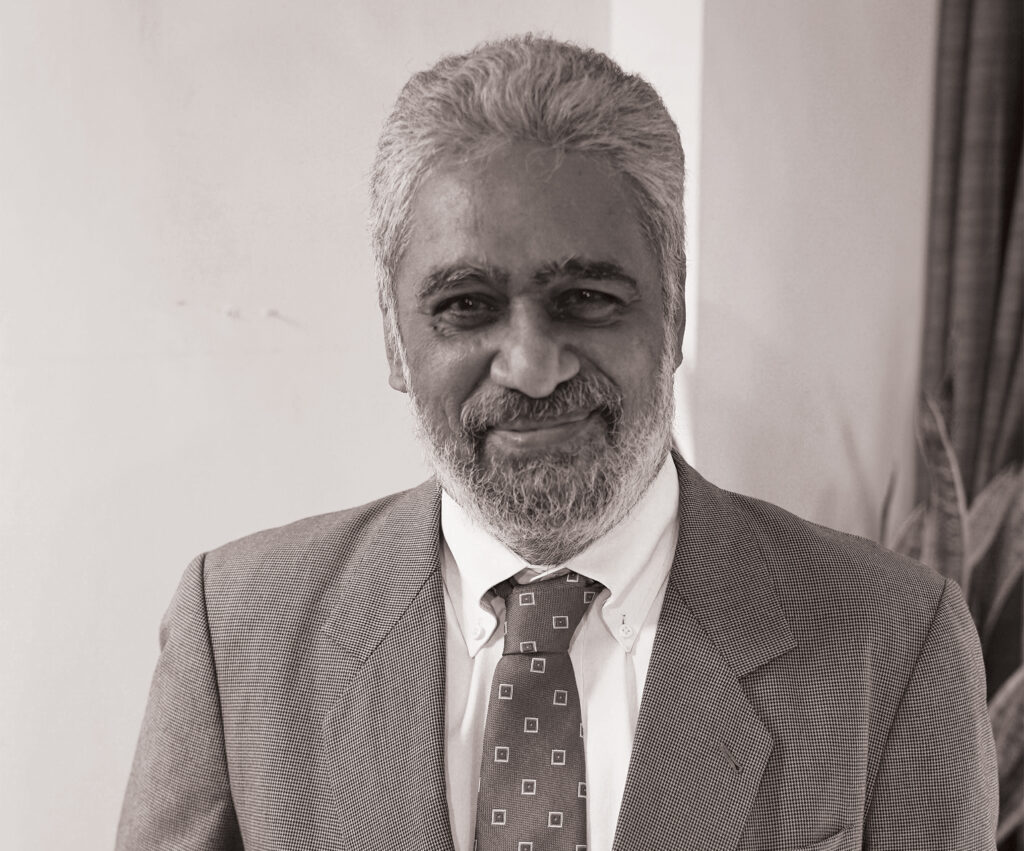
1963: Two years before the Canberra seminar, M. S. Rajan published India and the Commonwealth in International Studies, arguing that Commonwealth ties rested on consultation, habit and shared history rather than binding defence obligations. It was the position he would bring to the 1965 discussions.
1965: Commonwealth prime ministers meeting in London agreed to establish a permanent Commonwealth Secretariat. On 1 July, the Canadian diplomat Arnold Smith took office at Marlborough House as its first Secretary-General—the association’s first standing institution in its modern form. The Commonwealth had acquired its first permanent institution, but not one responsible for collective security.
1965: The same London conference exposed the limits of Commonwealth strategic cooperation. On 17 June, Prime Minister Harold Wilson announced in the House of Commons that Commonwealth heads of government had agreed to launch a peace mission to Vietnam. Neither Hanoi nor Washington embraced the initiative, and it quietly lapsed within months, demonstrating the Commonwealth’s inability to act collectively on hard-security questions.
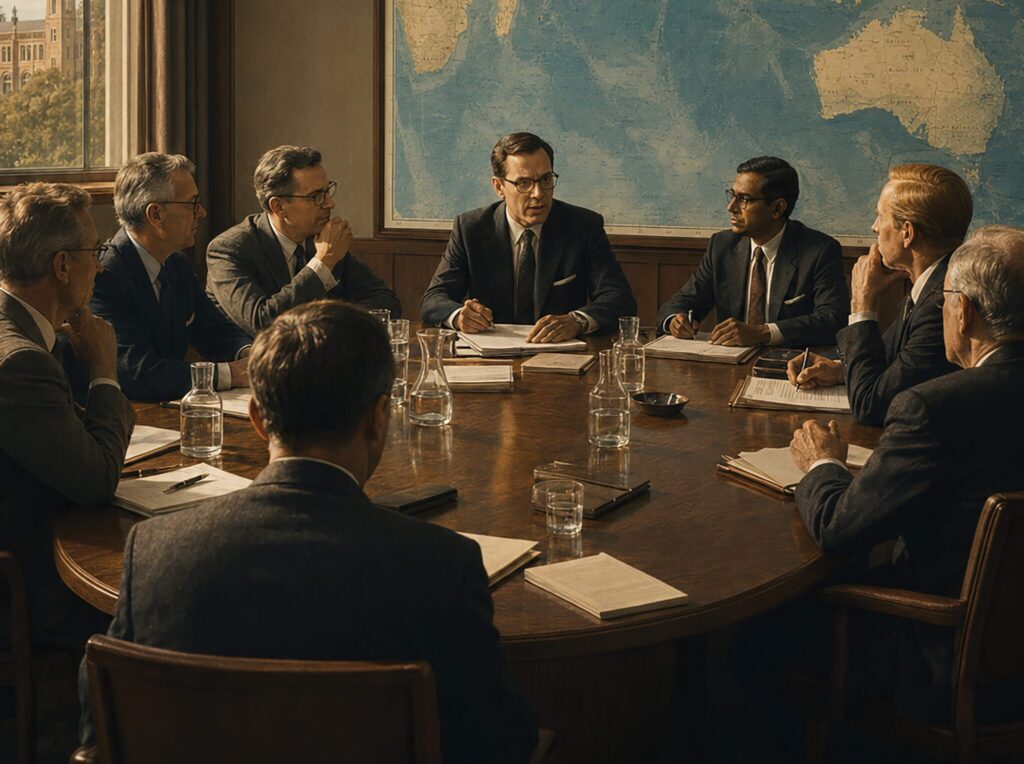
1965: On 11 September, scholars, officials and strategic thinkers gathered at the Australian National University under the chairmanship of political scientist Arthur Lee Burns for a seminar entitled Commonwealth Responsibilities for Security in the Indo-Pacific Region. Organised by the Defence Studies Project of the Australian Institute of International Affairs, it posed a fundamental question: Did Commonwealth membership imply collective security responsibilities across the Indian and Pacific Oceans? Among the participants was M. S. Rajan. As the meeting convened, India and Pakistan were still at war, with a UN-mandated ceasefire ten days away.
1965: In November, an Order in Council detached the Chagos Archipelago from the Crown Colony of Mauritius to create the British Indian Ocean Territory. The following year, Britain made the territory available for a joint UK–US military base on Diego Garcia. The strategic future of the Indian Ocean was thus shaped through an Anglo-American partnership rather than Commonwealth institutions.
1966: The seminar proceedings were published as Commonwealth Responsibilities for Security in the Indo-Pacific Region, with a preface and a postscript, “Interdependence in Defence,” by Arthur Lee Burns. Rajan, who had become Director of the Indian School of International Studies in 1965, continued to argue that Commonwealth sentiment carried little strategic significance for India’s non-aligned foreign policy.
1966: Presenting the Statement on the Defence Estimates 1966 (Cmnd 2901–2902), Defence Secretary Denis Healey reaffirmed Britain’s commitment to maintaining bases in Singapore and defending Malaysia. It proved to be London’s last major pledge to sustain a permanent military role east of Suez.
1966: Konfrontasi—Indonesia’s undeclared confrontation with Malaysia—came to an end, removing much of the strategic rationale for maintaining large British forces in Southeast Asia. Within months, the assumptions underpinning the Canberra discussions had already begun to shift.
Withdrawal and a Narrower Answer (1967–1971)
1967: Sterling’s troubles caught up with Denis Healey’s promises. Opening the Commons defence debate on the supplementary Statement on Defence (Cmnd 3203), the Defence Secretary confirmed the accelerated withdrawal of British forces from Singapore, Malaysia, Malta, Libya, and the Persian Gulf, reversing the previous commitment to maintain a military role east of Suez.
1968: In January, the Wilson government announced that Britain would relinquish its East of Suez role entirely by the end of 1971, closing bases across the Gulf and Southeast Asia and bringing to an end what a later Chatham House retrospective described as “a major, enduring world-wide military role.”
1971: The strategic vacuum was filled not by a Commonwealth-wide security arrangement of the kind debated in Canberra in 1965, but by a much narrower arrangement. Australia, Malaysia, New Zealand, Singapore and the United Kingdom concluded the Five Power Defence Arrangements (FPDA), replacing the Anglo-Malayan Defence Agreement with a consultative framework that obliged the five governments to consult rather than automatically intervene. The arrangements entered into force on 1 November 1971. India—the Commonwealth’s largest member and the country whose war had framed the 1965 seminar—was not a party.
The Term’s Rise, Formalisation and Retreat (2007–2026)
2007: The modern revival of the term Indo-Pacific is usually traced to 22 August, when Japanese Prime Minister Shinzo Abe addressed both houses of India’s Parliament in his speech, “Confluence of the Two Seas”. Describing the Pacific and Indian Oceans as “bringing about a dynamic coupling,” Abe provided the formulation that Japanese and Australian strategists would subsequently develop into the contemporary Indo-Pacific concept.
2018: On 30 May, US Defense Secretary James Mattis redesignated US Pacific Command as US Indo-Pacific Command at a change-of-command ceremony in Hawaii. Explaining that the new title reflected “the increasing connectivity between the Indian and Pacific Oceans,” Mattis incorporated into the formal name of America’s largest combatant command a strategic geography first debated in Commonwealth circles more than half a century earlier.
2021–2022: The institutional architecture of the Indo-Pacific continued to develop through selective coalitions rather than Commonwealth structures. Australia, the United Kingdom, and the United States announced the AUKUS security partnership in September 2021, while Washington’s 2022 Indo-Pacific Strategy identified the Quad—Australia, India, Japan, and the United States—as its principal regional grouping. The Commonwealth remained absent from the region’s emerging security architecture.
2026: On 16 June, the Department of War announced that USINDOPACOM would revert to its pre-2018 designation, US Pacific Command, removing “Indo” from the command’s title while leaving its mission and area of responsibility unchanged.
As the Indo-Pacific once again dominates strategic debate, it is worth remembering that the region was first debated as a shared strategic space within a Commonwealth context. Yet the Commonwealth never developed the institutions needed to translate that debate into a collective security architecture. Instead, the Indo-Pacific’s strategic framework evolved through US-led alliances and minilateral partnerships. The 2026 restoration of the name US Pacific Command has generated fresh debate over the future of the term, even as the strategic logic of the Indo-Pacific continues to shape regional security.