
Foreign policy has traditionally been communicated in a language designed for people who already follow foreign policy: diplomatic statements, press briefings, official communiqués and carefully worded responses. Social media has changed that equation. Diplomacy can now be communicated in real time, directly to the public and in formats designed not only to inform but also to attract attention and invite interaction. The photograph, the short video, the hashtag and even the comment section have become part of diplomatic communication. Diplomacy is no longer confined to the negotiating room or the press briefing; increasingly, it is also public, immediate and performative.
Instagram offers a particularly interesting window into this transformation. Its visual-first format and strong appeal among younger users make it different from social media in general. For a foreign ministry, Instagram is not simply another place to reproduce a press release. It is a space where foreign policy has to compete for attention in a fast-moving feed.
Likes, comments, shares and reposts cannot tell us exactly who is engaging with a post or why. But they can offer clues. Looking at selected recent posts on the Ministry of External Affairs’ Instagram handle from January 2025 onwards, this explainer asks a simple question: what kinds of India’s foreign-policy stories appear to make a younger digital audience stop scrolling and engage?
They Like It When India Responds Strongly
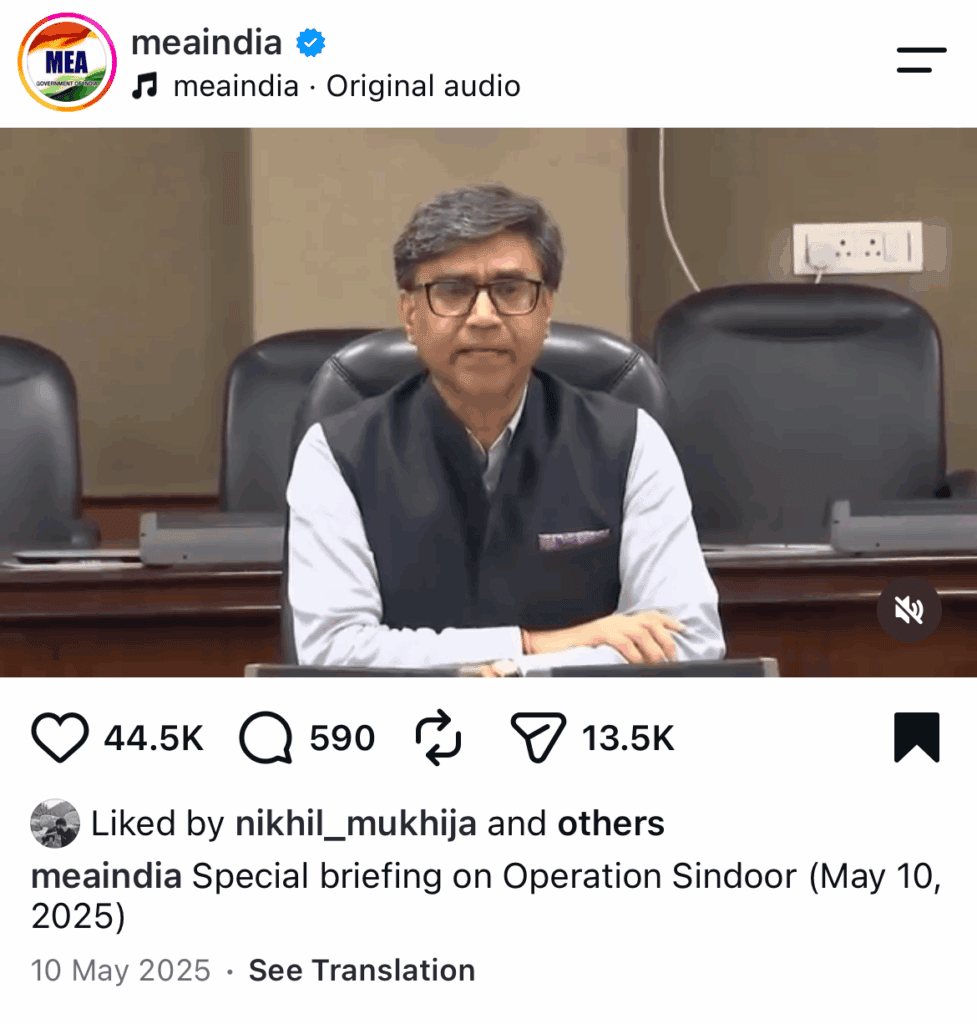
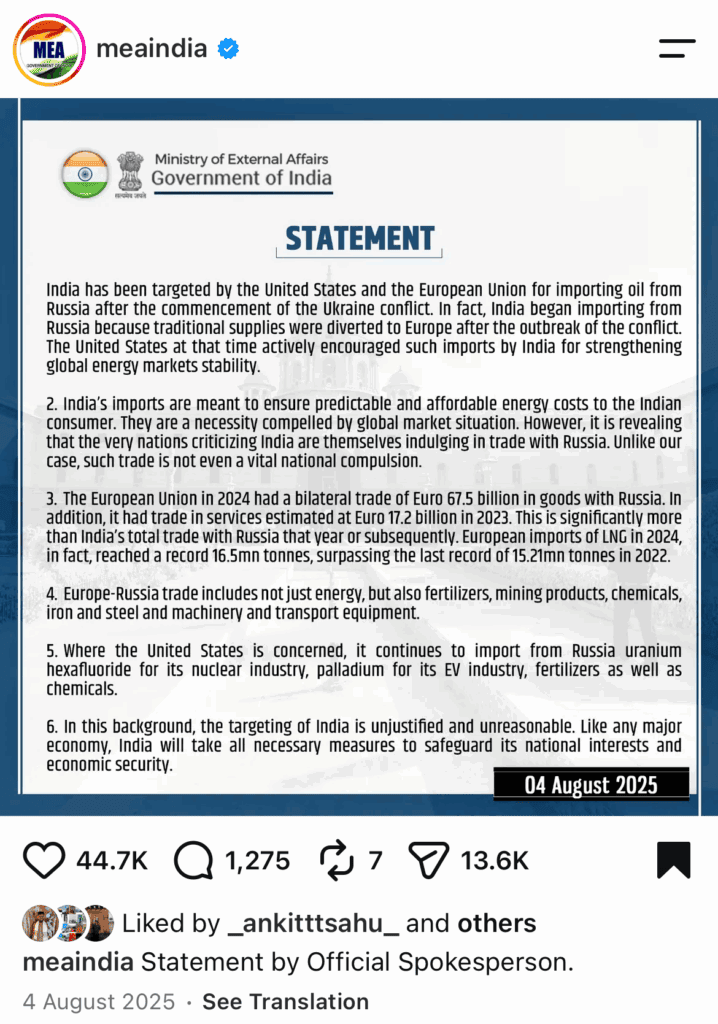
Some of the most strikingly engaged posts in the sample are not photographs of leaders or announcements of diplomatic visits. They are strongly worded responses to international developments.
In August 2025, MEA published a statement on India’s imports of Russian oil following criticism from the United States and the European Union. The statement defended India’s position and argued that the imports were necessary to ensure predictable and affordable energy costs for Indian consumers. Two days later, another statement responded to additional US tariffs, describing the measures as “unfair, unjustified, and unreasonable”. Both posts attracted considerable attention on Instagram.
The subject matter clearly matters. These were not distant foreign-policy questions. They concerned India’s energy security, trade and its relationship with the United States. More importantly, the posts gave the audience a clearly articulated Indian position.
A similar dynamic appears in MEA’s response to remarks made by Pakistan’s Army chief during a visit to the United States. The statement described “nuclear sabre-rattling” as Pakistan’s “stock-in-trade” and questioned the integrity of nuclear command and control in a country where, it said, the military was closely associated with terrorist groups. The post attracted significantly more attention than many routine diplomatic updates.
Operation Sindoor provided the most consequential example. MEA’s posts featuring Foreign Secretary Vikram Misri’s special briefing generated substantial interaction. The messaging was direct, immediate and connected to a rapidly developing national-security crisis.
It would be too simplistic to conclude that Instagram users prefer confrontational diplomacy. But the pattern does suggest something more specific: India’s response to pressure, criticism or security threats appears to command attention. Foreign policy becomes more engaging when audiences can clearly see India responding to what it presents as a challenge to its national interests.
They Are Interested in India’s Humanitarian Response
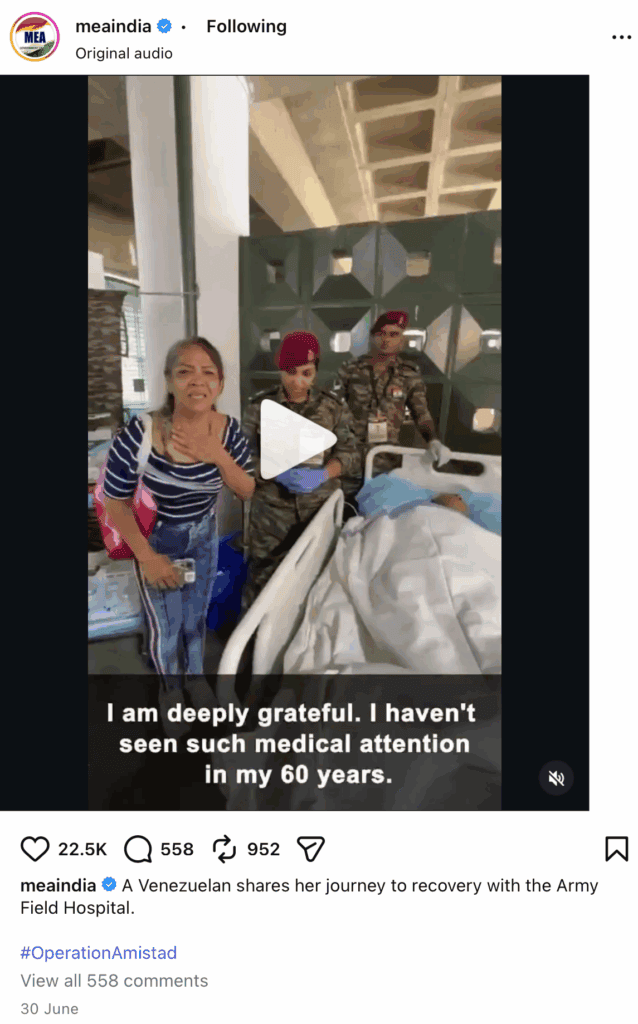
If assertive diplomacy attracts attention because it speaks to national interest, humanitarian diplomacy has a different advantage: it gives foreign policy a human face.
A recent MEA reel featuring a Venezuelan woman describing her recovery at an Indian Army Field Hospital is a good example. Rather than presenting India’s humanitarian assistance through an official statement, the post allows the recipient to tell part of the story herself. Posted under #OperationAmistad, the reel turns an international assistance operation into a personal account of care and recovery.
The format is important. A person speaking directly to the camera is easier to connect with than a paragraph describing humanitarian assistance. The audience does not need extensive knowledge of India’s foreign policy to understand what is happening.
India’s response to the earthquake in Myanmar was presented in a similar way, though through images of action rather than personal testimony. MEA highlighted India’s role as a “First Responder”, posting images of an 80-member NDRF search-and-rescue team arriving in Nay Pyi Taw under Operation Brahma.
The same human dimension appeared in MEA’s post on additional food supplies delivered to earthquake-affected people in Afghanistan.
None of this means that humanitarian posts will automatically outperform other forms of diplomacy. The response to different posts varies. But they reveal an important advantage of Instagram: foreign policy becomes easier to engage with when it can be seen through people rather than institutions.
They Want Peace
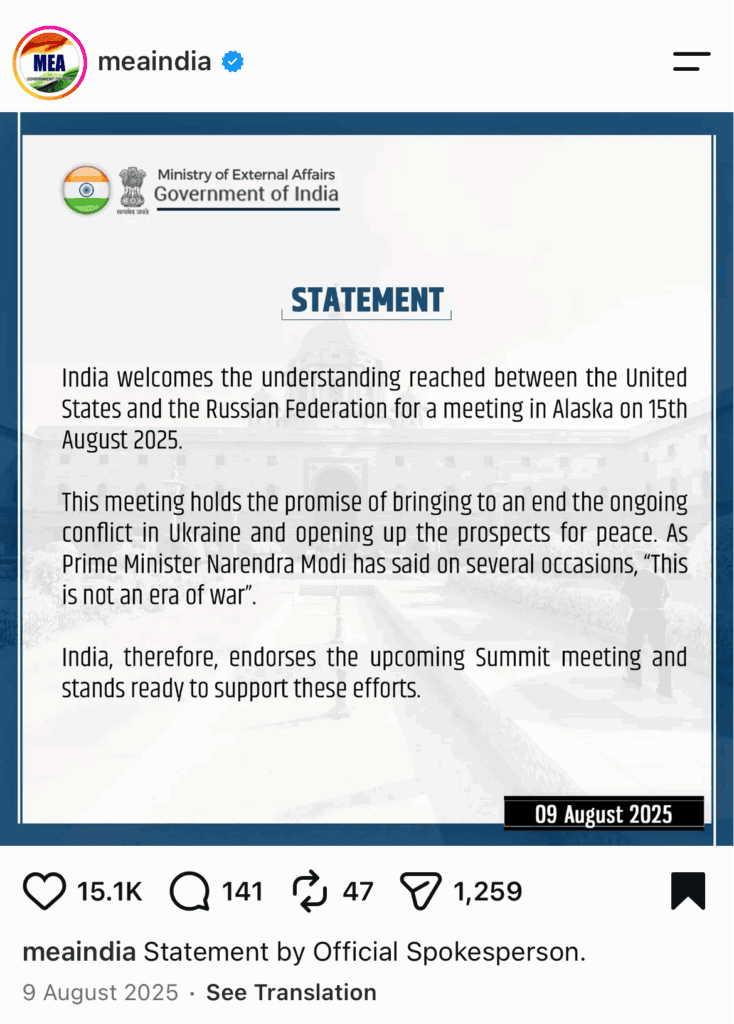
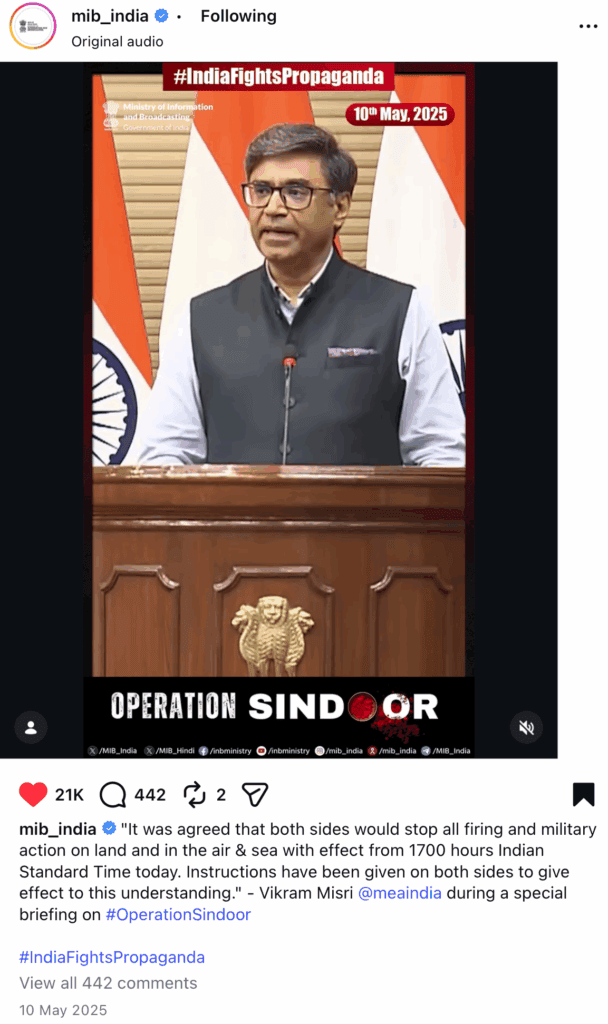
The engagement around Operation Sindoor also offers an interesting counterpoint to the idea that audiences are attracted only to confrontation.
The May 10 announcement that India and Pakistan had agreed to stop firing and military action was itself turned into social-media content. The Foreign Secretary’s statement was circulated as a video, while another post presented the agreement in a concise visual format.
The message was significant not because it announced another escalation, but because it announced a halt.
A similar example came in August 2025, when MEA welcomed the proposed meeting between the United States and Russia in Alaska. The statement said the meeting held the promise of bringing the Ukraine conflict to an end and opening prospects for peace, while invoking Prime Minister Narendra Modi’s formulation that “this is not an era of war”.
The posts suggest that the prospect of ending a conflict can be an engaging diplomatic story in its own right. The audience is not necessarily interested only in what countries are fighting about; it can also be interested in how wars might end.
This is worth noting because foreign policy on social media can easily become a spectacle of confrontation. The response to these posts suggests that diplomacy’s audience can also be drawn to the moment when confrontation gives way to negotiation.
No Special Love for US Stars
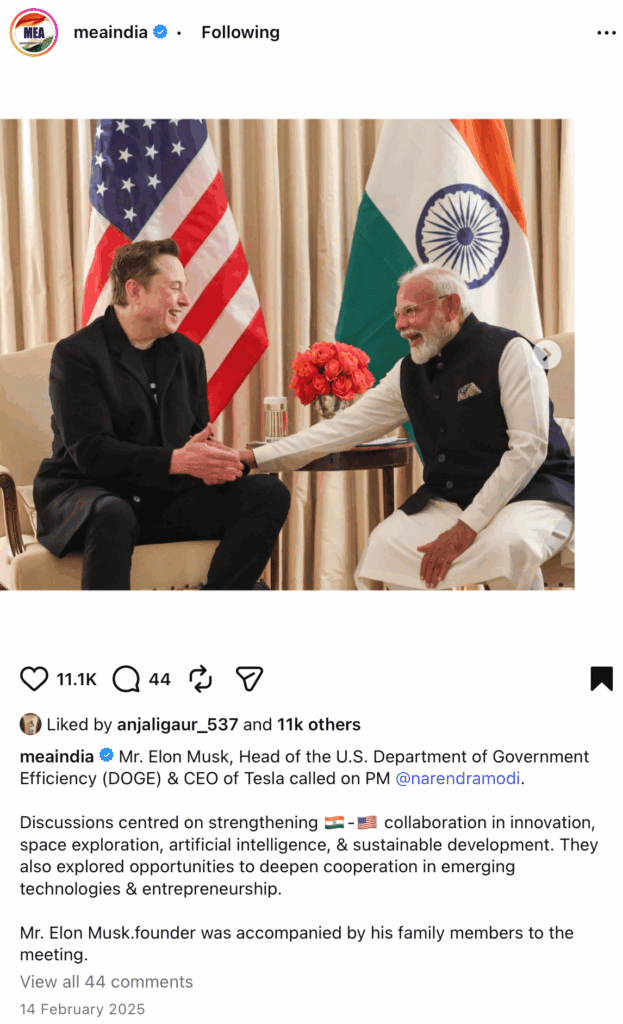
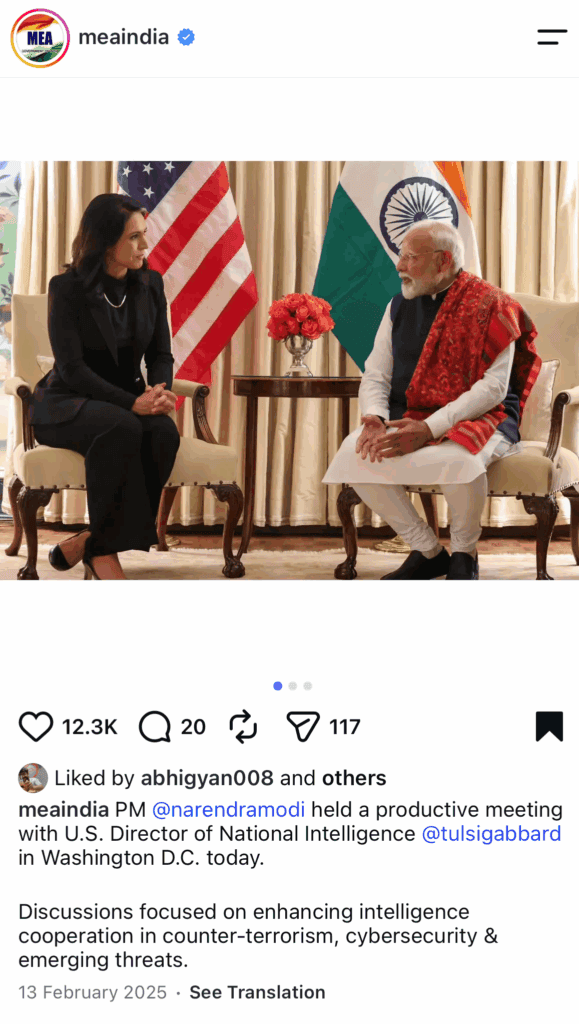
Perhaps the most interesting contrast comes from posts involving some of the most recognisable personalities in American public life.
Posts showing Modi meeting Elon Musk and US Director of National Intelligence Tulsi Gabbard did not attract the same level of attention as some of the more strongly worded or issue-driven posts. The Modi-Musk photograph, with the two figures smiling and interacting against the backdrop of the Indian and US flags, is almost textbook Instagram material. The Gabbard meeting similarly combined a recognisable personality with subjects such as intelligence cooperation, counter-terrorism and cybersecurity.
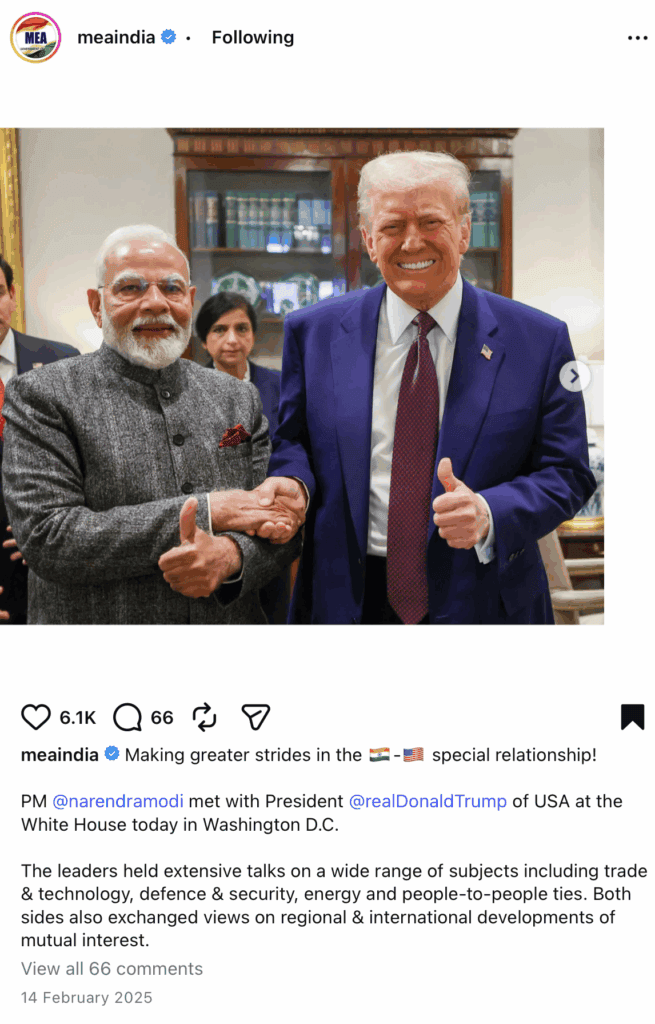
The post showing Modi with Donald Trump also received comparatively modest engagement.
It would be tempting to read this as a reflection of the changing mood around India–US relations, particularly amid disagreements over tariffs and other contentious issues. But Instagram engagement alone cannot establish such a connection. What it does suggest is something simpler and perhaps more interesting: American celebrity, by itself, does not guarantee attention.
A famous face may make someone pause. The issue surrounding that face may determine whether they stay.
They Are Less Interested in Conventional Diplomacy
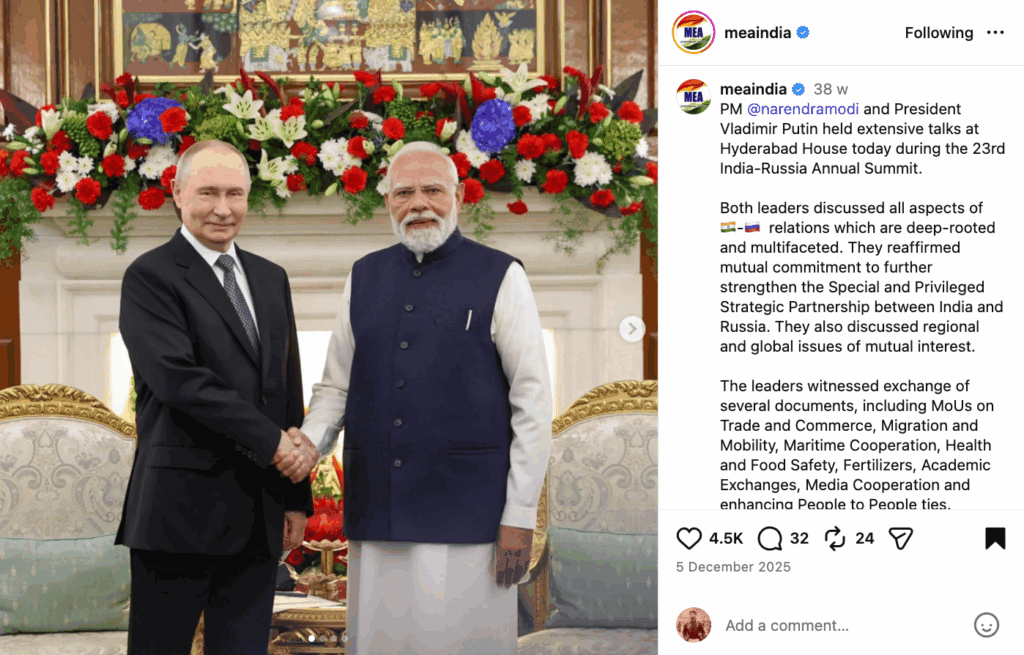
The India–Russia summit provides perhaps the clearest illustration of this distinction.
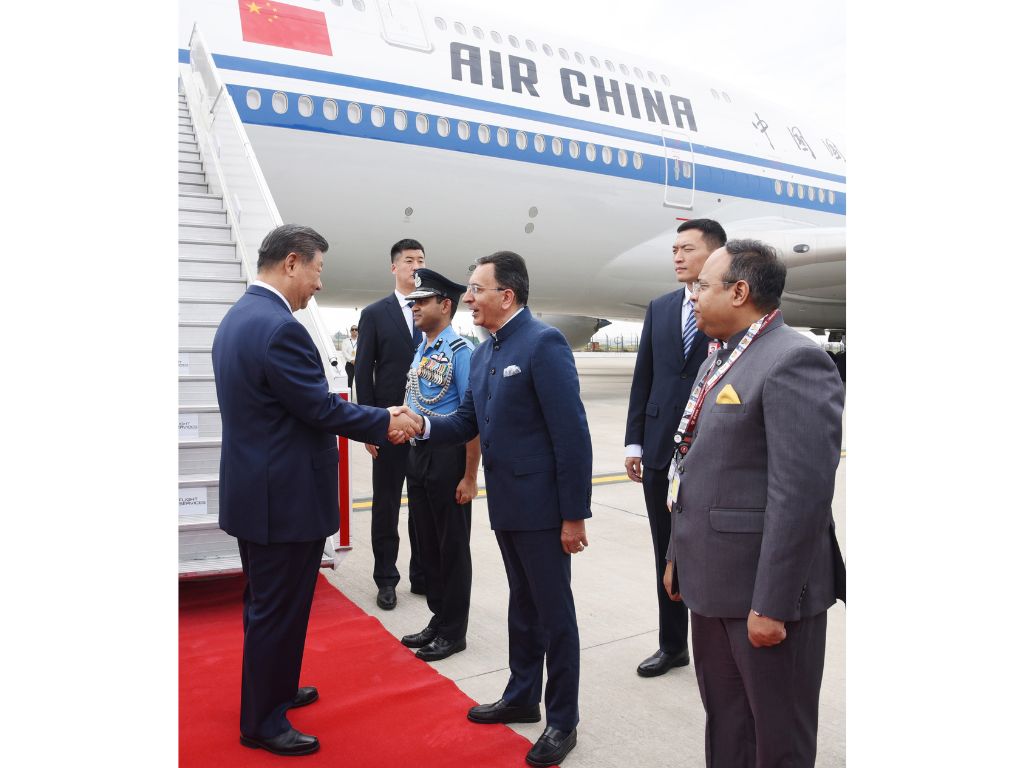
MEA’s posts from President Vladimir Putin’s December 2025 visit included his arrival in New Delhi, his meeting with Modi, the leaders’ discussions and a detailed list of outcomes from the summit. The outcomes included agreements on labour activity, migration and mobility, healthcare, food safety, academic exchanges, media cooperation and other areas.
Diplomatically, these are hardly trivial matters. Yet the more conventional posts—the formal meeting photograph and particularly the list of outcomes—appear to have generated less interaction than some of the sharper, more immediate posts elsewhere in the sample.
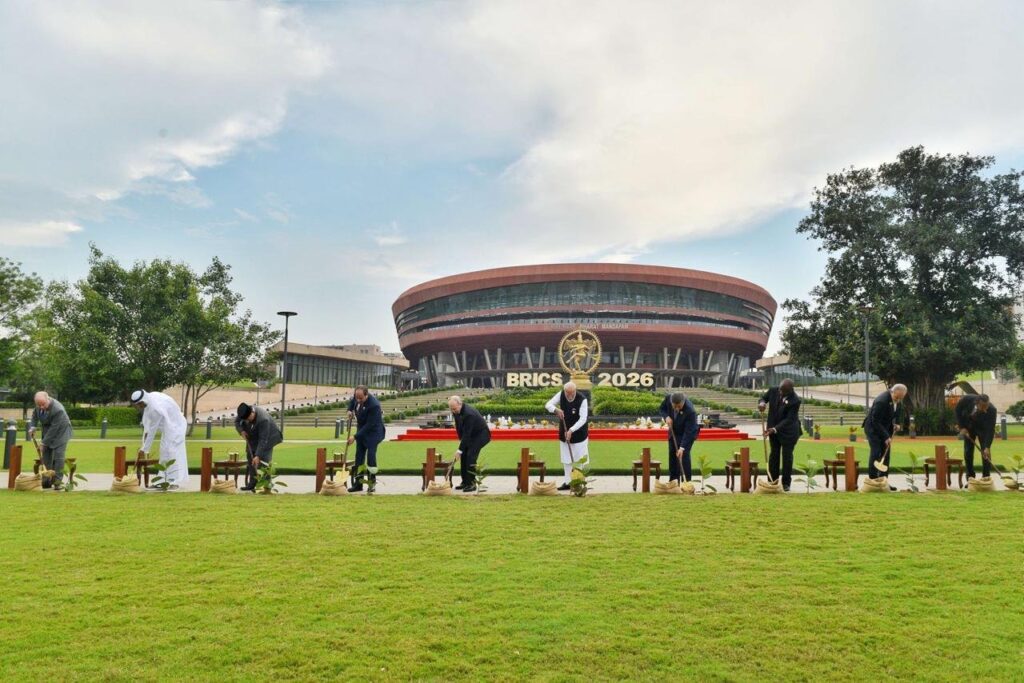
The contrast becomes particularly interesting when placed alongside a post from Modi’s meeting with Mongolian President Khurelsukh Ukhnaa. The leaders’ joint planting of a sapling, linked to India’s Ek Ped Maa Ke Naam initiative and Mongolia’s One Billion Trees campaign, generated much stronger engagement.
The tree-planting photograph tells a story almost instantly. The list of agreements requires reading.
That may be one of Instagram’s central challenges for diplomacy. The things that matter most diplomatically are not always the things that communicate most easily on a visual platform.
Diplomacy Has to Earn the Scroll
Instagram is not a poll of India’s young foreign-policy audience, and likes cannot tell us exactly what individual users believe. But the recent MEA feed offers a useful glimpse of what makes foreign policy visible to an audience accustomed to encountering information while scrolling.
A strong Indian response, a person being helped, a conflict moving towards peace or a compelling visual moment can give audiences an immediate way into foreign policy. A formal communiqué often cannot.
The lesson is not that diplomacy needs to become less serious. It is that the way seriousness is communicated has changed.
Diplomacy still happens across negotiating tables. But for a younger audience, its first encounter with foreign policy may happen somewhere very different: on the screen, in the feed, between everything else competing for attention.
And there, diplomacy has to earn the scroll before it can earn the attention.