
For centuries, diplomatic battles were fought in rooms most people would never see. Governments sent notes, summoned ambassadors, issued carefully worded statements and, when necessary, made their displeasure known through official channels. The language could be sharp, but the audience was usually limited.
Then diplomacy moved onto social media. Twitter, in particular, gave governments something traditional diplomacy rarely offered: a public stage on which one side could answer another directly, in seconds, before an audience of thousands or millions.
That changed more than the speed of diplomatic communication. It changed who could watch, respond and participate. Citizens were no longer simply spectators of diplomacy conducted between states. They could retweet, mock, challenge, fact-check, turn an exchange into a meme or push it far beyond the governments that started it. A diplomatic message could therefore acquire a second life entirely outside diplomatic control.
There was also a new ambiguity. Was a tweet merely communication, or was it an official diplomatic act? Governments discovered that a joke could travel like a formal statement, and that deleting a tweet did not necessarily erase the controversy it had created.
The five episodes below show different versions of this new diplomacy: a map used to mock a military incursion, history turned into a battleground, ministers fighting publicly over minority rights, a foreign embassy intervening in another country’s political conversation, and a friendly rivalry in which governments discovered that diplomacy could entertain as well as confront.
Canada–Russia Map War
In August 2014, Canada and Russia were already on opposite sides of a rapidly worsening crisis over Ukraine. Russia had annexed Crimea in March, and NATO had suspended practical cooperation with Moscow, although diplomatic channels remained open. Russia also maintained a diplomatic mission to NATO in Brussels, established in 1998. By then, the relationship was hardly friendly—but the diplomats still had a Twitter audience.
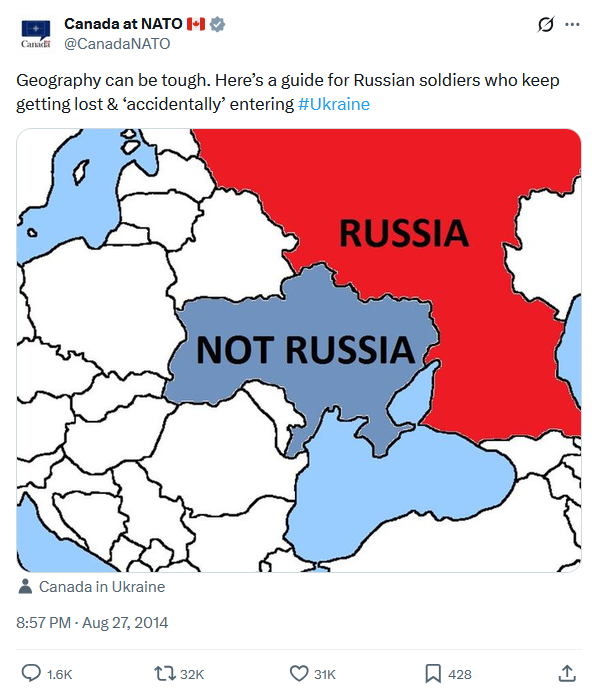
The exchange began on 27 August, when the official Canada at NATO account, @CanadaNATO, posted a map of eastern Europe. Russia was marked “Russia”; Ukraine was marked “Not Russia”. The caption delivered the punchline: “Geography can be tough. Here’s a guide for Russian soldiers who keep getting lost & ‘accidentally’ entering #Ukraine.”
The joke was aimed at a very specific incident. Ukrainian authorities had captured ten Russian paratroopers inside Ukrainian territory. Moscow acknowledged that the soldiers had crossed the border, but said they had done so accidentally. Canada took that explanation literally and turned it into a geography lesson.
The tweet was unusually direct for official diplomacy. It did not merely criticise Moscow; it mocked the explanation publicly. And it spread quickly. Even Samantha Power, then the US ambassador to the United Nations, retweeted it.
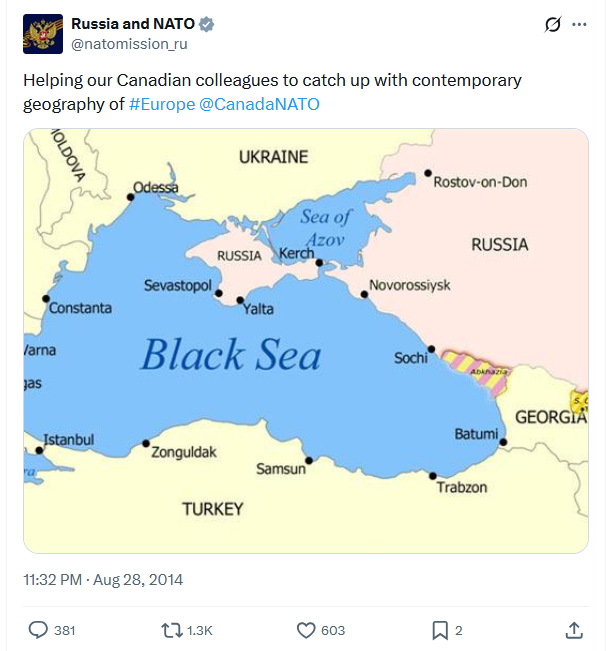
Russia’s Mission to NATO, @natomission_ru, responded the following day. Its account, operating as “Russians at NATO,” posted its own map with Crimea shown as part of Russia and addressed Canada directly: “Helping our Canadian colleagues to catch up with contemporary geography of Europe.”
The response was more than a geographical correction. Crimea had been annexed by Russia only months earlier, but Canada and most Western governments did not recognise the annexation. By putting Crimea inside Russia on its map, Moscow’s mission was using the same visual language to make its own territorial claim. The map also reflected Russia’s position on the disputed Georgian territories of Abkhazia and South Ossetia.
There was, however, an ironic twist. Canada’s map had itself omitted Kaliningrad, the Russian exclave between Poland and Lithuania. The geography lesson, as several media outlets noted, had a geography mistake of its own.
The exchange did not create a new diplomatic crisis or change the course of Canada–Russia relations. The confrontation over Ukraine was already far more serious than Twitter. What it did reveal was a new form of diplomatic communication: official missions could now trade arguments, maps and sarcasm directly in public, while an audience of ordinary users watched, shared and amplified the exchange. The map had become both the message and the weapon.
Russia-Ukraine: The Anne of Kyiv Battle
The spark came on 29 May 2017, when Russian President Vladimir Putin met French President Emmanuel Macron at the Palace of Versailles. Speaking about the long history of Russia–France relations, Putin referred to Anne Yaroslavna, the 11th-century queen consort of France, as “Russian Anna” and described her father, Yaroslav the Wise, as “our” grand prince.
The choice of words mattered. Anne was the daughter of Yaroslav, Grand Prince of Kyiv, and was born in Kyiv before marrying King Henry I of France in 1051. She belonged to the world of Kyivan Rus’, a medieval polity whose lands encompassed parts of what are now Ukraine, Belarus and Russia.
For Ukraine, Putin’s description was seen as part of a broader Russian attempt to appropriate the history of Kyivan Rus’. The issue quickly moved online.
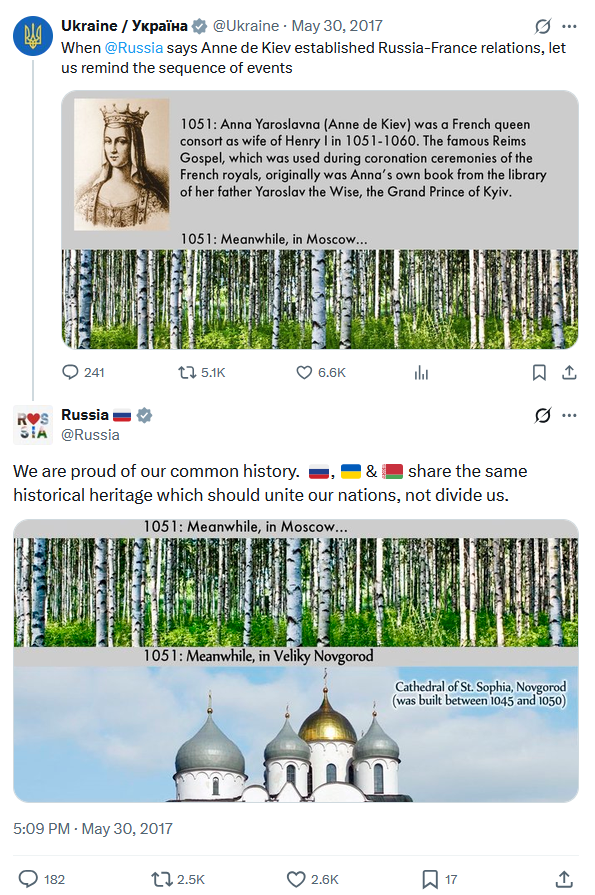
On 30 May, Ukraine’s official Twitter account, @Ukraine, responded directly to Russia’s official account, @Russia. Its opening tweet said: “When Russia says Anne de Kiev established Russia–France relations, let us remind the sequence of events.” The accompanying graphic pointed out that Anne became queen in 1051—nearly a century before Moscow is traditionally dated to 1147—and illustrated the point with a photograph of a forest captioned “Meanwhile, in Moscow…”
Russia answered through @Russia, stressing that Russia, Ukraine and Belarus shared a common historical heritage that should unite rather than divide them. It accompanied the message with an image of St Sophia Cathedral in Veliky Novgorod. Russia’s Foreign Ministry account, @mfa_russia, then entered the exchange, arguing that in 1051 Kyiv was the capital of a united Rus whose territory included areas of today’s Russia, Ukraine and Belarus.
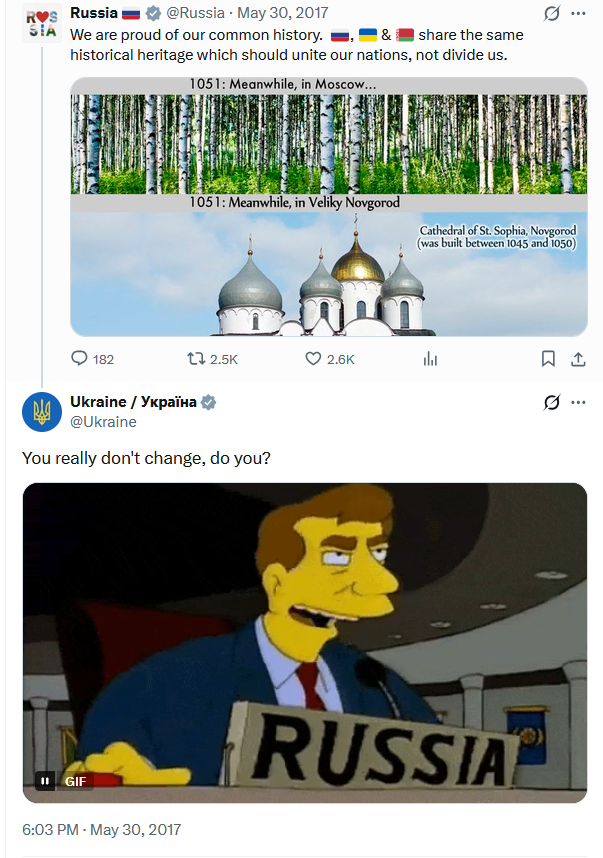
Ukraine fired back with another historical argument and a meme. Its account pointed out that Kyivan Rus’ had extended into territories corresponding to several modern European states and told Moscow not to promote the idea of a single “triune nation”. It then ended its exchange with Russia by posting a Simpsons GIF captioned: “You really don’t change, do you?”
The exchange quickly became an internet spectacle. Users joined in with jokes, historical arguments and their own memes. But Ukraine’s foreign minister, Pavlo Klimkin, insisted that the underlying dispute was serious. He argued that the problem was not simply Russia’s attempt to “expropriate” Anne, but its belief that the Kyiv-born queen was Russian.
The episode did not settle the history of Kyivan Rus’, and could not. Its significance lay elsewhere. A medieval queen had become a proxy in a modern struggle over historical memory and national identity. The Twitter battle showed how quickly an argument about the past could become a contemporary diplomatic weapon and how social media could turn that argument into a public performance watched by the world.
India–Pakistan: The Twitter Fight Over Two Girls
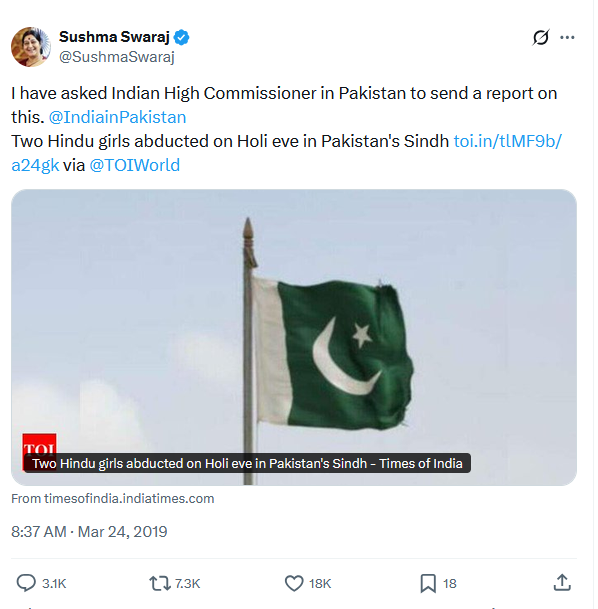
On 24 March 2019, India’s External Affairs Minister Sushma Swaraj, posting from her verified account @SushmaSwaraj, shared a report about the alleged abduction and forced conversion of two Hindu sisters in Pakistan’s Sindh province. She said she had asked India’s High Commissioner in Islamabad for a report. The official Indian High Commission account, @IndiainPakistan, responded that it was aware of the case and was sending details.
The tweet immediately drew a response from Pakistan’s Information and Broadcasting Minister Fawad Hussain Chaudhry, posting from his verified account @fawadchaudhry. He called the matter Pakistan’s internal issue and contrasted “Imran Khan’s Naya Pakistan” with “Modi’s India”, accusing India of failing to protect its minorities.
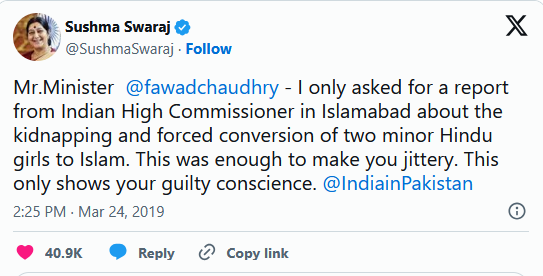
Swaraj did not let the challenge pass. She replied that she had merely asked her High Commissioner for a report and accused Chaudhry’s reaction of showing a “guilty conscience”. Chaudhry responded again, turning the argument back on India and invoking the treatment of minorities in Gujarat and Jammu.
The exchange was striking because neither side was speaking through an anonymous official statement. Two senior ministers were arguing directly, in public, before a Twitter audience. Their followers could read the exchange, respond to it and amplify it almost instantly.
And the argument did not remain online. The following day, India formally raised the matter with Pakistan through a note verbale, asking Pakistan to take appropriate measures for the safety and welfare of its citizens, particularly members of minority communities. Pakistan’s Prime Minister Imran Khan had also ordered an investigation into the allegations.
The episode showed how social media could collapse the distance between political rhetoric and diplomacy. A minister’s tweet could trigger a counterattack, draw in another government account and, within hours, find its way into a formal diplomatic communication.
China–Turkey: The Xinjiang Twitter Clash
On 5 April, İYİ Party leader Meral Akşener (@meral_aksener) marked the anniversary of the 1990 Barın uprising in Xinjiang. She referred to the Uyghurs involved as her “cognates”, said Turkey would not remain silent about their persecution and ended with a call for “East Turkestan” to one day become independent. Ankara Mayor Mansur Yavaş (@mansuryavas06) also posted that, 31 years later, Turks still felt the pain of what he called the “massacre” in East Turkestan.
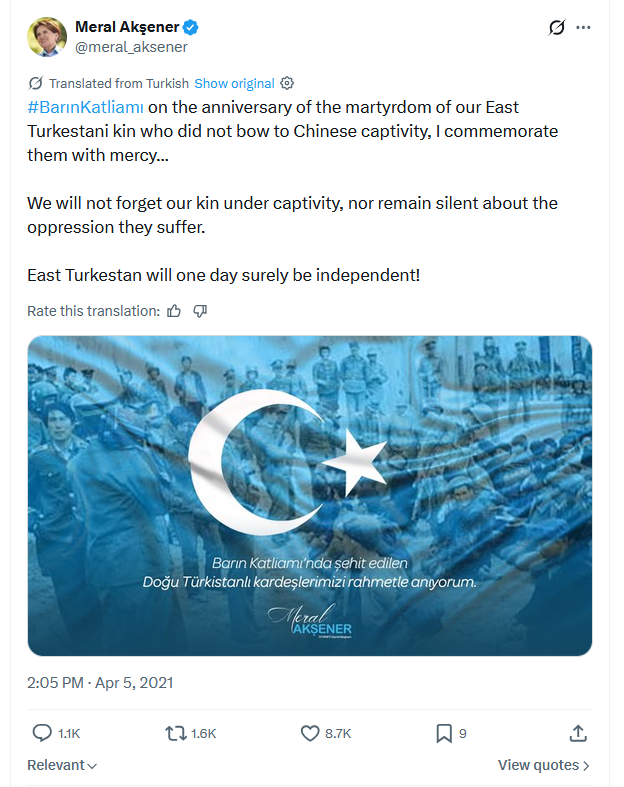
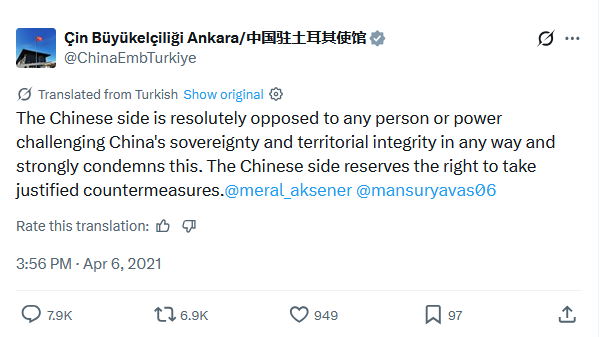
The following day, China’s Embassy in Ankara entered the conversation from its official Twitter account, @ChinaAmbTurkiye, directly tagging both politicians. In two posts, the embassy declared that the Xinjiang Uyghur Autonomous Region was an “integral part” of Chinese territory and said China “resolutely opposes and strongly condemns” anyone challenging its sovereignty and territorial integrity. It added that China reserved the right to respond.
That last phrase caused particular alarm in Turkey. What might have remained a political argument between Turkish politicians and Beijing had now become an official diplomatic intervention by a foreign embassy into Turkey’s domestic political debate.
The reaction was swift. On 6 April, Turkey’s Foreign Ministry summoned Chinese Ambassador Liu Shaobin and conveyed its discomfort over the embassy’s tweets.
The dispute also generated its own social-media counterattack. İYİ Party supporters responded on Twitter with an image depicting Akşener as a superhero confronting China and demanding an end to what they described as genocide.
The episode showed something new about digital diplomacy: an embassy no longer had to wait for a foreign ministry to make a formal statement. It could enter another country’s political conversation directly, tag its politicians and answer them before a mass audience.Here, a pair of domestic political tweets became an international diplomatic incident, and an ambassador was summoned because of what had happened online.
Denmark–Sweden: The Friendly Twitter War
On 7 July 2016, Sweden and Denmark turned their long-running Nordic rivalry into a day-long Twitter spectacle. It began with a seemingly harmless post from @swedense, the official Sweden.se account run by the Swedish Institute, joking about Swedes’ dislike of wall-to-wall carpeting. Denmark’s official @denmarkdotdk account, operated by the Danish Foreign Ministry, retweeted it with a friendly observation that this was “just one of many things” Danes and Swedes had in common.
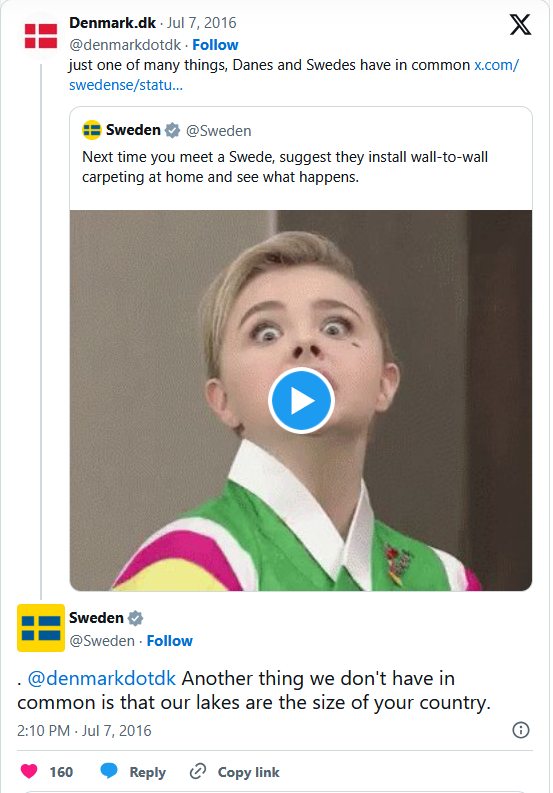
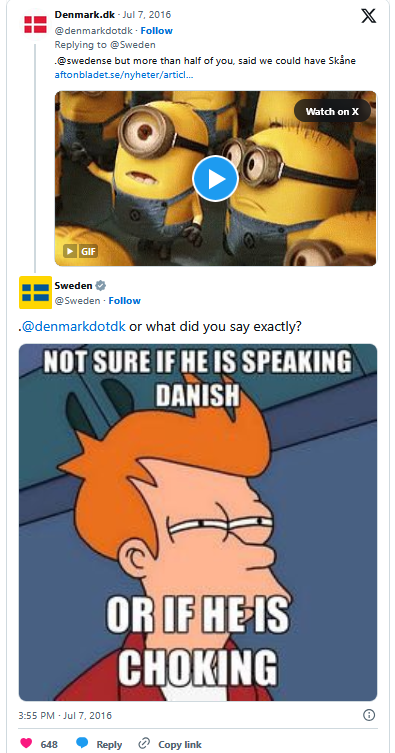
Sweden then changed the tone. Addressing @denmarkdotdk, it posted: “Another thing we don’t have in common is that our lakes are the size of your country.” Denmark answered with a joke about Sweden’s obsession with rules: “Did you know that everything that is not forbidden in Sweden, is mandatory?” The exchange was on.
What followed was less a diplomatic dispute than a carefully managed comedy duel. The two accounts traded jokes about geography, mountains, beaches, islands, language, alcohol, moose, LEGO and even Denmark’s reputation for sperm donation. Followers quickly joined the spectacle, taking sides and adding their own jokes. Swedish public broadcaster SVT described it as an unusually prominent “word war” between the countries’ official accounts.
But there was a secret behind the apparent spontaneity. Ferencz Thuroczy, the Swedish Institute’s social-media editor, later explained that he had contacted the Danish side privately before the exchange continued. They agreed to go ahead because they knew their target audience would enjoy it. The point was not to attack Denmark but to make Sweden, and its digital presence, more engaging.
There was therefore no diplomatic crisis to resolve. In fact, the two sides were careful to signal that the rivalry was friendly. The “war” worked precisely because everyone understood the rules.
That made the episode a revealing experiment in digital nation branding. Governments were discovering that social media could make a country’s official voice sound less like a ministry and more like a person with a sense of humour.
Here, diplomacy did not seek to defeat an opponent. It sought to win the audience.
These episodes point to a larger change in the diplomatic world. Social media did not invent rivalry between states; governments have always argued, competed and tried to shape how others see them. What changed was the arena. A diplomatic exchange that once might have been confined to officials can now unfold in public, in real time, with citizens, journalists and internet communities watching, and sometimes joining the fight. The result is diplomacy that is faster, more visible and often more unpredictable. The new digital arena is not only about winning an argument with another government. It is also about winning the audience watching the argument.