For 25 years, keeping warheads and missiles physically separate was the operational expression of India’s nuclear restraint. SIPRI’s 2026 Yearbook suggests that this may be ending, cautiously and at sea.
‘A Small Number … Occasional Deterrence Patrols’
The SIPRI Yearbook 2026, released on 8 June 2026, estimates India’s total stockpile at roughly 190 warheads as of January 2026, up from 180 a year earlier. About 12 are now estimated to be deployed and 178 held in storage. The whole claim rests on one carefully built sentence.
SIPRI writes that India “may have started to deploy a small number of nuclear warheads on a single SSBN conducting occasional deterrence patrols”. An SSBN, or ship submersible ballistic nuclear, is a nuclear-powered submarine carrying ballistic missiles. The hedging is deliberate. Words like may, a small number, a single and occasional all do real work in that sentence. SIPRI is not describing a standing deployment but the cautious possible beginning of one. India’s Ministry of Defence has confirmed none of it.
The figure of 12 is easy to misread as a decision India has taken and announced. It is neither, just an outside estimate of a possible transition. Even so it breaks a long pattern, because every previous Yearbook had counted India’s entire arsenal as stored. The 2026 edition is the first to place any Indian warhead in the deployed column.
SIPRI uses almost the words it used for China two years earlier. When China crossed the line, SIPRI’s 2024 press release noted that “for the first time, China may also now be deploying a small number of warheads on missiles during peacetime”. China’s 34 deployed warheads carry the caveat that the assessment “comes with considerable uncertainty”, and SIPRI attaches the same to India’s 12.
A ‘Recessed Deterrent’ Since 1998
To understand why a dozen warheads at sea matters, consider what India spent a quarter-century deliberately not doing. After the Pokhran-II tests of May 1998, Ashley Tellis called India’s approach, in his 2001 RAND monograph, a “recessed deterrent”, in which warheads were kept apart from their delivery systems, so that any launch needed a deliberate act of assembly first.
That became formal policy in January 2003, when the Cabinet Committee on Security adopted the nuclear doctrine. As Vipin Narang summarises in his 2018 India Review paper, it rested on No First Use, credible minimum deterrence, and massive retaliation, with weapons treated as “political and deterrent tools” rather than war-fighting instruments. Keeping warheads separate from missiles was how that idea worked in practice. A state that cannot fire on short notice signals that it will not strike first.
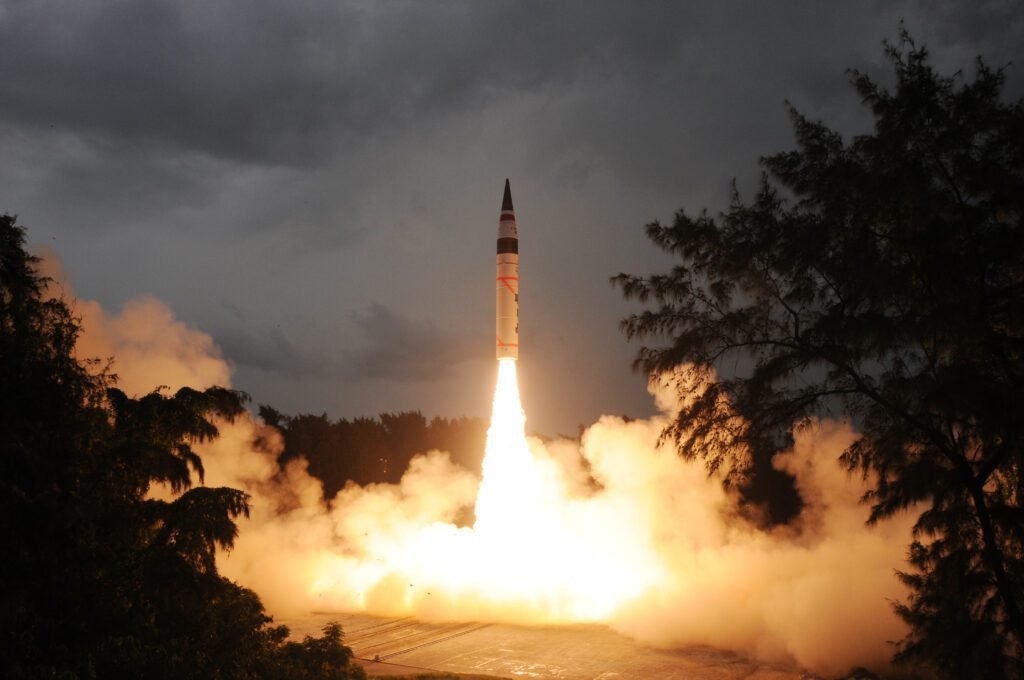
The cracks predate that shift, and Narang traced them to canisterisation, the practice of sealing a missile inside a climate-controlled tube that doubles as its launcher, often with the warhead already fitted, so the weapon can be moved and fired quickly. Narang noted that DRDO, the Defence Research and Development Organisation, called the canisterised Agni-V launchable “from anywhere at anytime”, implying a warhead already mated to the missile. A DRDO video of the January 2015 Agni-V test showed the canister seal intact until launch. “The picture of a recessed, disassembled, and certainly de-mated force,” he wrote, “may no longer be accurate.”
The Sea Leg Demands Mated Warheads
On land, separation is a choice; at sea it is closer to a contradiction. A ballistic missile submarine earns its value by staying hidden, guaranteeing retaliation even if India’s land forces are destroyed first. One that must surface mid-crisis to assemble its weapons cannot offer that guarantee.
India entered this territory publicly in November 2018, when Prime Minister Narendra Modi announced INS Arihant’s first deterrence patrol, calling it a historic moment that completed India’s nuclear triad. He said nothing about the weapons’ configuration. That came from a former admiral, quoted in The Wire, who said Arihant carried nuclear-tipped missiles in its launch tubes on the patrol. (The Wire did not name the officer.)
Whether that was a standing posture or a one-off was unverifiable until the 2026 Yearbook. India’s Ministry of Defence has not responded to SIPRI’s assessment, the BBC’s Hindi service reported, and analyst Rahul Bedi told it that such peacetime deployment would be a striking departure for a country long committed to keeping them apart.
The pull is also economic. As Kunal Singh argues in a May 2026 War on the Rocks essay, not mating warheads in peacetime forgoes much of the point of building three submarines, while mating in a crisis is hard and risks signalling escalation or inviting a pre-emptive strike before the boats disperse.
SIPRI counts three of India’s four launched submarines as operational. INS Arihant and INS Arighaat carry four missile tubes each; INS Aridhaman, commissioned in April 2026, and the forthcoming INS Arisudan each carry eight. Three boats are the minimum for continuous deterrence, enough to keep one on patrol while the others refit or transit.
There is a catch. Arihant carries only the K-15, a submarine-launched ballistic missile (SLBM) with a 700 km range. Arighaat has twice test-fired the K-4, which reaches about 3,500 km, most recently in December 2025, but it needs more testing. The trouble is range. Beijing sits roughly 3,200 km from the northern Bay of Bengal, so a K-4-armed boat could threaten Chinese targets only from a narrow patrol box that risks giving its position away. Fielding the K-4, and adding the longer-range K-5 and K-6, is the sea leg’s most pressing unfinished work.
No First Use, on Paper
India’s declared policy has not changed; No First Use remains official. But the gap between doctrine and what the hardware does has widened for years. Narang described how this happened. As India canisterised its land missiles and built its submarine fleet, the demands of those systems pushed the arsenal toward pre-mated configurations, whatever the doctrine said. He read the quiet dropping, then reinsertion, of “minimum” in the 2017 Joint Doctrine as evidence that the doctrine was already being renegotiated.
Warhead numbers point the same way. The first MIRV-capable Agni-V test, a multiple independently targetable re-entry vehicle system letting one missile carry several warheads, came on 11 March 2024 as Mission Divyastra. SIPRI assesses the Agni-V as carrying up to three warheads per launcher. If MIRVs reach the submarines’ SLBMs, Singh notes, India would further guarantee unacceptable retaliation even if much of its land force were destroyed.
Narang flagged the danger in this combination back in 2018. MIRVs on long-range missiles, joined to canisterisation and a maturing sea-based second strike, can look from Pakistan’s side like the early scaffolding of a counterforce capability, a force built to destroy an opponent’s weapons before they can be used, whatever India intends.
‘Focused on China’
SIPRI is blunt about India’s direction. Over the past decade, it stated that, India has placed “a greater emphasis on investing more resources in longer-range weapon systems that appear to be focused on China”, while its planning “still remains heavily influenced by its long-standing rivalry with Pakistan”. China’s arsenal stands at an estimated 620 warheads and 867 launchers. Within the same two-year window, both moved from fully recessed deterrents toward partial peacetime deployment. SIPRI adds that China and India “may occasionally have started to deploy warheads on high operational alert”, another step up if borne out.
After the Sindoor Clash
SIPRI describes Operation Sindoor in May 2025 as the most significant India–Pakistan armed conflict in decades, with India striking “air and missile bases that are assessed to have nuclear missions”. Both sides kept it conventional, yet SIPRI judges the 88-hour clash marked a regional shift, leaving the risk of rapid escalation toward the nuclear level a lingering concern. It was also the first time the two openly folded cyber operations into active conflict.
A dozen warheads at sea cut both ways. A survivable second strike is stabilising over the long run, because it removes any incentive for a disarming first strike when retaliation is guaranteed. But a submerged arsenal under restricted communications is harder to read in a fast crisis, harder to signal with, and harder to stand down.
Pakistan’s stockpile remains 170 warheads, none deployed, and, unlike India, it has never adopted No First Use, keeping the option of striking first to offset India’s conventional edge. SIPRI expects Pakistan to field the Babur-3, a sea-launched cruise missile assessed as potentially nuclear-capable, in 2027. India’s move gives Islamabad both a strategic reason and a domestic argument to accelerate.
From One Boat to Eight
The direction is set by arithmetic more than doctrine. SIPRI records that India has launched four SSBNs, three judged potentially operational. INS Arisudan, the fourth, with eight tubes, is expected in 2027; India is also developing the larger S-5 class, which could leave it operating six to eight boats at once.
The numbers move one way. India fields 152 launchers in all, 88 on land, 48 in the air and 16 at sea. As the fleet grows, so does the warhead count needed to arm patrols. The figure of 12 reflects a single boat on occasional patrol, the floor and not the ceiling of a trajectory the programme has already set.
India’s doctrine is unchanged on paper. What the 2026 SIPRI Yearbook records, caveats intact, is the point at which operational reality may have begun to pull away from declared doctrine in a way outsiders can finally see, and, for the first time, put a number to. Nothing in it confirms a settled new posture. What it flags is a direction of travel, and a reason to watch closely.
Note: This explainer has been researched, edited, and fact-checked by India’s World staff and prepared with AI assistance.