Trends, Top Investors, and the Growing Overseas Footprint of Indian Firms
For decades, India was viewed primarily as a destination for foreign capital. Today, Indian companies are becoming exporters of capital in their own right. From telecoms in Britain and pharmaceuticals in Europe to ports in East Africa and technology centres in France, Indian firms are deploying billions of dollars overseas, reshaping the geography of Indian capitalism.
The numbers tell the story. Indian companies raised their outward foreign direct investment (FDI) from $14 billion in FY2022–23 to $16.6 billion in FY2023–24, before accelerating to nearly $29 billion in FY2024–25—a 75% increase in a single year. According to the Reserve Bank of India, outward FDI between April and November 2024 reached $15.5 billion, up sharply from $8.9 billion during the same period a year earlier.
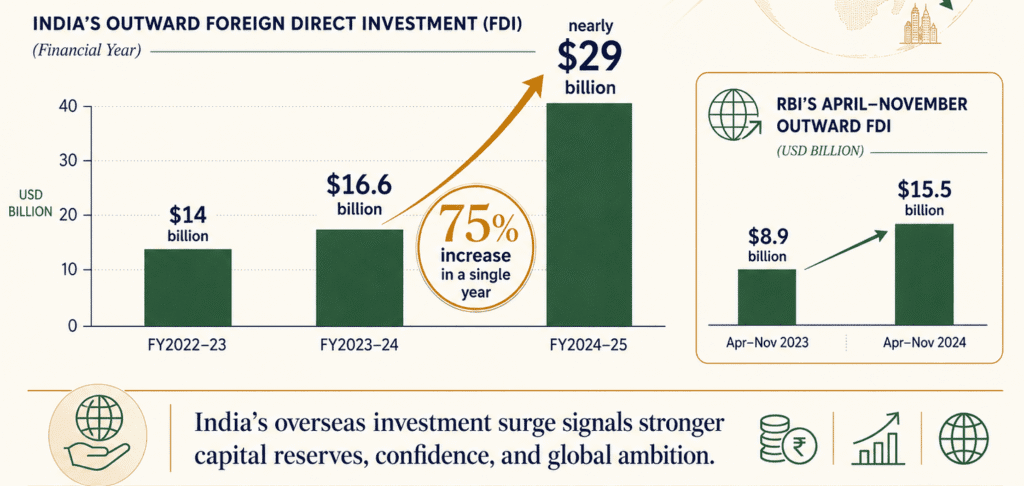
The surge is significant because outward investment has historically been associated with mature industrial economies. American, British, Japanese, and later Chinese firms expanded abroad only after accumulating substantial capital, managerial expertise, and technological capabilities at home. India’s growing outward FDI suggests that an increasing number of Indian firms now possess both the resources and the ambition to compete globally.
Singapore, Mauritius, the UAE, the Netherlands, and the United States together account for more than three-quarters of India’s outward FDI flows. These jurisdictions serve not only as investment destinations but also as strategic hubs through which Indian companies access wider regional markets.
The Flag-Bearers: IT and Professional Services
No Indian industry has planted its flag more firmly on the global map than information technology.
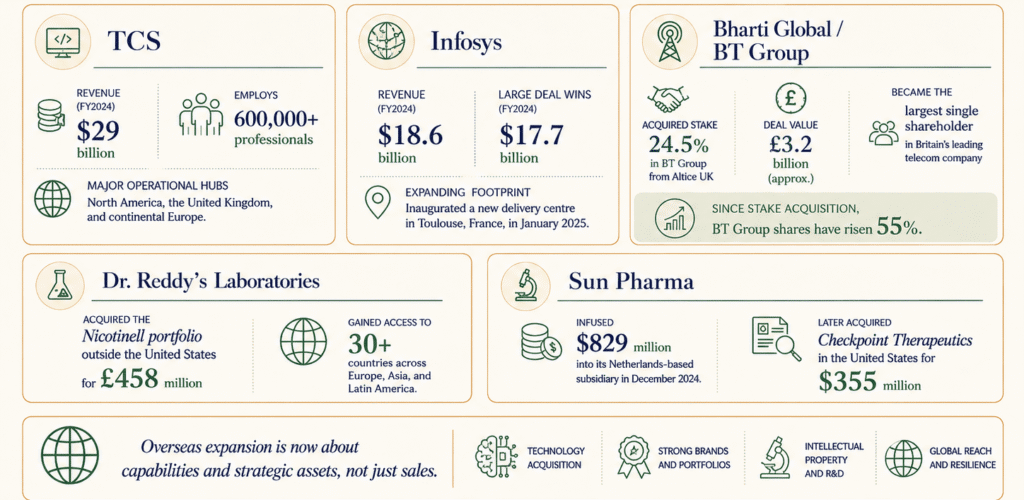
Tata Consultancy Services reported revenues of approximately $29 billion in FY2024 and employs more than 600,000 professionals across dozens of countries. Its global delivery model, supported by large operational hubs in North America, the United Kingdom, and continental Europe, has become the template for the internationalisation of Indian services capital.
Infosys has followed a similar path. The Bengaluru-based company recorded revenues of $18.6 billion in FY2024 and secured large deal wins worth $17.7 billion. In January 2025, it inaugurated a new delivery centre in Toulouse, France, targeting the European aerospace sector. Such investments demonstrate how India’s technology firms have evolved from outsourcing providers into genuinely multinational enterprises with permanent operational footprints overseas.
Conglomerates on the March
Beyond IT, telecommunications, pharmaceuticals, infrastructure, logistics, and manufacturing companies are increasingly seeking markets, brands, technologies, and strategic assets overseas.
One of the most notable transactions of 2024 involved Bharti Global’s acquisition of a 24.5% stake in BT Group from Altice UK. Valued at approximately £3.2 billion, the deal made Bharti the largest single shareholder in Britain’s leading telecommunications company. The UK government approved the acquisition on the condition that BT establish a National Security Committee to oversee sensitive state work.
The significance of the transaction lies not merely in its size but in its symbolism. For much of the twentieth century, British capital flowed into India. Bharti’s investment represented the reversal of a relationship that began when BT itself held a 21% stake in Bharti Airtel in 1997. Since acquiring the stake, BT Group’s shares have risen 55%, vindicating the investment. The deal highlighted the extent to which Indian firms have moved from the periphery of the global economy to positions of influence within it.
In pharmaceuticals, Dr. Reddy’s Laboratories acquired the Nicotinell nicotine replacement therapy portfolio from Haleon outside the United States for £458 million, gaining access to more than 30 countries across Europe, Asia, and Latin America. Sun Pharma infused $829 million into its Netherlands-based subsidiary in December 2024 and subsequently acquired Checkpoint Therapeutics in the United States for $355 million, strengthening its position in oncology and specialised therapeutics.
For decades, India sought foreign capital. Today, Indian companies are also exporting capital, acquiring global assets, and reshaping the map of Indian capitalism
For many Indian firms, overseas acquisitions are no longer primarily about expanding sales. They are increasingly about acquiring technology, intellectual property, established brands, and research capabilities that would take years to build organically.
Africa and the Global South
If Europe and North America represent the search for technology and advanced markets, Africa represents the search for growth.
The continent has emerged as a major destination for Indian investment in telecommunications, logistics, energy, and infrastructure. In June 2024, Adani Ports and Special Economic Zone acquired a container terminal in Dar es Salaam as part of a joint venture with Abu Dhabi Ports under the East Africa Gateway initiative. Adani Energy Solutions concluded a $736 million deal with Kenya Electricity Transmission Company to construct 388 kilometres of high-voltage transmission lines, with Adani managing operations for 30 years. Africa now accounts for over a quarter of Bharti Airtel’s consolidated revenues, underlining how Indian capital has converted the continent from a remittance destination into an investment target.
Africa’s importance reflects a broader shift in India’s economic engagement with the Global South. For decades, the continent was associated primarily with migration, trade, and remittances. Today, it is increasingly a destination for Indian capital itself.
This shift mirrors larger global trends. As growth slows in many advanced economies, emerging markets are becoming increasingly attractive destinations for long-term investment. Indian firms, like their Chinese counterparts before them, are seeking opportunities in regions where demographic expansion, urbanisation, and infrastructure demand promise decades of future growth.
What Is Driving the Expansion?
Three structural forces underpin the surge in outward investment.
First, Indian corporate balance sheets have strengthened considerably. Gross FDI inflows into India rose to $81.04 billion in FY2024–25, a 14% increase from the previous year. The country’s leading firms have accumulated both the financial resources and the confidence necessary to pursue international expansion.
Second, global market conditions have created opportunities. Slower growth and valuation pressures in parts of Europe have made acquisitions more attractive, while India’s own economic rise has enhanced the credibility of Indian investors. Reflecting this trend, India ranked second globally for announced greenfield FDI projects in 2024, up from sixth place in 2020.
Africa is emerging as a major frontier for Indian capital, attracting investment in telecommunications, ports, energy, and infrastructure
Third, Indian companies increasingly recognise that acquiring technology, brands, intellectual property, and market access through overseas investment is often faster than building them organically.
Yet the surge in outward investment also raises an important question. If Indian firms are investing nearly $29 billion abroad, why does domestic private investment remain relatively subdued? The same year that outward FDI surged by 75%, India’s net FDI inflows fell sharply. The challenge for policymakers is therefore not merely to celebrate the global ambitions of Indian firms, but also to ensure that India remains an attractive destination for its own capital.