Independent India’s fashion story did not begin on the runway. It began with the challenge of rebuilding one of the world’s richest textile traditions after colonial rule had reduced India from a leading exporter of finished textiles to a supplier of raw materials and low-value manufactures. Over the next seven decades, India revived its handloom heritage, built new institutions, nurtured generations of designers, and gradually transformed fashion into an instrument of culture, commerce, and diplomacy. The milestones below trace that journey, from the early revival of craft traditions to Indian designers, brands, and celebrities becoming fixtures on the world’s most influential fashion stages.
Craft Revival and Nation-Building (1947–1982)
1947: India gains Independence with one of the world’s richest textile traditions but an industry profoundly weakened by nearly two centuries of colonial rule. Reviving handlooms, handicrafts, and indigenous textile production becomes both an economic priority and a cultural project.
1952: The Government establishes the All India Handloom Board and the All India Handicrafts Board, placing the revival of India’s weaving and craft traditions at the heart of nation-building. Under the leadership of Kamaladevi Chattopadhyay and later Pupul Jayakar, these institutions reconnect artisans with domestic and international markets while laying the foundations for India’s contemporary craft economy.
1950s–1960s: Cultural leaders such as Pupul Jayakar promote Indian textiles and handicrafts through exhibitions, museums, and international cultural exchanges, helping reposition handloom as both heritage and contemporary design while influencing institutions such as the National Institute of Design and later the National Institute of Fashion Technology.
1969: Ritu Kumar begins working with traditional block printers in Kolkata, pioneering a design practice that blends historic Indian textiles with contemporary fashion and becoming one of the country’s earliest internationally recognised designers.
1970s: Rohit Khosla emerges as one of the pioneers of modern Indian fashion, introducing the idea of the designer label at a time when India had neither fashion weeks nor an organised luxury fashion industry.
1976: The establishment of Fabindia’s first retail store in New Delhi transforms a business that had exported handcrafted home textiles into one of India’s earliest brands to build a modern retail market around handloom and artisan-made products, demonstrating that traditional craft could succeed commercially.
1982: The first Festival of India, held in the United Kingdom, showcases Indian textiles, crafts, and design traditions on an unprecedented international scale. The travelling cultural festivals that follow across Europe and North America establish Indian craftsmanship as a key instrument of cultural diplomacy.
Cinema’s Opening Statement and Institution-Building (1983–2000)
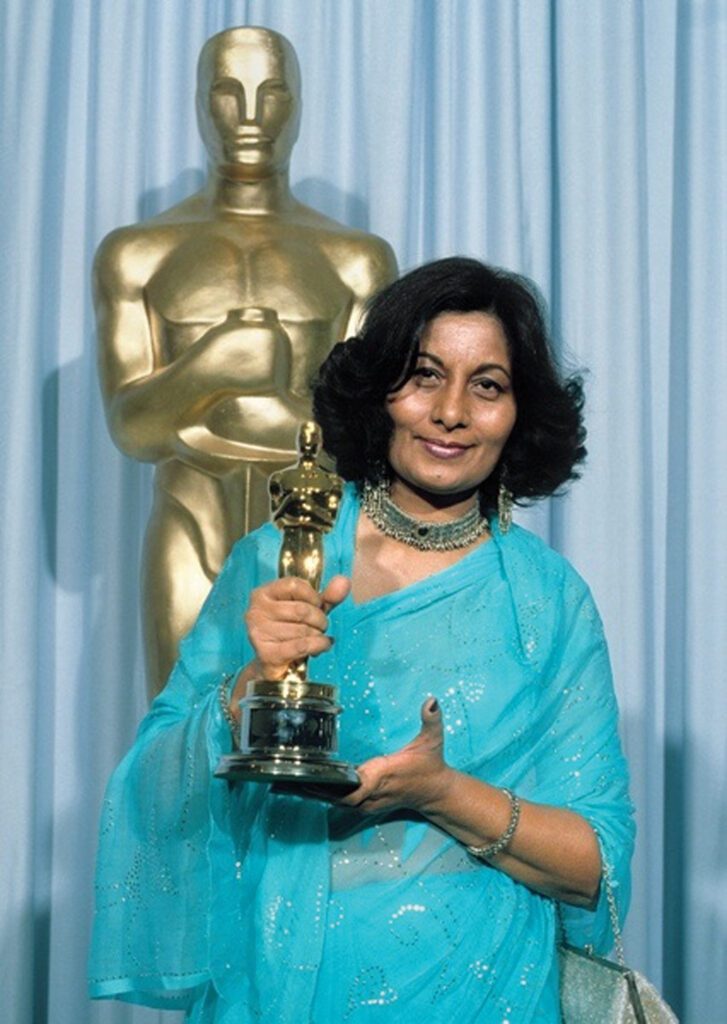
1983: Bhanu Athaiya becomes the first Indian to win an Academy Award, sharing the Best Costume Design prize with John Mollo for Richard Attenborough’s Gandhi. Her research-driven costuming, dressing Ben Kingsley in handwoven khadi inspired by Mahatma Gandhi’s own Kathiawadi wardrobe, marked a landmark moment for Indian costume design, even though India then had no organised fashion industry to absorb the international recognition.
1986: The National Institute of Fashion Technology isestablished under the Ministry of Textiles, with technical collaboration from New York’s Fashion Institute of Technology; its first design course follows in 1987, eventually producing designers such as Rajesh Pratap Singh, Manish Arora, and Namrata Joshipura.
1987: Ensemble, founded in Mumbai by designer Rohit Khosla together with Wharton-trained entrepreneur Tarun Tahiliani and his wife Sailaja Tahiliani, opens as India’s first multi-designer boutique, giving the institute’s early graduates somewhere to sell.
1991: Economic liberalisation opens the domestic market to foreign capital and ready-to-wear manufacturing.
1998: Designers form the Fashion Design Council of India, which goes on to institute the country’s first organised fashion week.
2000: Lakmé Fashion Week opens with 33 designers presenting ready-to-wear lines over seven days at Delhi’s Taj Palace, giving Indian design a recurring, mediated platform of its own rather than a borrowed one.
On the World’s Runways (2002–2011)
2002: Ritu Beri, from the National Institute of Fashion Technology’s first graduating class, steps in as head of ready-to-wear at the storied French house Jean-Louis Scherrer, calling herself the first Asian designer to lead a French fashion house.
2002: Aishwarya Rai makes her Cannes Film Festival debut in a yellow Neeta Lulla sari for Devdas, beginning more than two decades of Indian fashion visibility on one of cinema’s most-watched red carpets.
2003: Tarun Tahiliani becomes the first Indian designer invited to show at Milan Fashion Week, presenting jewel-toned, trompe l’oeil pieces printed with Mughal miniatures, a showing he later credited with the birth of his signature “India Modern” aesthetic.
2005: Manish Arora, a National Institute of Fashion Technology graduate, makes his London Fashion Week debut, introducing his exuberant, colour-saturated aesthetic to an international audience.
2007: Manish Arora becomes the first Indian designer to show at Paris Fashion Week, later joining the Chambre Syndicale du Prêt-à-Porter des Couturiers in 2009; his maximalist aesthetic is subsequently worn by Lady Gaga, Rihanna, and M.I.A.
2008: The Fashion Design Council of India launches India Couture Week in Mumbai, a dedicated showcase for bridal and embellishment craft that becomes the centrepiece of the design calendar.
2011: Manish Arora spends a year as creative director of Paco Rabanne’s womenswear in Paris, producing two seasons before returning to his own label, making him and Ritu Beri the only two Indian designers to have led a French fashion house rather than merely shown at one.
Craft, Commerce, and Global Footholds (2008–2023)
2008: Sabyasachi Mukherjee begins formalising commissions with weavers and artisans across India, including Benarasi weavers in Varanasi, kantha embroiderers in Bengal, kalamkari painters in Andhra Pradesh, chikankari artisans in Lucknow, patola weavers in Gujarat, and kanjivaram weavers in Tamil Nadu, building what is now a network of more than 3,000 craftspeople and master weavers.
2020: Rahul Mishra becomes the first Indian designer invited to present at Paris Haute Couture Week, marking India’s arrival in fashion’s highest tier of craftsmanship.
2021: Sabyasachi Mukherjee’s collaboration with H&M launches in 48 markets worldwide, the first such global partnership for an Indian designer label; in India, exclusive retail partner Myntra crashes within nine seconds of going live, with the entire collection gone in under seven minutes. The same year, Aditya Birla Fashion and Retail invests roughly $54.5 million in the Sabyasachi label and launches Tasva, a joint-venture menswear brand with Tarun Tahiliani.
2022: Sabyasachi Mukherjee opens his first international flagship store in New York.
2023: Sabyasachi Mukherjee unveils a nearly 26,000-square-foot flagship inside a heritage building in Mumbai and becomes the first Indian label to collaborate with Estée Lauder on a global beauty line; the French house Dior stages a runway show in Mumbai in recognition of India’s textile heritage.
Taken together, these milestones chart the transformation of Indian fashion over the seven decades since Independence. What began as an effort to revive handlooms, preserve craft traditions, and rebuild institutions evolved into a globally recognised creative industry. Each decade introduced a different kind of breakthrough—from craft revival and institution-building to international runways, global luxury partnerships, and the growing prominence of Indian designers, brands, and celebrities on fashion’s most influential stages. Beneath these cultural moments lies a substantial industrial base: India’s textile and apparel market was valued at more than $222 billion in 2024, demonstrating that its global visibility rests not only on symbolism but also on manufacturing capacity, design innovation, and centuries-old craftsmanship.