Russia and the Taliban have signed their first formal defence agreement, more than three decades after the Soviet Union withdrew from Afghanistan. The official text has not been released, but the political signal is clear.
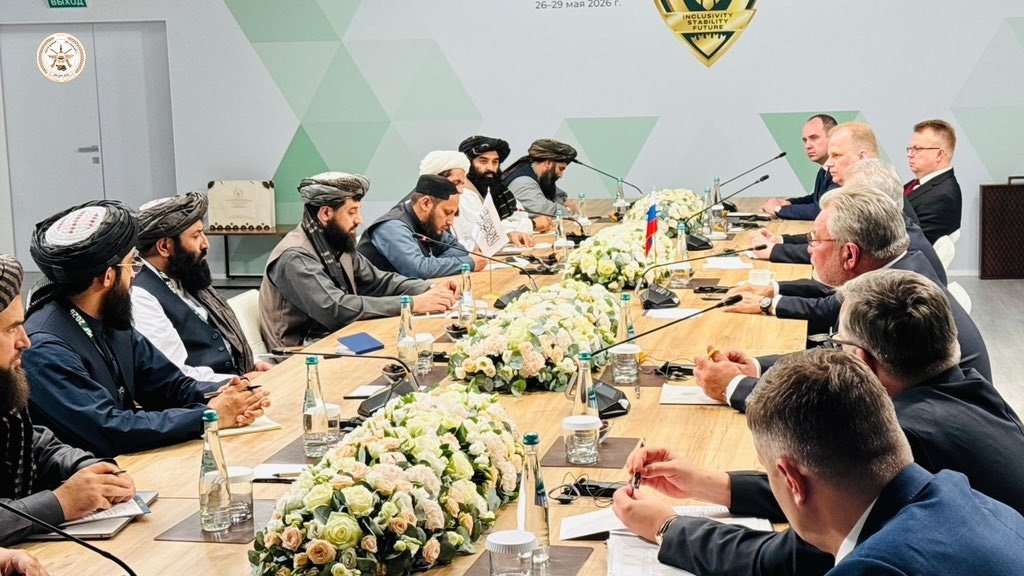
On 15 February 1989, the last Soviet armoured column crossed the Friendship Bridge out of Afghanistan. Lieutenant General Boris Gromov, commander of the Soviet 40th Army, followed the final vehicles and declared that not a single Soviet serviceman remained behind him. More than thirty-seven years later, on 27 May 2026, Mullah Mohammad Yaqoob, the son of Taliban founder Mullah Mohammad Omar, sat across from Russia’s Security Council Secretary Sergei Shoigu and signed a military-technical cooperation agreement, marking a striking reversal in the relationship between Moscow and the movement that emerged from the forces that once fought the Soviet Union in Afghanistan.
Sergei Shoigu, who oversaw the invasion of Ukraine before being shifted sideways into the Security Council, signed for Russia. Mawlawi Mohammad Yaqoob, the Taliban’s acting defence minister and Mullah Omar’s son, signed for the Islamic Emirate. The full text of the document has not been released.
What the Pact Covers
The pact was inked on the sidelines of the first International Security Forum hosted by Shoigu’s Security Council, which ran from 26 to 29 May. Russian state agency Interfax confirmed the signing first; the Taliban defence ministry confirmed the meeting but said little about the document.
In the days that followed, Zamir Kabulov, Russia’s special presidential envoy on Afghanistan, told RIA Novosti the deal was “framework-based and practical” and that its immediate focus would be the repair and restoration of Soviet- and Russian-made hardware sitting in Afghan inventories. Rustam Khabibullin, who runs Russia’s trade centre in Afghanistan, was more specific in remarks to Tatar-Inform: Tatarstan-based firms could service the Taliban’s more than 100 Mi-17 helicopters, over 30,000 KamAZ trucks, and around 2,000 other Russian-made heavy vehicles, with training centres and warranty facilities on the table.
Yaqoob himself, briefing reporters at Kabul airport on his return, kept the framing narrow. “As you can see, there are many Russian weapons in Afghanistan, including helicopters and aircraft, which need repair. We are obliged to sign agreements with the countries that manufactured these weapons so that we can use this equipment properly,” he said.
Why Russia Is Deepening Ties with the Taliban
The shift in Moscow’s posture did not begin in May. Russia’s Supreme Court took the Taliban off its list of banned terrorist organisations in April 2025. In July 2025, Russia became the first country to formally recognise the Islamic Emirate of Afghanistan. Vladimir Putin had already called the Taliban an “ally in the fight against terrorism” in 2024. The May agreement is the security layer placed on top of an already restored political relationship.
In a recent study for the Journal of Asian Security and International Affairs, Tatiana Belousova and Raghav Sharma of O.P. Jindal Global University frame this whole arc as “pragmatic realism”. The historical inversion they document is striking. In the 1990s, during the Taliban’s first stint in power, Moscow stood alongside India and Iran in arming, funding and providing political cover to the Northern Alliance against the same movement, even permitting the use of a Russian airbase in Tajikistan to ferry weapons to the front. Foreign Minister Sergei Lavrov gave the new framing its official Russian phrasing at the sixth Moscow Format consultations in October 2024: “maintaining a pragmatic dialogue with the current Afghan government”.
Three motives are doing most of the work. The first is Islamic State Khorasan Province, the regional ISIS affiliate. At the SCO security council heads’ meeting in Bishkek on 14 May, Shoigu said 18,000 to 23,000 fighters from more than twenty armed groups remain active in Afghanistan. Russian officials have separately put the strength of ISIS-K at around 3,000. Moscow has not forgotten the March 2024 Crocus City Hall attack that killed more than 140 people outside the capital and was claimed by ISIS-K.
The second is the vacuum left by the American withdrawal. Shoigu has used every recent forum to demand that Western governments unfreeze Afghan central bank assets and “take upon themselves the full burden of post-conflict recovery”, while warning in the same breath that any return of “third-country military infrastructure” to Afghanistan would be unacceptable. As an MP-IDSA brief by Priyanka Singh has noted, the Moscow Format in October 2025 issued a similarly scathing statement against external military presence in Afghanistan, read at the time as a response to Donald Trump’s stated interest in reclaiming the Bagram airbase. The translation is straightforward: nobody else gets a base, and Moscow will fill the room.
The third motive, less discussed but arguably the most consequential, is labour. The Diplomat reported in early June that buried inside Shoigu’s 14 May SCO remarks was a long-term plan for migrant-labour agreements with Kabul. With the Ukraine war hollowing out Russia’s labour market and demographic data now formally classified, Afghan workers are a resource the Kremlin can no longer afford to ignore.
The Russian analyst Ruslan Suleymanov, of the New Eurasian Strategies Center, has been blunter about the limits. “In reality, we’re definitely not going to see a full-blown military alliance or a mutual defense coalition.” Within a strict military frame, he has added, “Russia essentially has nothing to offer to the Taliban”.
What the Taliban Hopes to Gain
For Kabul the calculus is simpler. The pact is the Taliban’s first defence agreement with a permanent member of the UN Security Council since 2021. Hameed Hakimi, a non-resident senior fellow at the Atlantic Council, has argued that the symbolism will let the Taliban “claim external legitimacy and create a PR moment to influence public opinion domestically”.
It also offers something more practical. Much of the Afghan army’s inherited inventory, including Mi-17 and Mi-24 helicopters, T-55 and T-62 tanks, and BMP-1 and BMP-2 infantry fighting vehicles, traces back to Soviet and Russian production lines. A large share of it is reported to be obsolete or no longer operational, and there is no Western route to spare parts. The original manufacturer is the only realistic source of repair.
A Strategic Setback for Pakistan
The deal lands hardest in Islamabad. Pakistan spent decades cultivating “strategic depth” in Afghanistan, a doctrine that asked its western neighbour to remain pliable so that Rawalpindi could concentrate on its eastern front with India. The Taliban’s 2021 return was meant to be the doctrine’s vindication.
Three things have gone wrong instead. The Taliban refuses to recognise the Durand Line, the colonial-era boundary Pakistan inherited as an international border. The Tehrik-i-Taliban Pakistan has used Afghan soil for cross-border attacks while the Afghan Taliban declines to act decisively against it. And now Moscow has openly entered the maintenance contract Islamabad once dominated.
Yaqoob made the connection explicit himself. Back in Kabul on 30 May, he said implementation of the Russian deal would begin shortly and warned that, in the near future, “we will try to ensure that Pakistan no longer dares to attack [Afghan territory]”, a reference to repeated Pakistani air and rocket strikes into Afghan border provinces over the past year. Two anonymous Pakistani security officials pushed back on the threat. The Russian deal, they said, would not stop Pakistan from launching “airstrikes… targeting terror camps in future”. Gul-i-Ayesha Bhatti, an assistant professor of international relations at the National University of Science and Technology in Islamabad, called the deal largely symbolic and read Yaqoob’s remark as a hint that Kabul wants Russian air-defence systems. Russia is fending off large-scale Ukrainian drone attacks, she noted, and “neither Russia nor any other global superpower has the surplus capacity to fulfill Kabul’s needs”. Two days after Yaqoob’s airport remarks, Islamabad and Beijing announced fresh coordination against militant groups operating from Afghanistan.
The Taliban is increasingly less a Pakistani asset than a sovereign actor seeking to convert geopolitical relevance into diplomatic recognition, military cooperation, and economic support.
India, Central Asia, and the Limits of Recognition
India’s National Security Adviser Ajit Doval was at the same Moscow forum, holding bilateral talks with Shoigu on 28 May while telling the plenary there could be “no double standards” on terror. New Delhi has been working quieter channels with Kabul for over a year, and the erosion of Pakistan’s monopoly over Afghan policy serves Indian interests.
Russia’s Afghan strategy goes beyond the military deal. In a Special Eurasia assessment on 1 June, Silvia Boltuc notes that Moscow sees the planned Trans-Afghan railway, which would link Russian and Uzbek networks to Pakistani ports, as a southward extension of its own North-South Transport Corridor toward South Asia, with preliminary estimates of 8 to 15 million tonnes of freight a year. The Taliban’s acting industry minister has separately invited Russian firms to invest in Afghan lithium, copper and precious-stone reserves. The military pact, on this reading, sits on top of an economic and infrastructural relationship that does not feature in its text.
For the Central Asian republics, Russian engagement with Kabul is welcome insofar as it suppresses ISIS-K, and uncomfortable insofar as it formalises a long-term Russian role on their southern flank. China continues to engage Kabul on its own terms, with separate security understandings around the Wakhan Corridor.
Other governments are unlikely to follow Russia into formal recognition. Even Beijing and Tehran, the Taliban’s closest sympathetic interlocutors, have stopped short of it. Most senior Taliban figures remain on UN sanctions lists. As the Afghan analyst Shahmahmood Miakhel argued on 2 June, until that changes, recognition will arrive in pieces: an ambassador here, a memorandum there, a deal that puts helicopters back in the air but does not put Kabul back in the room.
Note: This explainer has been researched, edited, and fact-checked by India’s World staff and prepared with AI assistance.