How one telecom network helped transform India from a data-scarce nation into one of the world’s largest digital societies
Today, it is difficult to find an Indian without a smartphone. From farmers in remote villages to street vendors in crowded city markets, people spend hours on their phones watching videos, making video calls, sending voice messages on WhatsApp, making digital payments, and consuming content online. The smartphone has become an indispensable part of everyday life.
A decade ago, however, India looked very different. Smartphones were less common, particularly among lower-income households, and even those who owned them often used them sparingly. Mobile data was expensive. A gigabyte of data cost roughly ₹250, making internet access a luxury rather than a utility. Many users subscribed to monthly data packs of just one or two gigabytes and carefully rationed their usage. Watching YouTube videos on mobile data was uncommon. Downloading a movie, updating apps, or transferring large files was often postponed until a Wi-Fi connection became available. For millions of Indians, the internet was something to be accessed occasionally, not lived on continuously.
That world changed dramatically after September 2016, when Reliance Jio entered the telecom market.
In less than a decade, India moved from 155th place in global mobile broadband penetration to becoming the world’s largest consumer of mobile data. Mobile broadband users expanded from 132 million to more than one billion. The average Indian’s monthly data consumption rose from just 240 MB to among the highest levels in the world. Digital payments, streaming platforms, online education, telemedicine, and app-based services became part of everyday life.
The story of Jio is therefore not merely the story of a telecom company. It is the story of how connectivity became a mass utility in the world’s most populous nation.
Building the Foundations
On September 5, 2016, Jio launched commercial services across all 22 telecom circles simultaneously. Built as India’s first greenfield all-IP network, it was also the only operator at the time providing next-generation digital services over an end-to-end all-IP architecture at such scale.
The company’s growth was immediate and unprecedented.
Within 170 days, more than 100 million customers had signed up for Jio’s services. At its peak, the company was adding seven subscribers every second. By July 2018, just twenty-two months after launch, Jio had accumulated 215 million subscribers, making it one of the fastest technology adoption stories in history.
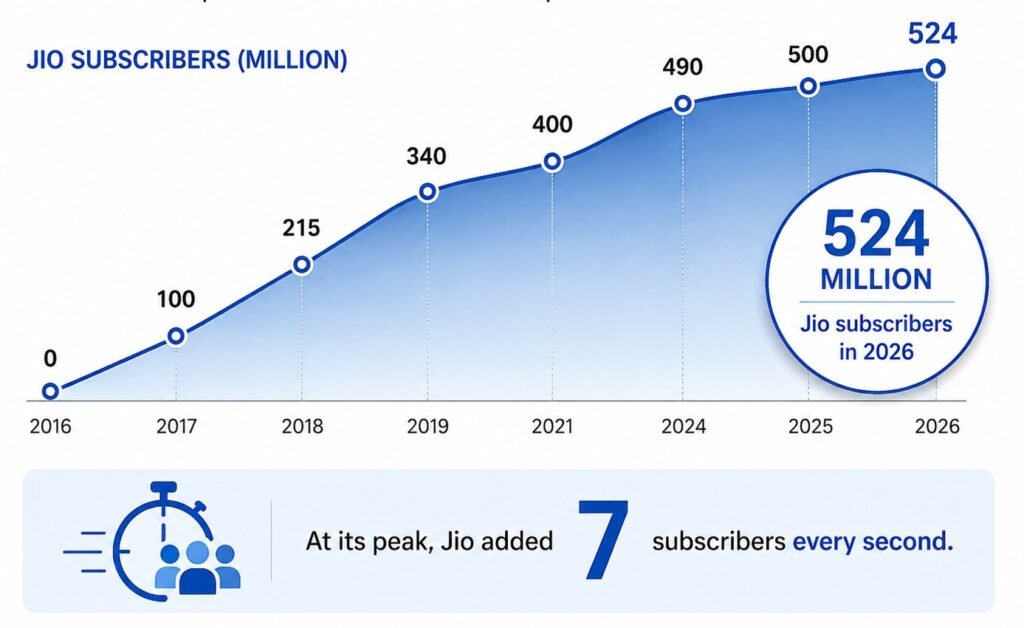
The speed of adoption reflected a deeper shift underway. Jio was not simply attracting customers from competitors; it was dramatically expanding the market for mobile internet itself.
The Price Revolution
The most important number in the Jio story is arguably not subscriber growth, revenue, or market valuation.
It is ₹250.
That was the approximate cost of one gigabyte of mobile data in India before Jio’s arrival.
Within a year, the price had fallen below ₹10. Today it stands at approximately ₹8.3 per GB—a decline of nearly 97%.
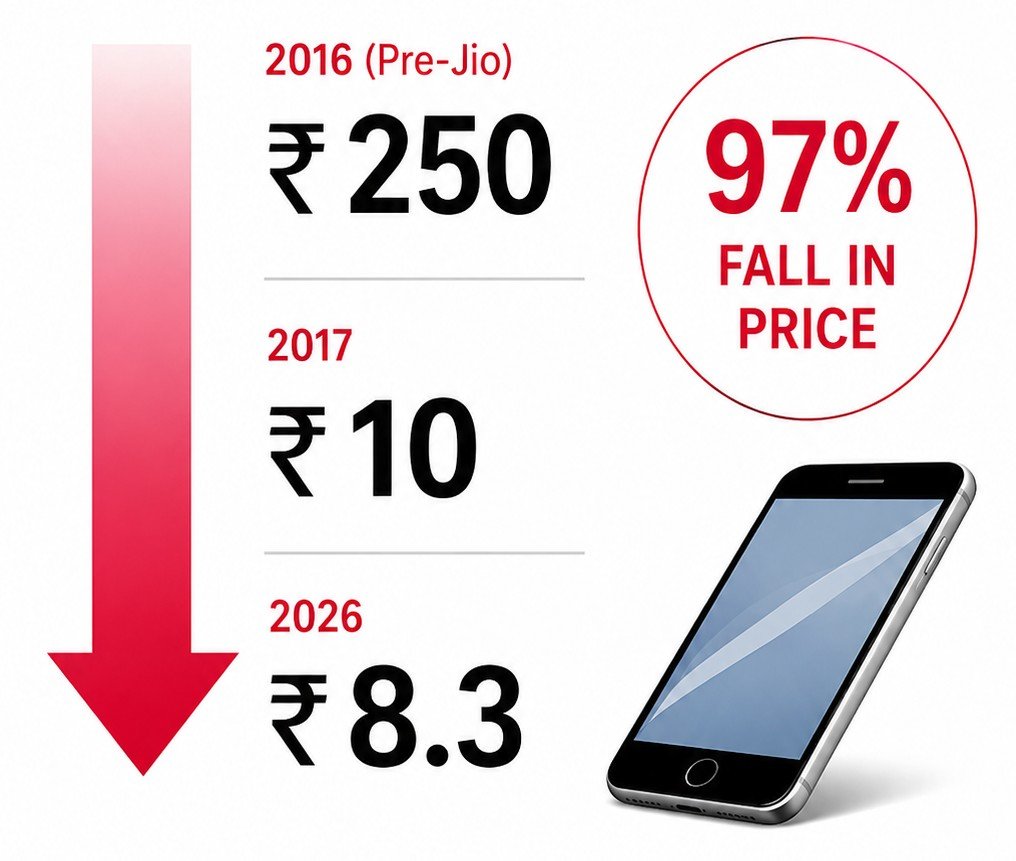
The consequences were profound. As the cost of connectivity collapsed, internet access ceased to be a scarce commodity and became an everyday utility.
Millions of Indians who previously limited their internet usage suddenly found themselves able to consume content, communicate, transact, and work online at a previously unimaginable scale.
From Data Scarcity to Data Abundance
The impact of cheaper data became visible almost immediately.
Before Jio, India consumed roughly 20 crore gigabytes of mobile data every month. Within six months of launch, consumption crossed 120 crore gigabytes. By July 2018, it had exceeded 240 crore gigabytes per month—a twelve-fold increase in less than two years.
India’s rise from 155th place in global mobile broadband penetration to the world’s leading consumer of mobile data occurred in less than a year.
The transformation was equally dramatic at the individual level.
Before Jio, the average Indian mobile broadband user consumed approximately 240 MB of data every month. By FY2026, industry-wide consumption had reached 25.7 GB per user per month. Jio subscribers consumed an average of 42.3 GB monthly—among the highest per-capita levels in the world.
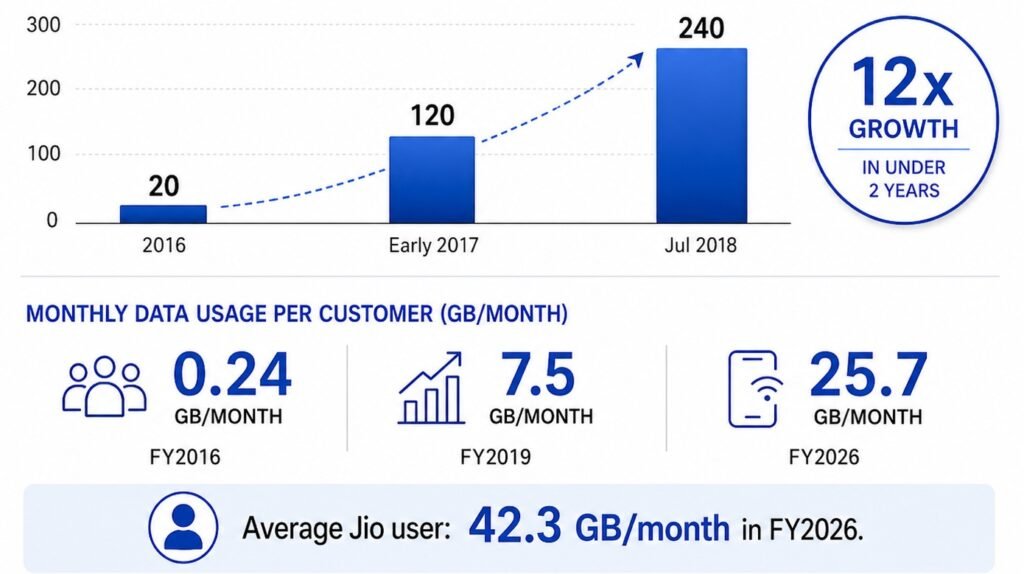
As of FY2026, Jio’s network carried approximately 60% of all mobile data consumed in India. During the six months ending September 2025, Jio carried more mobile data than any telecom operator globally outside China.
Its total annual data traffic crossed 241 exabytes in FY2026, growing by 30.8% year-on-year.
Connecting a Billion People
The spread of mobile broadband is perhaps the clearest measure of India’s digital transformation.
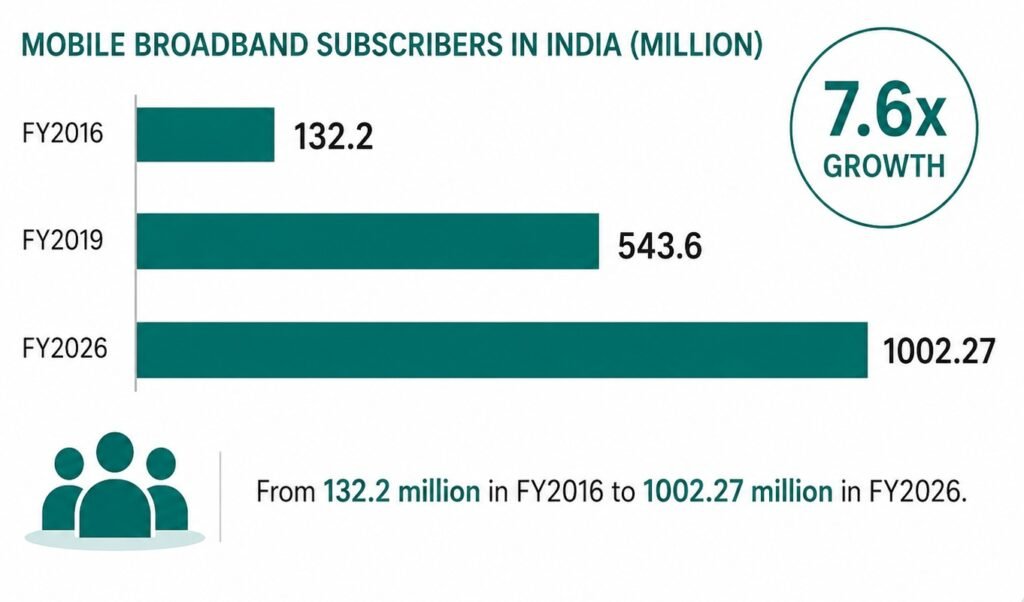
Mobile broadband users grew from 132.2 million in FY2016 to 543.6 million in FY2019. By FY2026, India had crossed the one-billion mark in mobile broadband subscribers.
The rise of 4G was even more remarkable.
India had fewer than 10 million 4G subscribers in FY2016. By FY2019, that number had risen to 478.4 million. By FY2026, the country had 568.3 million 4G subscribers.
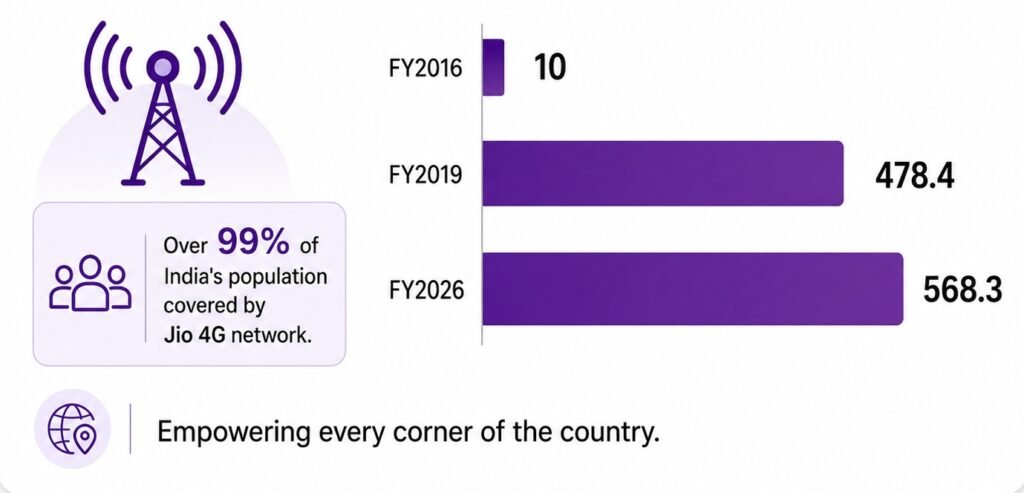
Meanwhile, Jio built a network covering more than 99% of India’s population within three years—a task that had taken incumbent operators roughly twenty-five years to achieve for earlier generations of telecom technology.
As of FY2026, Jio serves more than 524 million subscribers.
The Rural Internet Revolution
The benefits of connectivity were not confined to India’s cities.
Rural internet subscribers increased from 227 million in FY2019 to 427.7 million by September 2025.
Nearly 46% of all data consumed on Jio’s network during the nine months ending December 2025 originated in rural India. Similarly, approximately 37% of net additions to Jio’s fixed broadband business came from rural areas.
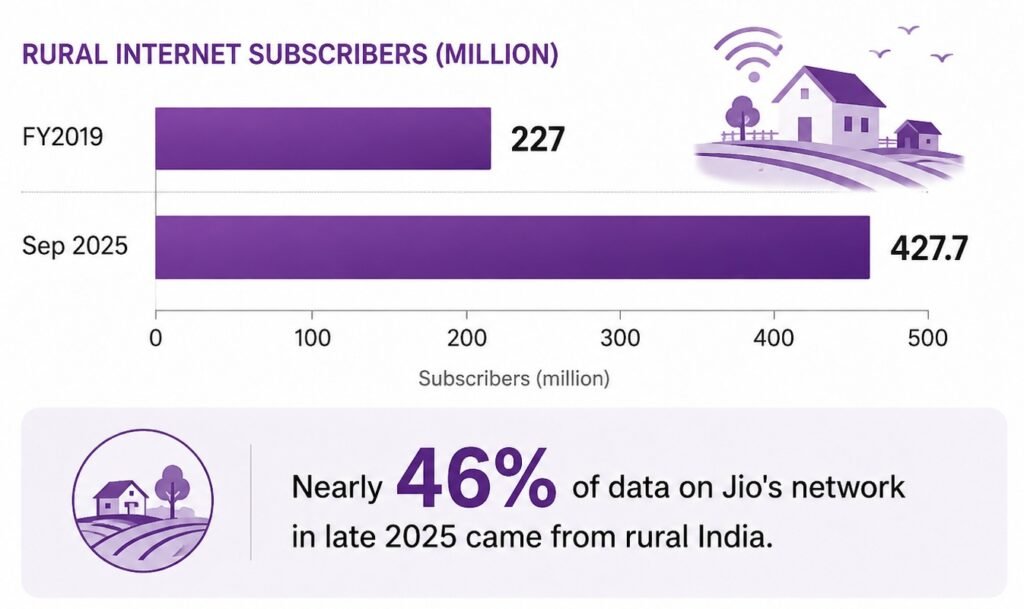
The significance of these numbers extends beyond telecommunications. For decades, discussions about India’s digital divide have centred on geography. Affordable mobile broadband narrowed that divide at a scale few had anticipated.
Enabling the Digital Economy
The significance of Jio lies not only in the networks it built but also in the economic ecosystem that emerged on top of those networks.
Consider digital payments.
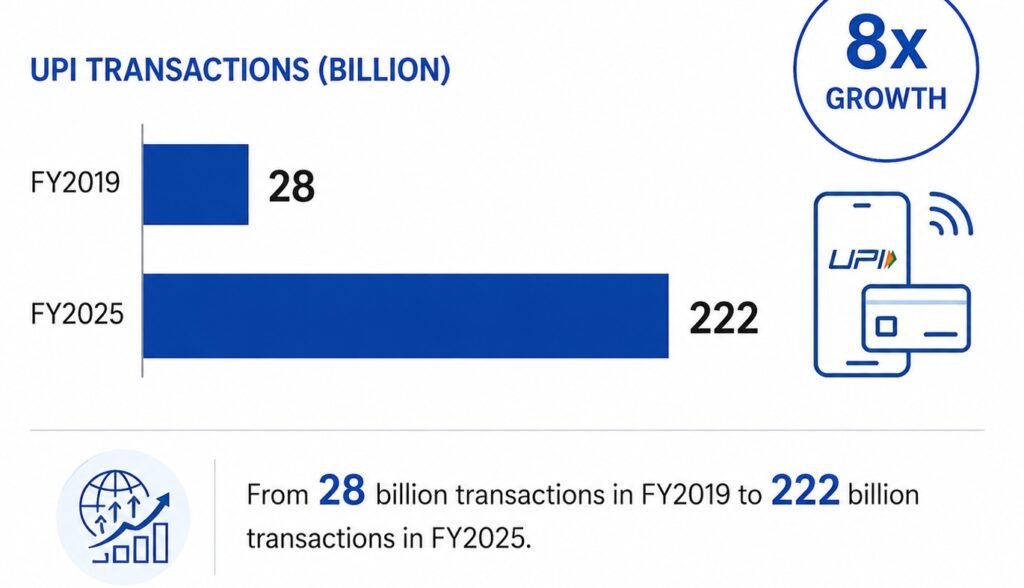
UPI transactions increased from 28 billion in FY2019 to 222 billion in FY2025.
Streaming platforms experienced similar growth. OTT subscribers increased from approximately 30 million in FY2016 to 275 million in FY2019 and 601 million by July 2025.
India’s startup ecosystem expanded from roughly 500 registered startups in 2016 to more than 200,000 by December 2025, including more than one hundred unicorns.
Today, India’s digital economy contributes approximately 13% of Gross Value Added, equivalent to around $500 billion. By FY2030, it is expected to exceed $1.2 trillion and account for nearly one-fifth of national economic output.
Many factors contributed to this transformation. But affordable connectivity provided the foundation upon which digital services could scale.
The 5G Era
Having reshaped the economics of 4G, Jio turned its attention to 5G.
On October 4, 2022, the company launched Jio True 5G, India’s first standalone 5G network. Built on a cloud-native and software-defined architecture, the network was developed entirely in-house.
Within a year, Jio deployed more than one million 5G cells across all twenty-two telecom circles, accounting for nearly 85% of India’s 5G capacity.
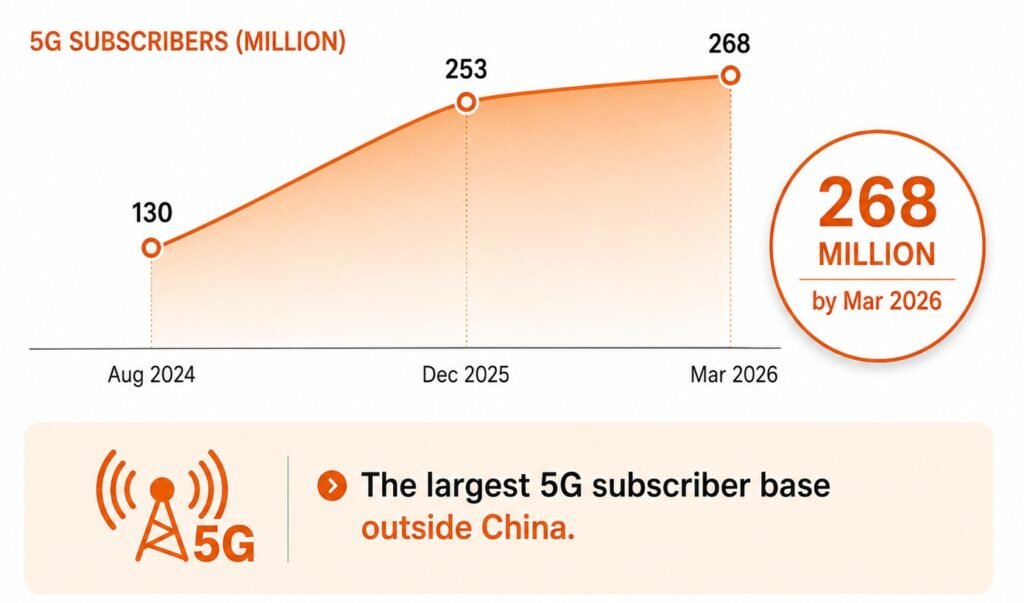
By March 2026, Jio had accumulated 268 million 5G subscribers, creating the largest 5G subscriber base outside China.
The deployment was supported by spectrum acquisitions across the 700 MHz, 3300 MHz, and 26 GHz bands, part of the nearly ₹2 lakh crore commitment made during RIL AGM 2022.
Beyond Connectivity
Jio’s ambitions increasingly extend beyond telecommunications.
In 2020, Jio Platforms raised ₹1,52,056 crore (approximately $20.5 billion) from fourteen global investors, including Meta, Google, KKR, Silver Lake, General Atlantic, Mubadala, ADIA, Qualcomm Ventures, and Intel Capital. The transaction remains the largest private fundraise in Indian corporate history and helped Reliance Industries become net-debt free.
The company has since expanded into artificial intelligence, enterprise platforms, cloud services, fintech, digital content, and smart-home technologies.
JioHotstar today claims approximately 300 million paying subscribers, making it the world’s second-largest streaming platform. JioBrain, the company’s AI platform, powers predictive network management, spam detection, churn prediction, and energy optimisation systems.
Fibre, Airwaves, and the Last Mile
Jio’s broadband ambitions extend beyond mobile networks.
JioFiber, launched commercially in September 2019, crossed 10 million subscribers by August 2023. The company’s fibre footprint now spans approximately 1.5 million kilometres.
In September 2023, Jio launched JioAirFiber, designed to bring broadband connectivity to the estimated 200 million Indian homes beyond the reach of fibre.
By March 2026, JioAirFiber had scaled to approximately 13 million customers, becoming the largest fixed wireless access service outside China.
Combined fixed broadband subscribers reached 25.3 million.
Networks Under Pressure
The true measure of a communications network often emerges during moments of national stress.
During the COVID-19 pandemic, Jio’s network connected more than 40 crore individuals and enabled over 30,000 organisations to function remotely. The company developed JioMeet within two months and provided free calls and SMS services to JioPhone users during lockdowns.
At the 2025 Maha Kumbh Mela in Prayagraj—the largest gathering of people anywhere in the world—Jio’s network handled approximately 20 million voice calls and 400 million data requests on a single peak day. More than 660 million pilgrims attended the event over forty-five days.
At the opposite extreme, Jio extended connectivity to Siachen Glacier, where temperatures can fall below minus 50 degrees Celsius.
Creating Intellectual Property
The story of Jio is not solely one of infrastructure but also of technology creation.
The company and its subsidiaries have cumulatively filed 6,817 patents as of March 31, 2026, across 5G, 6G, IoT, and related technologies. Of these, 2,393 were filed in India, and 4,424 have been filed in foreign jurisdictions. Of the total filings, 1,009 patents have been granted globally, comprising 538 grants in India and 471 across foreign jurisdictions.
The company has received the National Intellectual Property Award 2024, the WIPO IP Enterprises Trophy, and the Asia IP Elite Award 2025.
More Than a Telecom Story
Railways helped integrate colonial India. Highways accelerated the movement of goods in liberalising India. Digital networks have become the infrastructure of twenty-first-century India.
Measured by subscribers, revenues, patents, data traffic, or 5G deployment, Jio’s achievements are impressive in their own right. Yet the company’s larger significance lies elsewhere.
By driving down the cost of connectivity and expanding access to hundreds of millions of people, Jio helped create the foundations upon which India’s digital economy now rests. Mobile broadband users increased sevenfold. Data prices collapsed by more than 95%. Digital payments exploded. Streaming platforms flourished. Rural connectivity expanded dramatically.
The architecture of Digital India is built from many components—smartphones, digital public infrastructure, entrepreneurs, government policy, and consumers themselves. But the networks that carry information between them remain fundamental.
In that architecture, Jio occupies a central place.