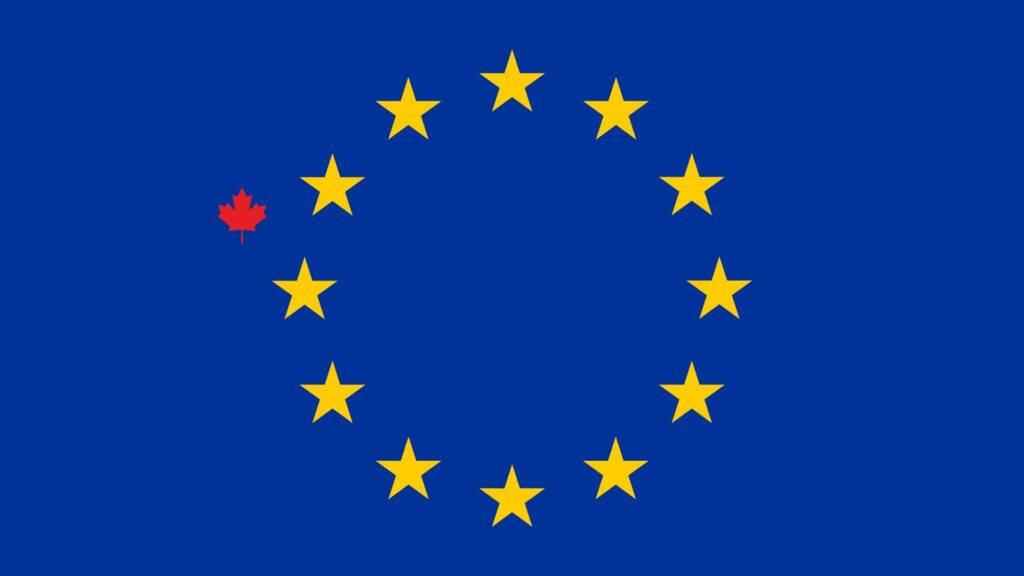
European Commission President Ursula von der Leyen proposed on 16 September 2026 that Canada become the European Union’s first “associate member”, opening the possibility of a new form of relationship between Brussels and Ottawa. She made the proposal during her State of the European Union address in Strasbourg, with Canadian Prime Minister Mark Carney in the European Parliament. The terms of the proposed status remain undefined.
“I said we must urgently reimagine our partnerships. So, I would like to work with you on opening the door for Canada to be the first associate member of the EU”, von der Leyen said. She outlined cooperation in defence, intelligent manufacturing, technology, the Arctic, energy, critical minerals, artificial intelligence, and other strategic sectors.
The announcement was significant, but it did not make Canada an EU member, nor did it create a new legal category overnight. The EU treaties do not currently define “associate membership”. Carney had already said on 13 September that Canada was seeking a “unique alliance” with the EU, not full membership.
The proposal is therefore the opening of a political process rather than the conferral of a settled legal status.
What Does ‘Associate Membership’ Actually Mean?
At present, there is no fixed answer. The EU has established forms of association with non-member countries, but “associate member” is not itself a recognised category of EU membership. Article 217 of the Treaty on the Functioning of the European Union allows the bloc to conclude association agreements with third countries involving reciprocal rights and obligations, common action and special procedures.
Countries already have very different relationships with the EU without becoming members. Norway, Iceland, and Liechtenstein participate in the European single market through the European Economic Area. Switzerland has a separate network of agreements with the EU, while Ukraine, Moldova, and Georgia have association agreements. The UK has its post-Brexit arrangements. Canada’s proposed status would therefore have to be negotiated rather than simply applied from an existing template.
That is why the most important point about the 16 September announcement is that it opened a negotiation over substance. The rights and obligations would come from whatever agreements Ottawa and Brussels ultimately negotiate, not from the phrase “associate member” itself.
The EU’s Strategic Interests in Canada
Full EU membership follows a different legal route. Under Article 49 of the Treaty on European Union, a “European State” that meets the Union’s political and legal requirements may apply to join. The accession process requires agreement by the EU institutions and the member states.
Canada is geographically in North America. Its political, historical, and cultural connections with Europe do not make it eligible for ordinary accession under the existing framework. Associate membership is consequently being discussed as a possible middle ground: closer integration than a conventional external partnership, but without Canada becoming an EU member state.
That distinction would matter institutionally. Canada would not automatically obtain a seat or vote in the Council of the EU, representation in the European Parliament, or EU citizenship for Canadian nationals.
What Could Canada Gain?
The proposal points towards a relationship built around strategic sectors rather than a wholesale replication of EU membership.
Trade would be central. Canada and the EU already have the Comprehensive Economic and Trade Agreement, or CETA, which has been provisionally applied since September 2017. The European Commission’s Canada trade page records a substantial increase in bilateral trade since CETA came into force.
A deeper arrangement could reduce additional trade barriers, expand regulatory cooperation, and connect Canadian companies more closely to European supply chains. The two sides are also negotiating a Digital Trade Agreement.
Technology and research would form another layer. Von der Leyen proposed a technology alliance, while existing cooperation already covers research through Canada’s association with Pillar II of Horizon Europe.
Defence is arguably more advanced than the “associate membership” label suggests. Canada signed a Security and Defence Partnership with the EU in 2025 and has since joined the EU’s Security Action for Europe (SAFE) defence procurement framework. The Canadian government’s account of the Canada-EU security relationship describes cooperation covering defence, military mobility, maritime security, and cyber security.
The Arctic could become another major area. Canada is an Arctic state, while European governments are paying greater attention to northern infrastructure, security and supply routes. Von der Leyen described the Arctic as a potential flagship area for joint work.
Mobility has also entered the discussion. There have been reports of possible arrangements concerning workers, students, and professional qualifications. But associate membership would not automatically give Canadians the right to live and work throughout the EU. Any such rights would have to be specifically negotiated.
The EU’s Strategic Interests in Canada
For Brussels, Canada offers a combination of resources, industrial capacity and strategic geography.
Critical minerals are particularly important. The EU has been trying to reduce vulnerabilities in strategic supply chains, including dependence on China for important raw materials. Canada has substantial supplies of critical minerals and an established mining and energy sector.
Canada can also contribute to European ambitions in artificial intelligence, quantum technologies, space, advanced manufacturing, and defence production. Energy is another attraction, while Canada’s Arctic position gives the relationship a strategic dimension beyond trade.
There is therefore an institutional calculation as well. The EU is exploring how far it can build close relationships with countries outside Europe without moving towards formal enlargement. A Canadian arrangement could become a test of whether the Union can create deeper economic and security integration without expanding its membership.
The Timing Behind the Proposal
The immediate context is the deterioration in Canada-US trade relations. Canada is reassessing an economic relationship that has for decades been heavily oriented towards the United States, while the EU is simultaneously seeking to strengthen its own capacity in defence, energy, technology, and strategic supply chains.
The most useful way to understand Ottawa’s policy is as diversification rather than decoupling: the scale of Canada’s existing integration with the US makes a clean break unrealistic. The objective is instead to reduce the extent to which changes in Washington can determine Canadian economic choices.
That distinction matters. The United States remains Canada’s overwhelmingly important export market, with industries including automobiles, energy, and agriculture built around cross-border supply chains. The Canada–United States–Mexico Agreement (CUSMA) remains in force, but the trade dispute has made the assumption of predictable US market access less secure.
Europe therefore represents diversification, not substitution. The EU is one part of a wider Canadian effort to expand markets and partnerships, alongside the Indo-Pacific and efforts to strengthen domestic industrial capacity.
Why Europe, Specifically?
Europe is not Canada’s only alternative. Ottawa has also been looking towards the Indo-Pacific, including India and ASEAN economies, while seeking to expand energy exports and strengthen critical-mineral supply chains, placing the EU within this wider effort rather than treating Europe as a replacement for the United States.
Europe nevertheless has a particular attraction because trade, political, and security ties with Canada are already well developed. CETA provides the economic foundation, while research and defence agreements have created additional institutional links. The proposed associate membership could bring several strands of an already expanding relationship into a more coherent framework.
Canada’s Security Ties with the US
This is where the limits of the European pivot become clearest. Canada and the United States remain deeply integrated through the North American Aerospace Defense Command (NORAD), the binational command responsible for the defence of North America. Their military, intelligence, and defence-industrial systems have developed together over decades.
Closer European defence cooperation can broaden Canada’s options, but it cannot simply replace the North American security architecture. The same logic applies economically. The European market can provide Canadian firms with additional opportunities, but it cannot quickly reproduce the volume, proximity, and supply-chain integration of the American market.
Canada can therefore deepen European defence partnerships while maintaining NORAD and NATO commitments. The strategy is better understood as creating more options rather than selecting one bloc over another.
The Possibility of Single Market Access
Possibly in selected areas, but it is too early to assume full access. The EU single market is based on the movement of goods, services, capital, and people, alongside a large body of common regulation. CETA gives Canada preferential trade access, but Canada remains outside the EU customs union and internal market.
A future arrangement could provide deeper access in specific sectors, perhaps through regulatory recognition, common standards or closer integration of strategic supply chains. But this would create a difficult political question for both sides: how much of the EU’s regulatory system would Canada accept, and what say would Canada have over rules it did not formally help make?
The Legal and Political Challenges
The first is legal uncertainty. There is no established EU treaty category of “associate membership”, meaning the political proposal would have to be translated into actual agreements and institutions.
The second is political. Von der Leyen cannot create a new membership category by herself. The EU’s member states would have to agree to whatever substantive arrangement eventually emerges.
The third is the question of market access and regulatory alignment. A special Canadian arrangement would have to coexist with the rights and obligations of EU members and other closely integrated partners.
There is also unfinished business around CETA. The agreement has generated substantial trade growth, but not all EU member states have completed national ratification. A much more ambitious arrangement would involve even more politically sensitive questions.
Finally, there is Washington. President Donald Trump warned on 16 September that the United States could impose additional tariffs on the EU if it considered a new Canada-EU arrangement a “hostile act”. That adds another layer of uncertainty to what is already a complicated negotiation.
What Happens Next?
The immediate challenge is to turn a political proposal into a defined negotiating agenda. Carney has indicated that Canada and the EU will begin discussions on a broader security and economic alliance, while the Canada-EU summit scheduled for 29–30 October in Montreal is expected to provide an important setting for advancing the relationship.
The eventual substance will determine whether “associate membership” becomes a meaningful new category or simply an umbrella for cooperation that is already expanding.
For Canada, the attraction is greater economic and strategic choice at a time when dependence on the US has become less predictable. For the EU, Canada offers resources, technology, energy, defence capacity, and an important Arctic connection.
The proposal is therefore less about Canada becoming European than about constructing a relationship that neither side currently has. The 16 September announcement opened that conversation. The negotiations that follow will determine what “associate member” actually means.
Note: This explainer has been researched, edited, and fact-checked by India’s World staff and prepared with AI assistance.