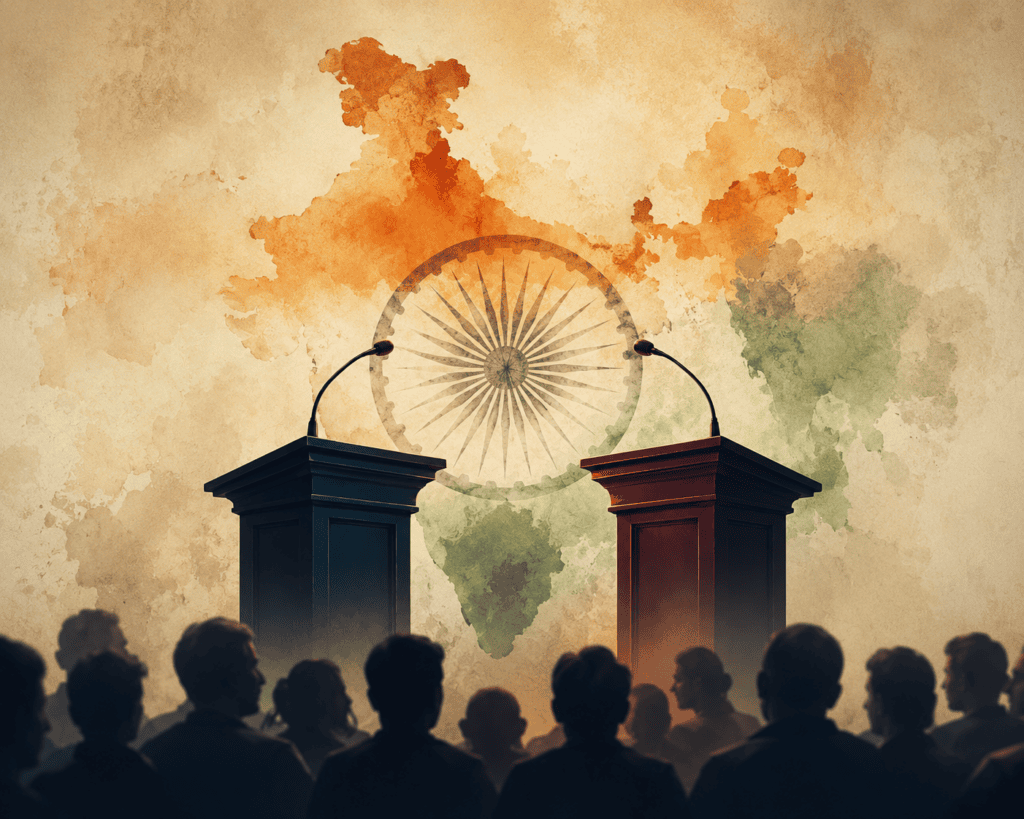
Prime Minister Narendra Modi announced on 15 August 2026 that India would build a “massive, modern Civil Defence volunteer force”, arguing that the nature of warfare and security threats has changed. Speaking from the Red Fort on the country’s 80th Independence Day, he said wars were no longer confined to border areas and that threats could also target data centres, banking systems, factories, refineries and other critical infrastructure.
The announcement does not mean that India is creating civil defence for the first time. India already has a statutory Civil Defence system, backed by the Civil Defence Act, 1968. What Prime Minister Modi has announced is an overhaul and expansion of that existing framework, with greater emphasis on modern threats, technology, preparedness and civilian participation.
What Is Civil Defence?
Civil Defence is the system through which civilians and civil authorities prepare for and respond to emergencies arising from war, hostile attacks and disasters.
Under India’s legal framework, civil defence includes measures that do not amount to actual combat but are intended to protect people, property, places and other assets from hostile attacks. The law also covers measures for disaster management. Its objectives include saving lives, limiting damage to property, maintaining essential production and services, and supporting public morale.
In practical terms, this can involve warning systems, evacuation, rescue, firefighting, emergency communications, medical assistance and measures to restore essential services after an emergency. Civil Defence volunteers can also support authorities during disasters and other emergencies.
The concept has consequently evolved considerably from its original wartime meaning. India’s official Civil Defence framework now includes threats ranging from conventional attacks to nuclear, biological and chemical hazards, as well as natural and man-made disasters.
Does India Already Have a Civil Defence Force?
Yes. India’s present system dates back to the security environment of the 1960s.
Before the 1962 war with China, civil protection planning was largely focused on encouraging States and Union Territories to prepare for emergencies in major cities and towns. The Chinese aggression in 1962 and the India-Pakistan conflict in 1965 led to a major reassessment of the country’s civil defence arrangements.
Parliament subsequently enacted the Civil Defence Act in May 1968. The Act extends across India and provides the legal basis for Civil Defence Corps and for measures to protect civilians and property from hostile attacks.
The law was subsequently amended to give Civil Defence an additional disaster-management role while retaining its primary civil defence function. The present legal framework therefore already allows Civil Defence personnel to operate before, during and after disasters.
So What Exactly Has Prime Minister Modi Announced?
The key announcement is the modernisation and expansion of this existing system.
Prime Minister Modi said that civil defence arrangements developed according to the requirements of the previous century had become outdated. He announced that India would establish a “vibrant network of Civil Defence” and create a “massive, modern Civil Defence volunteer force” capable of dealing with contemporary challenges.
His argument was that India’s security preparedness must now extend beyond the traditional battlefield.
“Wars are not just being waged on the borders”, Prime Minister Modi said, referring specifically to data centres, banking systems and other parts of critical infrastructure. He argued that India must not only modernise its weapons and armed forces but also prepare its citizens for new forms of crisis.
The precise organisational structure of the proposed expanded force has not yet been set out in the announcement. It is therefore more accurate to describe the policy as a planned overhaul of Civil Defence rather than the creation of an entirely new institution.
Why Does the Government Believe the Old System Needs to Change?
The underlying argument is that the nature of security threats has broadened.
A conventional military attack would be directed primarily against military targets or territory. A contemporary conflict can also create disruption by attacking infrastructure that civilian life depends upon.
Power systems, communications networks, financial institutions, data centres, transport infrastructure, factories and refineries can all be strategically important. Damage to such facilities could have consequences far beyond the individual site involved.
This is also why modern civil defence is increasingly linked to the broader idea of national resilience. The objective is not simply to protect people from physical attack. It is to ensure that society can continue functioning during a major crisis and recover quickly afterwards.
Prime Minister Modi’s announcement places civilian preparedness within this wider security framework.
What Do Civil Defence Volunteers Currently Do?
India’s Civil Defence organisation is primarily voluntary, supported by a smaller number of full-time personnel. Volunteers are trained and administered through the Civil Defence structure and can receive duty and training allowances.
Their work is not restricted to wartime situations. Civil Defence volunteers can assist government authorities in disaster response, relief operations, prevention and mitigation of disasters, social and welfare activities, and other emergency-related tasks.
Training is conducted through a multi-level system. The National Civil Defence College in Nagpur provides specialised and master-trainer training, while State-level institutions conduct team and leadership training. Local-level training is then provided to volunteers through trained instructors.
The existing architecture therefore gives the government a base on which to build a larger and more technologically capable network.
How Large Is the Existing System?
The official Civil Defence website states that the existing volunteer target is 14.11 lakh, with 5.38 lakh volunteers already raised. The same framework identifies a longer-term objective of building a Civil Defence presence across districts and reaching one crore volunteers over seven years.
The organisation has historically not been uniformly established across the country. The official system says Civil Defence activities have been concentrated in areas considered vulnerable from an enemy-attack perspective, with activities listed across 259 categorised towns in 36 States and Union Territories.
A nationwide expansion would therefore represent a major change in scale as well as in purpose.
What Could a Modern Civil Defence System Look Like?
The government’s announcement does not yet specify the complete design, so it is too early to say exactly what the new force will look like.
But its stated rationale indicates a shift towards preparedness for a wider range of threats. Civil Defence could increasingly involve modern warning and communication systems, emergency coordination, evacuation and shelter management, protection of essential services, disaster response and public preparedness.
The experience of recent civil defence exercises already shows how such preparedness can involve multiple agencies and critical infrastructure.
In May 2025, against the backdrop of heightened tensions with Pakistan following the Pahalgam terror attack, the government conducted Operation Abhyaas, a nationwide civil defence exercise covering around 400 districts, including 244 categorised civil defence districts. The exercise involved air-raid warning sirens, communication links with the Indian Air Force, blackout measures, evacuation drills and measures to protect vital installations.
Such exercises illustrate an important point: civil defence is not simply about volunteers standing by for a military attack. It requires coordination among district administrations, police, fire services, health authorities, infrastructure operators and the public.
How Is This Different From the Armed Forces?
Civil Defence is not a military force and its personnel are not intended to replace the armed forces.
The Civil Defence Act explicitly defines civil defence in terms of measures that do not amount to actual combat. Its role is to protect civilians and support the functioning of society during emergencies.
In a major conflict, the armed forces would remain responsible for military operations. Civil Defence would address the consequences for the civilian population and essential services.
This division becomes particularly important when threats extend beyond conventional military targets. The more critical civilian infrastructure becomes to national security, the more important civilian preparedness becomes alongside military capability.
What Can India Learn From Other Countries?
Several countries have integrated civilian preparedness much more deeply into their national security systems.
Sweden’s concept of “Total Defence”, for example, combines military defence and civil defence. The country’s civil defence framework involves central government, local authorities, regions, private companies and voluntary organisations. Its purpose includes protecting the civilian population, maintaining essential societal functions and supporting the armed forces.
Finland similarly places considerable emphasis on civilian preparedness. Its system includes civil defence shelters, emergency warnings and responsibilities at the household and building level. The country maintains around 50,500 civil defence shelters with space for about 4.8 million people. Finnish civil defence shelters are designed to protect people from dangers including explosions, building collapse and dangerous substances, and shelters can be required to become operational within 72 hours when authorities order their activation.
Switzerland provides another example of extensive physical civil protection. It has around nine million shelter places across approximately 370,000 private and public shelters, broadly corresponding to shelter capacity for the country’s population, although local gaps remain.
These systems are not identical, but they demonstrate a common principle: national preparedness extends beyond the armed forces and involves the wider civilian population and essential services.
What Does Prime Minister Modi’s Announcement Mean for India?
The announcement points to a broader conception of national security.
For much of its history, Indian Civil Defence was shaped by the requirements of conventional warfare and the threat of air attacks. Its responsibilities later expanded to include disasters. Prime Minister Modi now wants the system to adapt again to an environment in which security threats can affect digital systems, financial networks, industrial infrastructure and other civilian assets.
The significance of the announcement therefore lies less in the creation of another security organisation and more in the attempt to broaden the country’s preparedness architecture.
It also comes within a wider push for defence modernisation and self-reliance. In the same Independence Day address, Prime Minister Modi identified “Defence Shakti” as one of seven areas requiring greater national capability and called for India to strengthen indigenous defence technologies, including drones, counter-drone systems and hypersonic technologies.
He also said work was progressing on Mission Sudarshan Chakra, an indigenous air-defence system announced from the Red Fort in 2025 to strengthen protection of strategic and civilian infrastructure by 2035, and he tied the civil defence overhaul to that wider effort.
Civil Defence is the civilian counterpart to that effort. The armed forces can deter and respond to military threats, but a resilient state also needs citizens, local administrations and essential services capable of functioning through disruption.
What Remains Unclear?
The most important details of the proposed overhaul have not yet been announced.
It is not yet clear how many volunteers the expanded system will eventually contain, how they will be recruited, what new training they will receive, how technology will be incorporated, or how responsibilities will be divided between the Centre, States and local administrations.
It is also unclear how far the proposed network will extend into areas such as cyber preparedness and the protection of privately operated critical infrastructure. Prime Minister Modi’s remarks establish the direction of travel, but not yet the full institutional design.
What is clear is the problem the government says it is trying to solve. India’s Civil Defence system was built for an earlier security environment. The proposed overhaul is intended to prepare the civilian side of the state for a world in which an emergency may not begin at the border and may not involve conventional weapons at all.
The emerging question, therefore, is not whether India needs Civil Defence. It already has one. The question is how India redesigns it for a security environment in which protecting the population also means protecting the systems that keep modern society functioning.
Note: This explainer has been researched, edited, and fact-checked by India’s World staff and prepared with AI assistance.