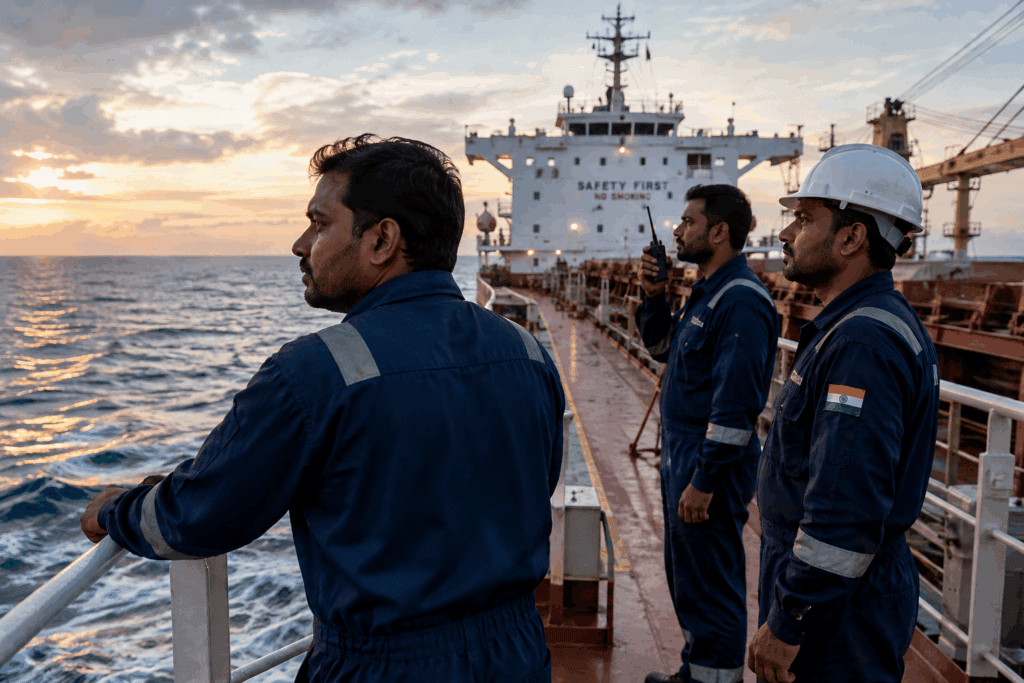
India is now the world’s second-largest supplier of seafarers. As commercial shipping comes under attack in the Strait of Hormuz, the Black Sea and other conflict-affected waters, Indian sailors are increasingly exposed to wars in which they have no role. What is happening, and how much can India do to protect them?
Indian Crews Caught In The Crossfire
India’s maritime regulator said on 6 August that 15 Indian seafarers had been killed and two remained missing in 57 incidents linked to the conflicts in West Asia and the Black Sea over the preceding three months. It described the geopolitical environment as “extremely challenging”.
The incidents span different theatres, different parties and different cargoes. Many involved vessels flying foreign flags with Indian crews aboard.
In the Black Sea, four Indian seafarers were killed when the Guinea-Bissau-flagged MV Golden Leo was attacked whilst leaving Odesa on 19 July. India summoned Russia’s chargé d’affaires and conveyed its “grave concerns and unequivocal condemnation”. Days later, 13 Indian seafarers aboard the MV AMIR1 were reported to be in a life-threatening situation at Ukraine’s Chornomorsk port amid continuing drone and missile attacks. The Indian Embassy in Kyiv said it was in constant contact with those concerned.
Indian crews have also been caught in disruptions around the Strait of Hormuz, a critical route for global energy shipping. The International Maritime Organization (IMO) warned in June that there were no reliable security guarantees for ships attempting to transit the Strait and that commercial considerations could not justify exposing seafarers to such risks.
India’s Growing Seafaring Workforce
The BIMCO-ICS Seafarer Workforce Report 2026 estimates that India has 311,936 seafarers, or 12.16% of the global seafaring workforce. India is now second only to the Philippines, having moved ahead of China, Russia and Indonesia. India’s share has risen sharply, from 5.2% in 2015 to 6% in 2021 and above 12% in 2026. The workforce comprises 140,718 officers (13.41% of the global total) and 171,218 ratings (11.29%).
The BIMCO-ICS report also projects that the global merchant fleet, which currently employs 2.57 million seafarers, could require an additional 113,735 officers by 2030. The Indian government has set a target of raising India’s share of the global workforce to 20% under Mission 20%.
Why Indian Crews Sail Under Foreign Flags
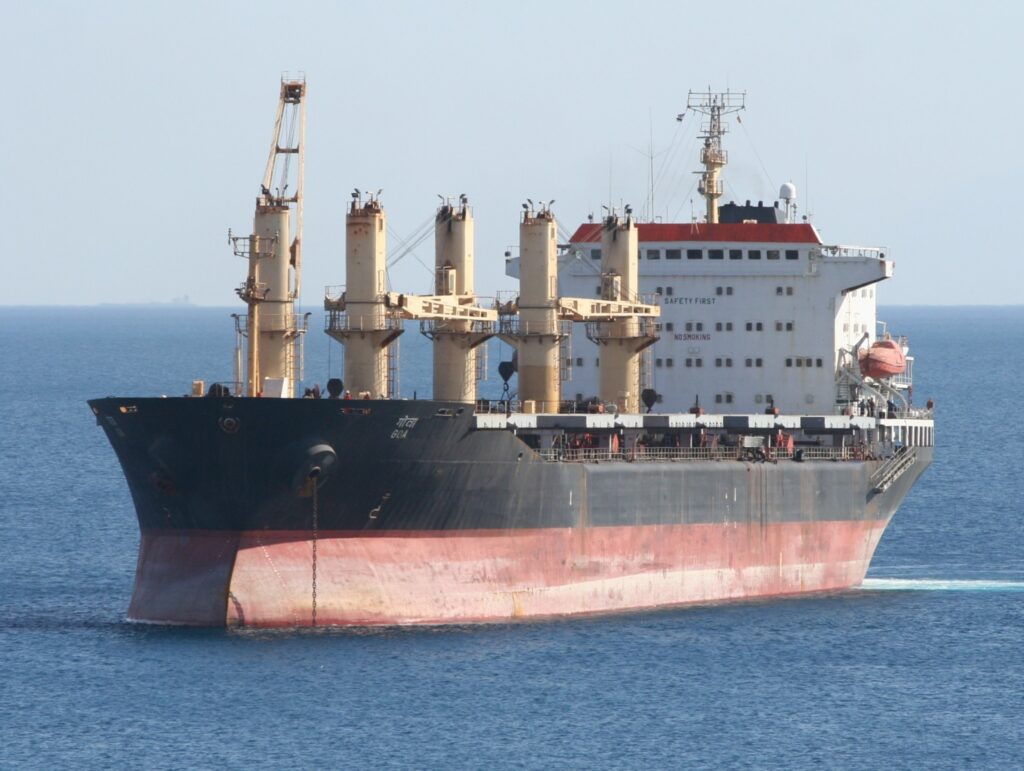
Merchant shipping is an international industry. A vessel may be owned or managed by a company in one country, registered in another, and crewed by nationals of several. An Indian seafarer may therefore be working aboard a vessel flying the flag of Liberia, Panama, Guinea-Bissau, Palau or the Marshall Islands.
The distinction matters during conflict. An Indian citizen on a foreign-flagged vessel is not the same, legally, as an Indian-flagged vessel. India can provide consular assistance and raise the matter diplomatically, but the vessel remains subject to the legal regime of its flag state. Protecting Indian seafarers on such vessels is therefore considerably more complicated than protecting personnel aboard an Indian naval or Indian-flagged commercial ship.
Why Ships Keep Sailing Through War Zones
Commercial shipping depends on a limited number of maritime routes and chokepoints. The Strait of Hormuz is critical to the movement of oil and other energy supplies from the Persian Gulf. The Black Sea is important for the movement of grain and other commodities from the region. The Red Sea and Gulf of Aden provide another major link between the Indian Ocean and the Mediterranean. Rerouting is possible in some circumstances but increases voyage times, costs, insurance premiums and logistical complications.
The IMO has said that safety must take precedence over commercial considerations, and that safe passage through the Strait of Hormuz cannot be considered to exist without credible security guarantees. It subsequently helped run an international evacuation framework that moved 136 vessels and roughly 2,900 seafarers from the Persian Gulf before being paused.
When Merchant Ships Become Targets
The recent incidents belong to different conflicts. In the Strait of Hormuz, some attacks have been connected to the confrontation involving the United States and Iran. In the Black Sea, merchant vessels have been caught in the Russia-Ukraine war.
The circumstances surrounding individual vessels can be disputed. Russia has indicated that vessels believed to be carrying military supplies for Ukraine could be targeted; India said its maritime authorities had information that the Golden Leo had loaded grain. The Settebello, another vessel with Indian crew members, was attacked in the Gulf. The United States said it had violated a blockade and was involved in transporting Iranian oil; the ship’s manager said the vessel had been stationary and had no connection with Iranian oil or Iranian ports. The legal status of a vessel during armed conflict depends on factors including its cargo, conduct and relationship to the parties involved.
What International Law Says About Merchant Ships
Merchant seafarers are civilians. They are not combatants because they work aboard a commercial vessel. The United Nations Convention on the Law of the Sea (UNCLOS) provides the principal framework for maritime rights and navigation. During armed conflict, additional rules apply. The San Remo Manual, for example, sets out principles concerning naval warfare and the treatment of merchant vessels.
A merchant vessel does not automatically become a lawful military target simply because it is in a conflict zone. The principle of distinction requires parties to distinguish military objectives from civilians and civilian objects. Proportionality limits attacks where expected civilian harm would exceed the anticipated military advantage.
The practical limitation is that international law establishes rules but does not provide an international navy to enforce them whenever a merchant vessel comes under attack. The IMO has repeatedly condemned attacks on civilian merchant vessels, including in the Black Sea, warning that such attacks endanger seafarers, disrupt supply chains and undermine navigational rights.
How India Is Responding
India has responded through diplomacy, advisories, monitoring, evacuation and repatriation.
Following the Golden Leo attack, India summoned Russia’s chargé d’affaires and External Affairs Minister S. Jaishankar raised the safety of Indian seafarers with Russian Foreign Minister Sergey Lavrov. India has similarly raised concerns over attacks involving Indian crews in the Gulf.
The Directorate General of Shipping has issued advisories to Indian seafarers and shipping companies. Its February advisory asked stakeholders to closely monitor the safety of Indian crew operating in Iranian waters and nearby regions, advised against deploying Indian seafarers to Iran until further orders, and called for heightened caution around the Strait of Hormuz.
According to Shipping Minister Sarbananda Sonowal, 4,052 stranded Indian seafarers had been repatriated during the West Asia crisis by early August. Government emergency-response channels had handled 16,448 calls and 40,594 emails. The government has provided medical and counselling support and announced ₹10 lakh in immediate financial assistance to the next of kin of deceased seafarers under the Seafarers’ Welfare Fund Society (SWFS) Special High-Risk Area Scheme. The IMO has separately estimated that around 20,000 seafarers and other maritime workers were affected by the Strait of Hormuz crisis.
Can The Indian Navy Protect Indian Seafarers?
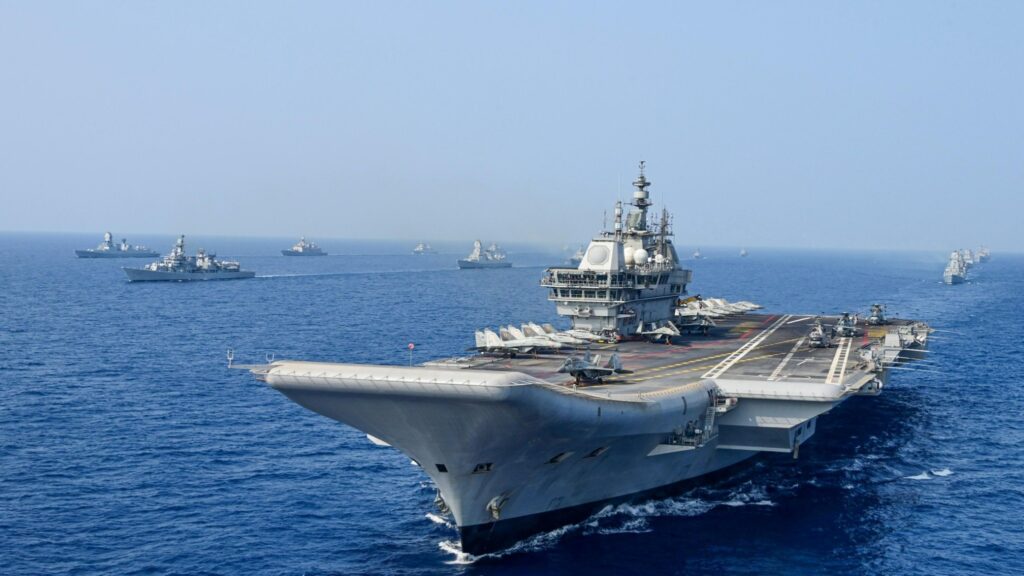
India has used naval assets to assist merchant shipping during earlier crises, including attacks by Somali pirates and Houthi forces. Operation Sankalp is its principal maritime-security deployment in the region.
The situation is harder when the threat comes from a state involved in an active conflict. An Indian naval escort for a foreign-flagged vessel could carry diplomatic and military consequences, particularly in waters where opposing states are conducting military operations. The Navy also cannot realistically escort every ship simply because it carries Indian nationals. India’s ability to protect its seafarers therefore varies with the location, nature of the threat, nationality of the vessel, state of the conflict and willingness of relevant states to cooperate.
What Can India Do?
India’s options fall into a few areas.
Diplomacy: continue raising attacks on Indian seafarers with all parties involved and press for the protection of civilian shipping.
International maritime arrangements: work through the IMO and other forums for safe-passage arrangements, maritime corridors and real-time warnings in conflict zones.
Monitoring and evacuation: strengthen India’s ability to track Indian seafarers in high-risk waters and evacuate crews quickly when conditions deteriorate.
Regional cooperation: work with other seafarer-supplying countries, particularly the Philippines.
Worker protection: ensure seafarers receive adequate information about war risks, war-risk insurance and employment protection before accepting assignments in high-risk areas. The IMO has said no commercial consideration should justify exposing seafarers to known and significant danger, and that shipowners and masters have a duty to conduct realistic voyage and security risk assessments. India’s maritime authorities have similarly advised seafarers to assess prevailing security conditions before accepting such assignments.
Naval assistance: retain the capacity to rescue and evacuate Indian nationals where circumstances permit, whilst recognising the legal and diplomatic constraints surrounding foreign-flagged vessels.
Why Does This Matter To India?
With more than 311,000 Indian seafarers in the global merchant fleet, and an expected shortage of qualified officers making countries such as India increasingly important to international trade, the safety of Indian seafarers is no longer only a consular question. It sits at the intersection of maritime security, international law, freedom of navigation, diplomacy and the protection of Indian workers abroad.
India has already had to repatriate more than 4,000 seafarers from West Asia since the conflict there began. A comparable disruption on any other major shipping route would place similar demands on India’s monitoring, diplomatic and evacuation capacity, and involve a workforce whose scale is only expected to grow under Mission 20%.
The central difficulty is straightforward. India can protect its citizens through diplomacy, monitoring, evacuation and, at times, naval assistance. It cannot control the wars through which many of those citizens have to sail.
Note: This explainer has been researched, edited, and fact-checked by India’s World staff and prepared with AI assistance.