Why did Trump reach for a 1950 mobilisation law? The Iran war depleted US missile stockpiles; the fix is industry coordination, not a production order.
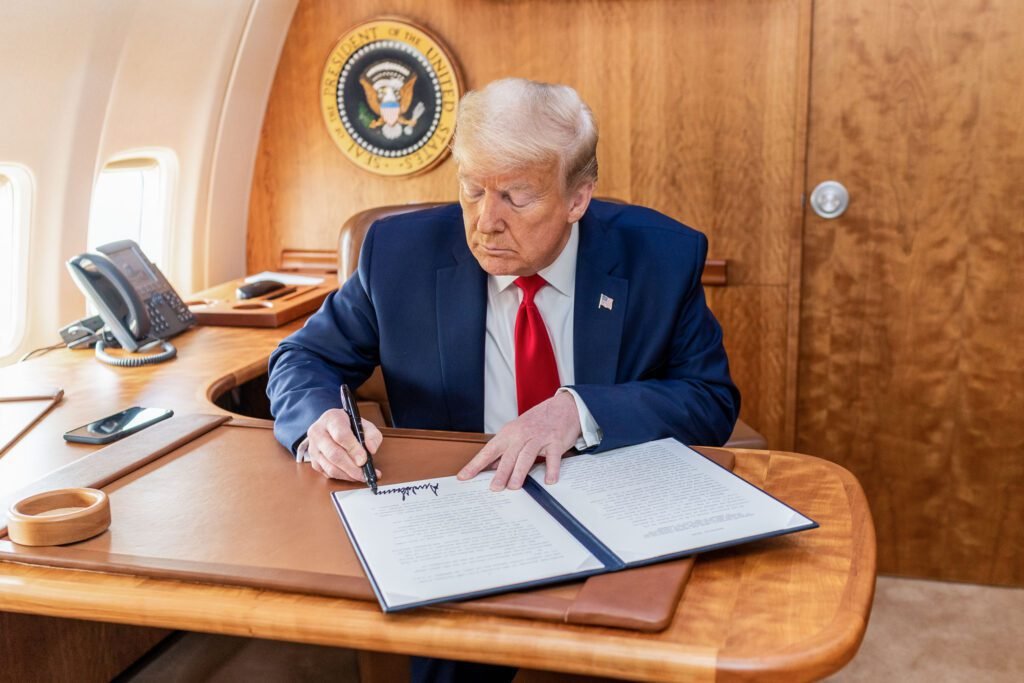
On 11 June 2026, President Trump signed a one-page memorandum invoking the Defense Production Act, the 1950 law that lets a president steer private industry towards national defence. Most coverage framed it as Trump forcing companies to make more weapons. The text does something far narrower. It tells the defence secretary, Pete Hegseth, to set up “voluntary agreements and plans of action” with arms makers. It names no company, fixes no production quota, and compels nothing. The memorandum addresses Hegseth as Secretary of War, a title retired in 1947 that Trump revived as a secondary designation by executive order in September 2025.
The authority Trump invoked does nothing until the president formally finds a threat to defence preparedness. He made that finding in the memorandum, writing that “conditions exist which may pose a direct threat to the national defense or its preparedness programs” and blaming “systemic constraints in the munitions industrial base, including limited production capacity, fragile supply chains, long-lead dependencies, and related production bottlenecks”. That finding is what lets the government bring competing arms makers together to coordinate, the power Trump was after.
A 1950 Law With a Long Reach
The Act dates to the Korean War, when Congress armed President Truman with tools to mobilise factories for a sudden conflict. The Federal Emergency Management Agency, which coordinates it across government, calls the law the primary source of presidential power to “expedite and expand the supply of materials and services” from American industry. Three sets of authorities remain in force. Title I lets the government jump the queue, ordering a supplier to fill a Pentagon contract ahead of its commercial ones. Title III pays for capacity directly, through loans, subsidies, and government-bought equipment. Title VII, the part Trump used, does something the others cannot: it lets rival firms sit in a room and plan together without breaking antitrust law.
Headlines blurred that distinction. Presidents have stretched the Act well beyond tanks and shells. Trump used it in 2020 to rush ventilators and face masks; Joe Biden used it for clean-energy equipment; both have reached for it on critical minerals and infant formula. What it has rarely been used to do is what the press described last week, namely march into a factory and dictate output. This order does not do that either.
What Section 708 Actually Authorises
Section 708, codified at 50 U.S.C. 4558, is the voluntary-agreements clause, and it answers one narrow problem. Defence firms that compete for the same contracts are normally barred from comparing notes on prices, capacity, or shared suppliers. Section 708 hands them a legal shield to do precisely that, under government supervision. The shield is conditional. The defence secretary must consult the attorney general and the Federal Trade Commission, and win the attorney general’s approval, before any agreement takes effect. It is not blanket antitrust immunity, and the order itself says so.
The Pentagon’s industrial-base policy chief, Michael Cadenazzi, described the aim plainly at a Center for a New American Security event. He wants to put every solid rocket motor maker in a single room to work through shared bottlenecks, allowing them, in his own words, to “communicate and work together, essentially collude”, all under government oversight. He compared the structure to the Civil Reserve Air Fleet, the standby pool of commercial airliners the military calls up in an emergency. The framework convenes industry. It does not command it. And coordination has a ceiling: it can synchronise the capacity that exists, but it cannot conjure capacity that does not.
The Iran War Ran Down American Stockpiles
The order is a response to one war. The campaign against Iran, Operation Epic Fury, began on 28 February 2026. Over the next seven weeks it consumed munitions at a rate the United States had not seen in decades. American forces fired more than 1,000 Tomahawk cruise missiles and an estimated 1,500 to 2,000 air-defence interceptors, including Patriot, Terminal High Altitude Area Defense (THAAD), and Standard Missiles, according to US officials cited by the Wall Street Journal.
The drawdown was steep. A Center for Strategic and International Studies analysis found the US had expended roughly half its Patriot interceptors, more than half its THAAD stock, and at least 45% of its Precision Strike Missiles. Mark Cancian, the report’s co-author and a retired Marine colonel, told The Hill and other outlets that rebuilding these inventories would take one to four years, and longer still to reach the levels planners actually want. Replacing the Tomahawks alone could run to late 2030, since fewer than 200 are built a year.
The Constraint Is Industrial, Not Financial
The order is built around a problem that money alone cannot fix. The shortage is not chiefly a funding gap; it is an industrial base that has thinned to the point of fragility. The hardest single component to produce is the solid rocket motor, which sits inside nearly every American missile. The number of US firms that build them has fallen from six to two since 1995, the Government Accountability Office has found, as reported by Aeronautics Magazine. The wider supplier base shrank from roughly 5,000 firms to about 1,000 over two decades. Skilled welders, machinists, and cleared technicians take years to train and cannot be conjured up in a hiring spree.
So a cheque cannot fix the problem on its own, which is exactly why the administration reached for a coordination tool rather than a chequebook. When only two firms make a critical part, the constraint is structural, not financial. The government’s bet is that letting suppliers plan capacity jointly, certify new entrants faster, and pool data on workforce and materials will ease bottlenecks that contracts by themselves never touch.
China Is the Real Driver
Iran was the trigger, not the real concern. The unstated driver is China. The interceptors spent over Iran, Patriot and THAAD rounds, are the ones the Pentagon would need most in a war in the Pacific. So are the long-range missiles fired alongside them. Planners increasingly point to a fight over Taiwan, with 2027 often named as the year Beijing wants the option of taking the island by force. Cancian warned that the spending had opened “a window of increased vulnerability in the western Pacific”. Mike Rogers, who chairs the House Armed Services Committee, put it bluntly in March: allies “must wait years for the American weapons they need”, while China is “outproducing us on ships, drones, and munitions”.
For governments watching from outside Washington, that is the uncomfortable signal. The United States fights its own wars and arms Ukraine and Israel from the same stockpiles that supply the 17 other countries that use Patriot. When those stockpiles run low, allied orders wait in line.
The administration’s public message contradicts its own order. Three days after Trump signed it, the defence secretary told CBS’s Face the Nation that talk of a stockpile crisis was “a manufactured story that the media wants to peddle”, adding that “our stockpiles are great”. Days later he was on Capitol Hill pressing senators for a $350 billion package aimed squarely at replenishing munitions. Senator John Cornyn, a Texas Republican, offered the plainer reading after meeting him: the Pentagon is “running short of funding” for the weapons it needs.
The invocation changes little overnight. Its real test is whether coordination can compress replenishment timelines in an industry where adding a production line takes years, not months. If the next crisis arrives on the schedule the Pentagon fears, the weapons ordered now may still be years from delivery.
Note: This explainer has been researched, edited, and fact-checked by India’s World staff and prepared with AI assistance.