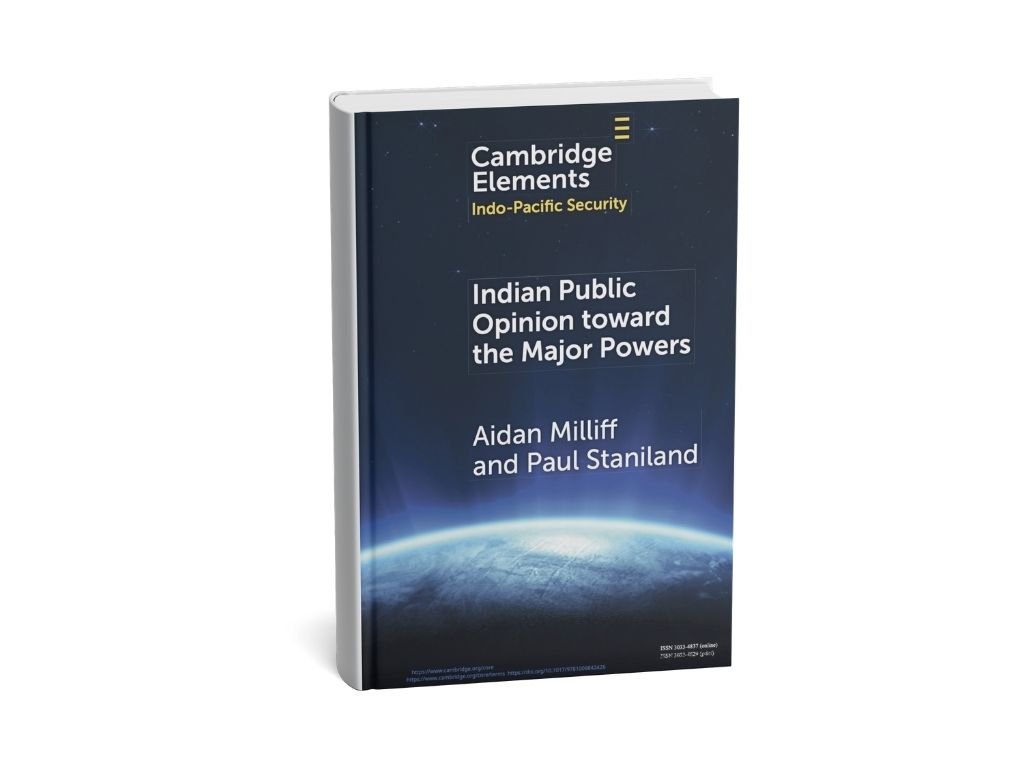
Foreign policy has now travelled into Indian domestic electoral politics, but the overall scholarship on Indian public opinion and how they shape foreign policy remains understudied in the Indian context. Indian Public Opinion toward the Major Powers, authored by Aidan Milliff and Paul Staniland as part of Cambridge’s Elements in Indo-Pacific Security series, is an empirically solid book addressing the above lacunae. Though the book is thin, its findings, including that Indian foreign policy opinion is structured differently from its Western counterparts, are both original and consequential for how the field approaches India.
Drawing on decades of surveys, the authors make two arguments. First, they offer a longitudinal portrait of how the Indian public has viewed the three major powers, the United States, China, and Russia/USSR. Second, they characterise the structures shaping what they call India’s “foreign policy public.” Both contributions are valuable, and the findings are at times genuinely counterintuitive. The forces organising Indian public opinion look quite different from those familiar in the Western literature: regional identity emerges as a prominent variable, while partisan identification proves largely irrelevant.
Also notable is the finding on opinion formation. In the Indian case, the foreign policy public does not cohere through elite cueing in any straightforward sense. In at least one instance, the 2019 elections, it was public opinion that appears to have shaped politicians’ rhetoric toward foreign policy, and not the reverse. The survey data also sit comfortably alongside India’s policy of multi-alignment, which reflects that an electorate is not ideologically committed to any single external partner.
The authors offer a cautious correlation between public opinion and foreign policy outcomes. They posit that opinions act as a “loose constraint”. Such constraints impose outer bounds on government choices with opinions notably stronger toward China than toward the US or Russia.
Additionally, there lies a valuable contribution in this book in terms of future research direction, how foreign policy opinion is voiced, what translates mass attitudes into political pressure, and how elite-public relationships operate across different moments.
The book is an essential starting point for those interested in the relationship between Indian foreign policy and public opinion, but the deeper theoretical work remains to be done. Milliff and Staniland have shown the way.