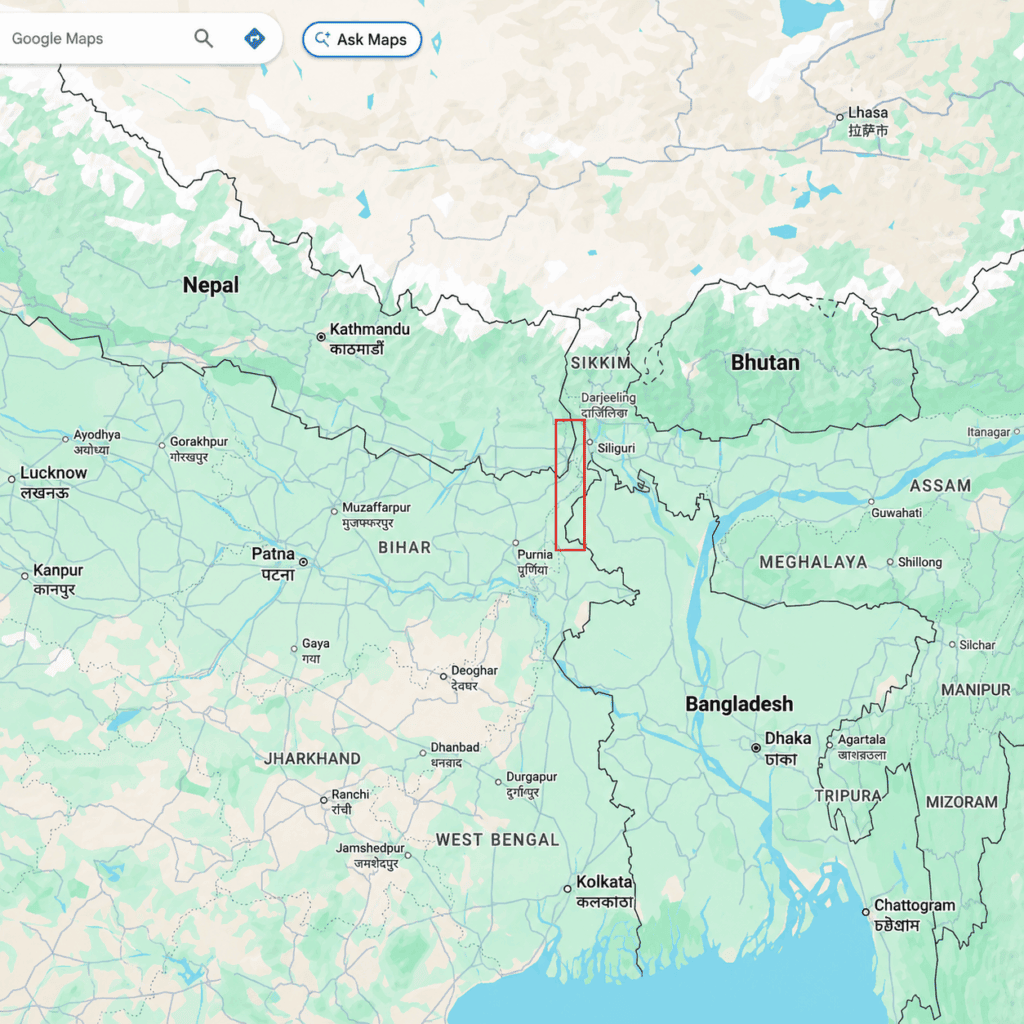
The Siliguri Corridor is the narrow land link connecting mainland India with the north-east. Popularly known as the “Chicken’s Neck”, it is strategically important because it connects the eight north-eastern states with the rest of the country. It is bordered by Nepal, Bhutan, and Bangladesh and lies close to the India-China-Bhutan tri-junction and the Chumbi Valley.
On 21 August 2026, Union Home Minister Amit Shah described a new security arrangement around the corridor as a “Triangular Security Grid”. The Home Ministry said the corridor was directly connected to national security and that the government was working to make it “impregnable”.
The three points identified by the Home Minister are Dhubri in Assam, Kishanganj in Bihar, and Chopra in West Bengal. He described them as three new military garrisons and said the government had increased its presence at the three locations.
There is, however, an important distinction. Defence reporting had already identified new military garrisons at Bamuni near Dhubri, Kishanganj, and Chopra in November 2025. The August announcement therefore did not mark the first public reporting of military positions at these locations. What it did was bring the three locations together under the “Triangular Security Grid” formulation.
The government has not publicly explained how the three positions will operate together. Their precise command arrangements, troop strength, and individual tactical roles have also not been disclosed.
Why Is the Siliguri Corridor So Important?
The corridor’s importance comes from its geography. It is the narrow land connection between mainland India and the north-east, making it vital for the movement of people, supplies, and military forces into the region.
Its location also makes it strategically sensitive. Nepal lies to the west, Bhutan to the north, and Bangladesh to the south. The corridor is close to the India-China-Bhutan tri-junction and China’s Chumbi Valley.
The government describes the corridor as highly sensitive and strategically important. In his 21 August remarks, the Home Minister said it connects eight states and is bordered by three international boundaries.
The corridor is commonly described as roughly 20 to 22 km wide at its narrowest point, although this figure does not appear in the government’s 21 August release and should therefore be treated as a reported geographical estimate rather than an official government figure.
What Are the Three Military Positions?
The three locations identified by the government are Dhubri, Kishanganj, and Chopra.
The Dhubri installation is the Lachit Borphukan Military Station at Bamuni. Defence reporting in November 2025 described the three locations as new, operational military garrisons.
Later reporting identified the Kishanganj and Chopra installations as forward garrisons.
These details come from defence reporting rather than a public Ministry of Defence account of the three sites as a single operational system. The government has not set out the specific role of each position or explained how they will be coordinated.
Is This Only About the Army?
No. The Army is part of a wider security system around the corridor.
The Sashastra Seema Bal (SSB) guards India’s borders with Nepal and Bhutan, while the Border Security Force (BSF) is responsible for the India-Bangladesh border. Intelligence agencies, state police, and the civil administration also have roles.
On 22 August, the Home Minister reviewed security at Sukna, outside Siliguri. Officials from the Ministry of Home Affairs, Ministry of Road Transport and Highways, Army, BSF, SSB, and Railway Protection Force attended, along with West Bengal’s Chief Secretary and Director General of Police. West Bengal Chief Minister Suvendu Adhikari also attended.
The Multi Agency Centre’s Standing Focus Group on the Siliguri Corridor presented its progress and recommendations. The government said the meeting was also part of efforts to develop the framework for the Triangular Security Grid.
The review covered encroachments, illegal immigration, demographic change, border affairs, and activities involving Persons of Indian Origin. The Home Minister also called for more Sainik schools in North Bengal, greater participation of senior NCC cadets, and stronger Civil Defence and Home Guards.
How Does the Grid Fit Into the Wider Border Strategy?
The triangular grid is part of a broader border-security effort. It is separate from the government’s “quadrangular security grid”, a wider model for organising responsibility along India’s borders.
In May 2026, the Home Minister described that model as bringing together the public, civil administration, military, and BSF.
The distinction is straightforward. The triangular grid is a geographically focused arrangement around the Siliguri Corridor. The quadrangular model is a broader framework involving several stakeholders across the border-security system.
The two approaches overlap in the Siliguri area. At the 22 August review, the Home Minister stressed the quadrangular approach as part of the wider security strategy.
What Is Being Done on Fencing and Technology?
The military positions are only one part of the security effort. Fencing, surveillance technology, and supporting infrastructure are also being expanded.
During a July 2026 visit to the Jhumagachh Border Outpost, the Home Minister inspected a radio-based fence-breach detection system and an infrared alarm system designed for difficult terrain.
The visit also included the foundation of BSF projects worth about ₹47 crore and a four-kilometre border fence costing about ₹30 crore. The government put the combined value at about ₹77 crore.
Land has been a separate challenge. On 21 August, the Home Minister said the Centre had received 1,129 acres of land for the BSF and SSB within 45 days of the new West Bengal government taking office. He said the land had been sought since 2014.
He also said agencies required 560 acres to fully strengthen the corridor and that the West Bengal government had given in-principle approval for its allocation. That does not mean the land had already been transferred.
A separate 29-acre figure was mentioned in connection with border fencing. Contemporary reporting said that land was still required to complete the fencing. It is distinct from the 560 acres cited for strengthening the corridor.
Is the Grid About China?
China is part of the wider strategic context, but the government has not publicly said that the Triangular Security Grid was created specifically to counter China.
The 21 August government release describes the corridor as strategically important and refers to its location alongside Nepal, Bhutan, and Bangladesh. It does not identify China as the specific purpose of the grid.
The 22 August security review likewise focused on infrastructure, demographic change, illegal immigration, encroachments, border affairs, and the presence of security agencies. China was not identified as the stated rationale for the grid.
There is nevertheless a broader strategic context. Reporting on the three garrisons in 2025 linked their establishment to the changing security environment along India’s eastern frontier, including concerns involving Bangladesh and China.
That connection is an analytical interpretation, rather than a stated government objective.
What Else Is Being Strengthened?
The security build-up extends beyond the three military positions.
On 21 August, the Home Minister laid the foundation stone for the administrative building of the SSB Frontier Headquarters in Siliguri, to be constructed over 80 acres. He also laid the foundation stone for the SSB’s 19th Battalion at Thakurganj, an e-foundation stone for the 12th Battalion at Kishanganj, and the foundation stone for a transit camp at New Jalpaiguri.
The government invested ₹190 crore in these projects to improve facilities for SSB personnel and strengthen security infrastructure.
The government is also linking security with civilian infrastructure and economic activity. The Home Minister cited the Delhi-Siliguri high-speed rail corridor, one of seven approved in the 2026-27 Budget, as well as the redevelopment of Siliguri and Jalpaiguri stations under the Amrit Bharat Scheme. He also referred to the Vibrant Villages Programme and its role in strengthening border areas.
What Does the Triangular Grid Actually Change?
The key change is not the establishment of three new military positions. All three had already been reported as operational garrisons in 2025.
The August announcement brought Dhubri, Kishanganj, and Chopra together under the government’s “Triangular Security Grid” formulation and placed the arrangement within a broader push involving the military, border forces, surveillance, infrastructure, and civilian administration.
What remains unclear is how the three positions will function as a coordinated security arrangement and what specific role each will play. The government has said the aim is to make the corridor “impregnable”, but it has not publicly explained how the three bases will be coordinated or what the operational framework of the grid will look like.
Note: This explainer has been researched, edited, and fact-checked by India’s World staff and prepared with AI assistance.