
To discuss the role of Indian capital in foreign policy may seem incongruous at a moment when the reluctance of Indian business to invest at home has become a subject of public debate. Yet the relationship between capital and external engagement is too important to ignore.
The rise of capitalism lies at the heart of modern international relations. Yet it receives surprisingly little attention in international relations scholarship, diplomatic discourse, or strategic analysis. The same is true in India, where the relationship between Indian capital and the nation’s engagement with the world remains largely unexplored.
Indian capital’s international engagement did not begin with economic liberalisation. Long before Independence, Indian merchants, financiers, and traders operated across Asia, Africa, and the Gulf. Under the British Empire, Indian capital expanded alongside imperial networks. From the opium trade in China and rubber plantations in Malaya to commercial ventures in East Africa and the Gulf, Indian entrepreneurs were important actors in the globalised economy in the imperial age.
Independence and the turn towards state-led development altered this trajectory. Restrictions on private enterprise steadily eroded the global footprint of Indian capital. The state occupied the commanding heights of the economy. Indian business became largely inward-looking and played only a marginal role in diplomacy.
India now needs a new compact between state and capital. A nation aspiring to shape the international order cannot separate economic power from strategic influence
There were minor exceptions. The Hinduja family, with deep roots in Iran and Britain, helped facilitate India’s rapprochement with the Shah’s Iran in the 1970s and later worked to soften Western criticism after India’s 1998 nuclear tests. Such episodes, however, were rare.
The reforms of 1991 transformed the landscape. Indian firms increasingly ventured abroad in search of markets, resources, technology, and investment opportunities. The IT industry deepened India’s ties with the West. Energy companies sought overseas assets. Foreign policy expanded beyond traditional security concerns to include trade, investment, technology, and support for Indian business abroad.
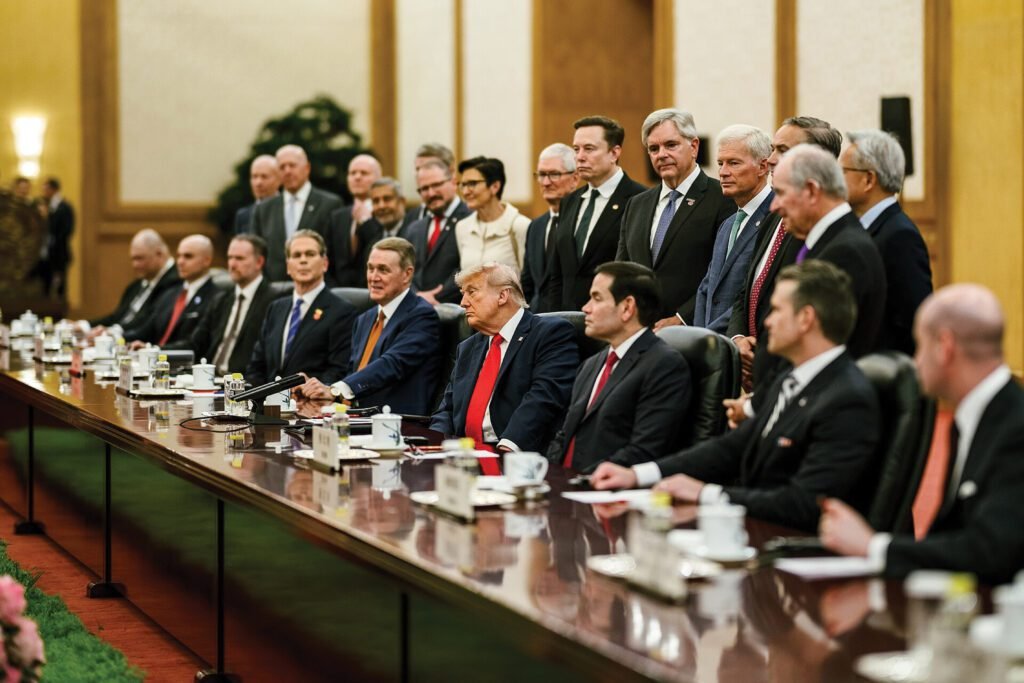
The United States once embraced the notion that what was good for General Motors was good for America. Under Trump, the US is more vigorous in promoting the interests of US capital. China has systematically encouraged its firms to “go out” and serve broader strategic objectives.
As Indian companies expand across the world, their overseas presence should become an important part of India’s diplomatic toolkit. At the same time, Indian business has begun investing in the intellectual infrastructure of foreign policy, reflected in initiatives such as Reliance’s support for the Observer Research Foundation and the Adani Group’s creation of the Chintan Research Foundation.
India now needs a new compact between state and capital. A nation aspiring to shape the international order cannot separate economic power from strategic influence. If India is to play a larger global role, its diplomats and entrepreneurs will have to learn to work together far more closely than they have in the past.