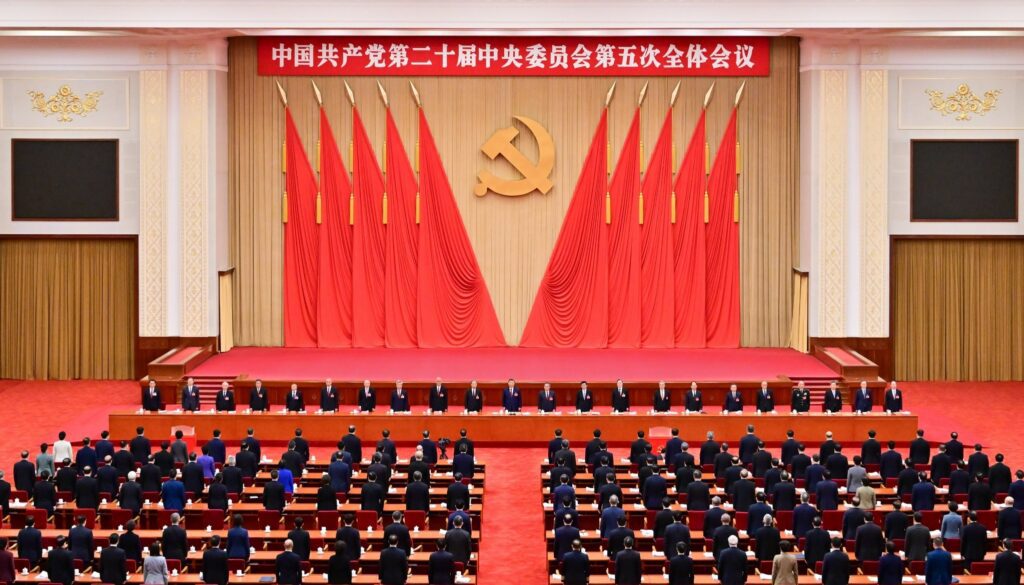
China’s Fifth Plenum was less about unveiling a new economic programme than reinforcing political discipline and consolidating Xi Jinping’s control over the party. Its decisions also offered a glimpse of how Xi is positioning the party ahead of the 21st Party Congress in 2027.
The 20th Central Committee of the Communist Party of China concluded its Fifth Plenum in Beijing on 29 October. It adopted a resolution on “persevering with full and rigorous Party self-governance”, confirmed the expulsion of 33 officials, and elected Zhang Shengmin, the military’s long-time discipline official, to the Politburo. The meeting also decided that the 21st Party Congress would be held in the second half of 2027. The gathering followed years of investigations involving senior civilian and military officials.
The meeting did not announce a new economic programme. It addressed Xi’s long-standing concern with making the party’s bureaucracy follow central instructions and maintain political discipline.
How the Chinese Communist Party’s Plenums Work
The Communist Party of China (CPC) holds a National Congress every five years. The congress sets the party’s broad political direction and elects the Central Committee, its leading body between congresses. The 20th Central Committee was elected in October 2022 and originally consisted of 205 full members and 171 alternate members. Full members have voting rights. Alternate members attend meetings and take part in discussions, but do not vote. When a full-member seat becomes vacant, an alternate member may be promoted to fill it.
The Central Committee meets in plenary sessions, or plenums, to discuss major political, organisational, and policy questions. A plenum is a meeting of the Central Committee, not of the entire CPC. The Politburo, a smaller body within it, usually prepares major proposals. At the first plenum after a National Congress, the Central Committee elects the general secretary, the Politburo, and its Standing Committee.
The party’s decisions guide China’s state institutions, including the State Council, ministries, provincial governments, state-owned enterprises, and the armed forces. Plenum decisions are not ordinary legislation, but they set priorities that these institutions are expected to implement. Agendas cover economic reform, development plans, party discipline, ideology, and senior appointments.
The sequence of plenums follows convention, not a fixed rule. The Third Plenum of December 1978 marked the shift towards reform and opening up under Deng Xiaoping. Fifth plenums have often considered the next five-year plan. But the current Central Committee’s Third Plenum was delayed until July 2024, and the Fourth Plenum adopted the 15th Five-Year Plan recommendations in October 2025. The 2026 Fifth Plenum therefore took up party-building and internal governance, subjects more often associated with a sixth plenum.
A Plenum Focused on Party Governance, Not Economic Planning
The 2026 meeting did not take up the next five-year plan because the Fourth Plenum had already adopted recommendations for the 15th Five-Year Plan (2026–2030), covering high-quality development, technological progress, living standards, environmental protection, and national security.
The Fifth Plenum adopted the “Resolution of the Central Committee of the Communist Party of China on Certain Major Issues concerning Persevering with Full and Rigorous Party Self-Governance”. Released on 1 November, it gives an institutional framework to Xi’s emphasis on discipline and anti-corruption and presents “Xi Jinping Thought on Party Building” as part of his broader political thought.
From Anti-Corruption to Tighter Party Control
“Full and rigorous Party self-governance” covers more than prosecuting officials who take bribes. It includes political education, cadre conduct, appointments, supervision of official power, and enforcement of party rules. The underlying principle is “self-revolution”: the claim that the CPC must correct its own weaknesses before they undermine its authority.
The resolution calls for closer assessment of officials. Evaluations should consider how cadres handle risks and difficult assignments, their daily conduct, social interactions, family education, and family values. Before promotion, personal files and declarations must be checked and specific reports of possible misconduct investigated. The document also calls for checks on family assets and spending that far exceed officials’ normal incomes; tighter oversight of the commercial activities of their spouses, children, and children’s spouses; and stronger action against nepotism.
The document says party leaders must follow collective decision-making procedures and must not treat the region or organisation under their charge as personal territory. It calls for stronger supervision of senior officials and targets informal networks, currying favour, backroom deals, and the use of personal connections to influence official decisions.
The resolution extends party-building into the economy. It calls for stronger party organisations in private businesses, mixed-ownership enterprises, internet platforms and high-tech firms, and among platform workers. It also proposes digital discipline-inspection tools and a big-data platform to oversee public power. Corruption involving the internet, virtual currencies, cross-border capital, and blockchain is specifically listed for action.
The party is seeking a stronger organisational presence in sectors where new business models and forms of employment have expanded quickly.
Xi’s Concern: Turning Central Directives into Local Action
Xi’s anti-corruption campaign has continued for more than a decade. Chinese disciplinary and supervisory bodies said they opened more than one million cases and disciplined 983,000 people in 2025. In the first nine months of 2026, they opened 800,000 cases and disciplined 680,000 people. At a post-plenum briefing, officials said that since the 18th Party Congress in 2012, 8.1 million cases had been opened and 7.9 million people disciplined. These figures cover a wide range of cases, not only senior political purges.
The party presents the campaign as a way to remove corruption and prevent the abuse of public office. Xi’s criticism of officials who profess loyalty but resist instructions in practice points to another concern: whether central decisions are actually carried out.
Beijing can set targets, but local officials hold much of the information needed to carry them out. Some conceal problems, pursue showcase projects, or report progress that has not been achieved. Inspections can reward the appearance of compliance when they rely too heavily on paperwork rather than results on the ground. The plenum’s emphasis on implementation addresses this problem.
There are costs. When punishment becomes the main concern, officials may wait for instructions, focus on paperwork, or avoid local experiments. The resolution also asks cadres to take responsibility and work creatively within party rules. It calls for false accusations to be investigated and wrongly accused officials cleared. Beijing must enforce discipline without making officials afraid to act.
The Scale of the Purges and the Uncertain Future of Military Leadership
The communiqué recorded 162 full members and 117 alternate members in attendance, 279 people in total. That was 74.2% of the 376 members and alternates elected in 2022. Attendance is not a direct count of those purged, since vacancies, investigations, and deaths also affect the total. It nevertheless points to substantial turnover. Counting this plenum’s expulsions and earlier removals, the committee elected in 2022 has lost 37 full members and 15 alternates. Nearly 20 more full members stayed away, though only three are formally under investigation; among the absentees was the navy commander, Hu Zhongming.
The plenum confirmed the expulsion of 33 people, including former Politburo member Ma Xingrui, former Central Military Commission (CMC) Vice-Chairman Zhang Youxia, former CMC Joint Staff Department chief Liu Zhenli, and former CPC International Department head Liu Jianchao. It separately removed Li Yunze, the former head of China’s National Financial Regulatory Administration, from his party post. Sixteen of the 33 expelled officials were from the military. The official communiqué is the clearest basis for the total, as some secondary reports give conflicting breakdowns of full and alternate members.
The military leadership has been hit particularly hard. The CMC, the party body that leads the armed forces, had seven members in 2022. Following the removals, only Xi and Zhang Shengmin remained. The plenum made no new CMC appointments, but elected Zhang, the CMC vice-chairman and long-time discipline chief, to the Politburo. Vice-chairmen normally sit on the Politburo, and Zhang Youxia’s fall had left the armed forces without a seat there. One likely reason no new CMC members were named is that Xi has few full generals to choose from, and unexplained absences at the plenum suggest the investigations of the officer corps are not over. The commission is likely to be rebuilt at the 2027 congress, the year of the People’s Liberation Army’s centenary.
Ten alternate members were promoted to full membership to fill vacancies. None was from the military. That left 14 of the 24 vacant full-member seats empty, although the party constitution provides for alternates to step up in order of votes received. The plenum did not identify a successor to Xi or settle the 2027 leadership line-up. Xi is widely expected to seek a fourth five-year term as general secretary, but no succession announcement was made.
What the Communiqué’s Language Reveals about Xi’s Position
One analysis noted that the communiqué omitted the “Two Establishes”, “Four Consciousnesses”, “Four Confidences”, and “Two Safeguards”, formulas that had appeared in the communiqués of the Second, Third, and Fourth Plenums. The absence is worth noting, but it does not show that Xi’s position has weakened. The communiqué still called on party members to rally around the Central Committee “with Comrade Xi Jinping at its core”, while the resolution itself restated the substance of the “Two Establishes”. The omission may reflect a change in emphasis, not a change in Xi’s standing.
The Implications for China’s Governance and India’s Border Security
For the economy, the question is how tighter discipline will affect officials implementing the 15th Five-Year Plan. Oversight may curb corruption and wasteful projects, but cannot by itself lift household consumption or resolve local government debt. If officials become too cautious, supervision could slow investment and reform. The resolution also asks local party committees to apply central guidance to local conditions and work creatively.
For India, Wang Haijiang’s expulsion matters because he formerly commanded the People’s Liberation Army’s Western Theatre Command, responsible for the frontier with India. His expulsion demonstrates that the purge has reached the former leadership of a command directly relevant to India’s security along the Line of Actual Control (LAC), but does not indicate any change in China’s boundary position or suggest that pressure along the LAC will ease. The command’s subsequent appointments will offer more meaningful indicators of Beijing’s military priorities and leadership preferences. Among the plenum’s observers was Wen Junfei, the Western Theatre Command’s deputy commander in charge of military affairs. The observers included several serving military deputies and recently promoted generals, making this group a potential pool for Xi Jinping’s next appointments to theatre commands, military services and senior command institutions.
Overall, the Fifth Plenum was less about announcing a new economic programme than about tightening the party machinery expected to deliver existing policy. Xi wants a more disciplined organisation and stronger supervision of officials. Whether this improves governance will depend on whether Beijing can enforce rules while allowing local officials to identify problems, exercise judgement, and take responsibility. The plenum has not resolved that tension.
Note: This explainer has been researched, edited, and fact-checked by India’s World staff and prepared with AI assistance.