In “Locating Minilateralism in International Relations”, a forum published in International Studies Review in 2026 (Volume 28, Issue 4), Sarah Teo, Maria Rost Rublee, Matteo Piasentini, Nele Marianne Ewers-Peters, Jada Fraser, Mason Richey, Alice Dell’Era, Lai-Ha Chan, and Pak K. Lee examine the growing use of minilateral arrangements in international politics. The forum asks what distinguishes these smaller groupings from other forms of international cooperation and how they affect established multilateral institutions. Its contributions can be read through three connected questions: how minilateralism should be defined, how these groupings operate, and what makes them legitimate.
First, the question of definition. Teo and Rublee argue that minilateralism has become a regular feature of statecraft, although its effectiveness remains uncertain. They call for more systematic research into how these groupings make decisions and whether their agreements produce results. Rather than presuming agreement about what minilateralism is, they write that “we treat definitional contestation as productive”. Mason Richey takes this debate further in “New Kid on the Block: Definitional and Theoretical Foundations of Minilateralism”, suggesting that six members might serve as an upper limit. He provisionally defines minilaterals as “small arrangements of three to six states or other international political entities cooperating on a more or less flexible or institutional basis to efficiently solve defined, restricted problems of IR”. For Richey, the purpose of cooperation matters as much as the number of participants.
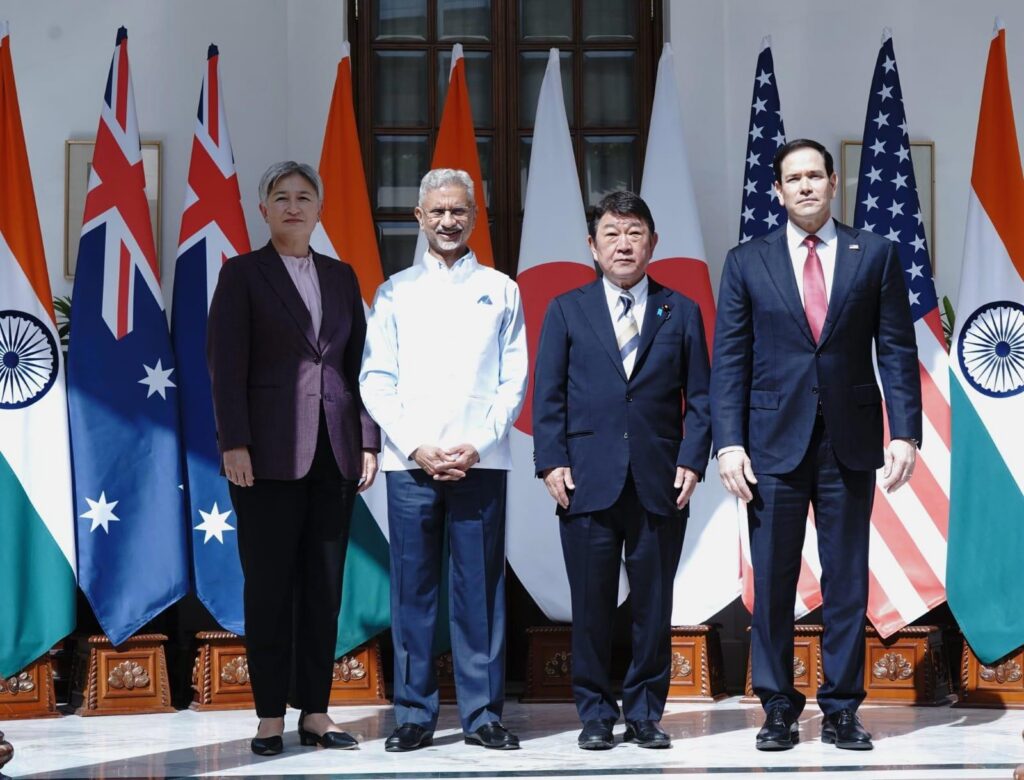
Second, how minilaterals operate and relate to existing institutions. In “Informality versus Formality”, Matteo Piasentini and Maria Rost Rublee explain that these arrangements generally fall between formal intergovernmental organisations and ad hoc coalitions. The Quadrilateral Security Dialogue (Quad) and AUKUS (Australia, the United Kingdom, and the United States) illustrate how states can cooperate without elaborate legal structures, while the Global Combat Air Programme, involving Japan, Italy, and the United Kingdom, shows that some partnerships may move towards formal institutionalisation.
Nele Marianne Ewers-Peters and Jada Fraser examine this relationship from the perspective of multilateral cooperation. They distinguish minilaterals operating within, around, or outside larger institutions. Smaller groupings can help European states coordinate within the North Atlantic Treaty Organization (NATO) and the European Union, while minilateralism in the Asia-Pacific has developed partly in the absence of a NATO-like collective security organisation. The authors describe these arrangements as potential “stop-gap measures to sustain effective global governance”. They also warn that competition for resources may weaken the institutions these groupings are intended to supplement.
Third, the politics of membership. Alice Dell’Era questions whether states in minilateral groupings necessarily share common values. In “Natural Partners? Unpacking the Role of Like-Mindedness in Minilateral Initiatives”, she shows that like-mindedness can refer to shared values, strategic interests, common threat perceptions, trust, or technological expertise. Governments may also use the term to project an image of shared purpose and legitimise the grouping. Its meaning can change as geopolitical circumstances and national priorities shift.
Lai-Ha Chan and Pak K. Lee take up the related question of legitimacy in “Do Minilaterals Necessarily Suffer from Legitimacy Deficit? An Interpretive Perspective”. Examining the Quad in Southeast Asia, they find that regional states accept its membership but have mixed feelings about its conduct. It challenges the claim of the Association of Southeast Asian Nations (ASEAN) to centrality in regional security, yet may do better than ASEAN institutions in meeting the security challenges posed by China. They conclude that “there is no generalized meaning of minilaterals’ legitimacy”. Exclusion alone does not determine whether a grouping is accepted by those outside it.
The forum presents minilateralism as a site of continuing conceptual debate. In their closing note, the co-editors locate its significance in the tensions it illuminates, among them those between small-group efficiency and broader legitimacy and between like-mindedness and strategic interest. Teo and Rublee set out an agenda for further research, starting with a systematic catalogue of minilateral arrangements, which would require at least partial agreement on membership size and institutional form. Ewers-Peters and Fraser add that, although minilaterals appear to be here to stay, whether they supplement or compete with multilateral organisations deserves further exploration.