The General Debate of the 81st United Nations General Assembly (UNGA) concluded in New York on 28 September, closing six days of speeches against a backdrop of wars, climate disasters, economic uncertainty, and growing pressure on the multilateral system. Presided over by Bangladesh’s Khalilur Rahman, the session adopted the theme “Restoring Trust, Managing Transformation: A United Nations That Delivers for All”. The General Debate put that promise to a practical test: what do countries expect the international system to deliver when conflicts, climate change, technological disruption, and economic insecurity increasingly overlap?
For South Asia, the answer was far from uniform. India, Pakistan, Nepal, Bangladesh, Bhutan, Sri Lanka, and the Maldives all spoke about aspects of the same changing international environment, but from very different positions. Climate change emerged as a question of justice, sovereignty, and development; conflicts beyond South Asia were framed through diplomacy, terrorism, maritime security, and economic vulnerability; artificial intelligence (AI) through questions of technological access and sovereignty; and UN reform attracted broad support without a common prescription. The striking feature of the seven interventions was therefore not a unified South Asian agenda, but how differently governments approached problems that increasingly affect the region as a whole. Afghanistan, South Asia’s eighth SAARC member, was a notable absence from the General Debate. It did not appear on the official speaker list for UNGA 81, although its Permanent Mission remained active during High-Level Week.
A Region Under Pressure
Climate change provided the clearest point of overlap. Nepal’s Prime Minister Balendra Shah used the country’s recent floods to make a broader argument about the priorities of the international system. He contrasted the speed with which military supplies can cross borders with the difficulty of obtaining fertiliser, fuel, and other essentials, arguing that the world has developed “flawless logistics for war and broken logistics for food”. Shah was careful to place Nepal’s experience in a wider regional context, explicitly naming Bangladesh, Bhutan, India, the Maldives, Pakistan, and Sri Lanka as countries facing related pressures. He also proposed a Himalayan Climate Resilience Mechanism involving Nepal, India, and China, focused on satellite data, glacial-lake monitoring, early-warning systems, and disaster response.
That argument found a wider institutional echo during the UNGA week. The General Assembly presidency convened “Sagarmatha to the Sea”, linking Himalayan, riverine, coastal, and island vulnerabilities within a single climate system. The meeting emphasised the connections between glacier loss, downstream water security, and sea-level rise, while calling for stronger monitoring, early-warning systems, and climate finance.
The other South Asian interventions nevertheless approached climate change differently. The Maldives treated rising seas partly as a question of sovereignty and international law, insisting that changing geography should not erase statehood or maritime rights. Bangladesh focused more heavily on adaptation, development, and climate finance. Pakistan presented climate vulnerability through flooding, glacier melt, and sea-level rise, while Sri Lanka connected climate action with economic recovery and renewable energy. Bhutan placed environmental sustainability within its broader development model. There was therefore no single “South Asian climate position”. The countries share exposure to climate risks, but their diplomatic arguments reflect their different geographical and economic circumstances.
Different Readings of Conflict
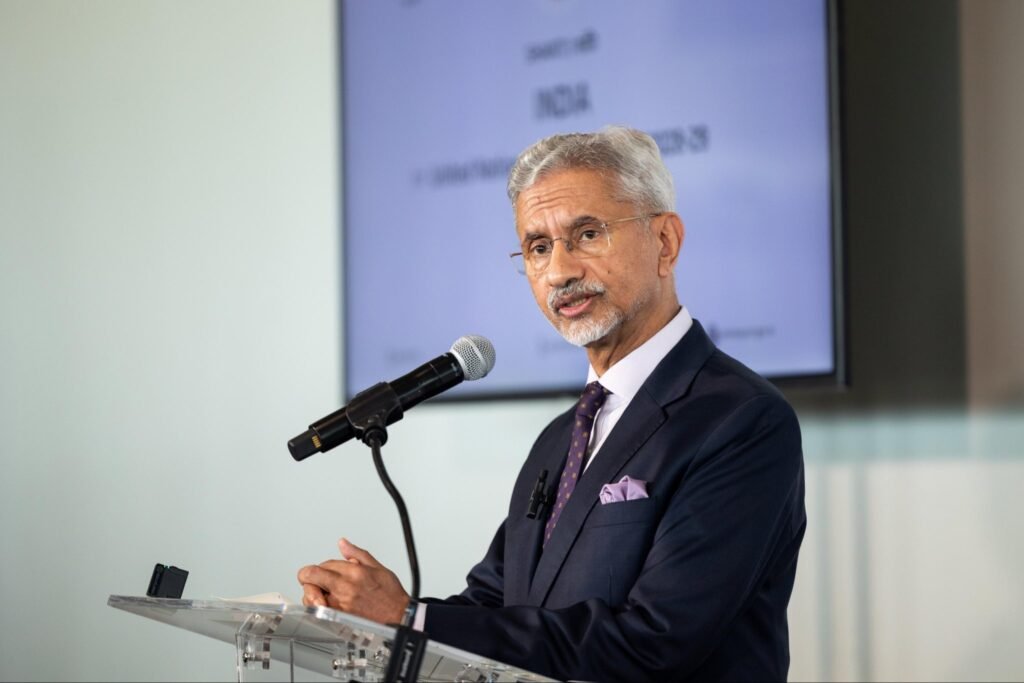
The same divergence appeared in responses to geopolitical instability beyond South Asia. Pakistan’s Prime Minister Shehbaz Sharif presented diplomacy and de-escalation as central to Pakistan’s message, while placing Kashmir and the Indus waters prominently in his address. India, through External Affairs Minister S. Jaishankar, approached the regional security environment through terrorism, accountability, and maritime security. India’s statement also broadened the discussion to the effects of geopolitical competition on finance, technology, markets, and supply chains.
The contrast is important because India and Pakistan were responding to the same international environment without seeing it in the same way. Pakistan foregrounded dialogue, Kashmir, and water. India foregrounded terrorism and the wider consequences of geopolitical competition. Their speeches thus showed the limits of treating South Asia as a single diplomatic actor. The wider West Asian crisis produced other readings too. For the Maldives, instability around maritime routes had immediate implications for fuel, food, aviation, and tourism. Sri Lanka emphasised neutrality and humanitarian action, including its response to a vessel caught up in the regional conflict. Pakistan highlighted diplomacy and mediation, while India stressed maritime security and the vulnerability of global supply chains. The same crisis therefore entered South Asian diplomacy through very different national concerns.
Palestine Offered Convergence
Palestine was one of the clearest areas of convergence. Bangladesh reaffirmed support for Palestinian self-determination and statehood. The Maldives supported a Palestinian state on pre-1967 borders with East Jerusalem as its capital. Sri Lanka reiterated its support for Palestinian statehood alongside Israel, while Pakistan also placed Palestine prominently within its foreign-policy concerns.
Yet convergence did not amount to a common South Asian diplomatic bloc. Each country situated Palestine within a different political narrative. Bangladesh connected Palestinian self-determination with its own historical experience of liberation; the Maldives linked the issue to international law and the equal application of rules; Sri Lanka drew on its longstanding diplomatic position; and Pakistan incorporated Palestine into its wider critique of the international order. Similar positions, in other words, did not necessarily reflect a coordinated regional policy. Palestine showed considerable convergence across South Asia, but not necessarily common diplomatic strategy.
Reform Without a Blueprint
The same pattern was visible in calls for reform of the UN system. South Asian governments broadly agreed that existing institutions do not adequately reflect contemporary realities, but their prescriptions differed. India argued that the emergence of a more multipolar world strengthens the case for reformed multilateralism and greater representation. Pakistan framed its approach as “Reform for All, Privilege for None”. The Maldives offered a particularly detailed prescription, calling for expanded permanent and non-permanent Security Council membership, greater African representation, a rotating seat for small island developing states, and abolition of the veto. It also raised the question of gender representation in UN leadership. Sri Lanka supported the UN80 reform process and called for an organisation that listens more closely, represents more fairly, and delivers more effectively.
The difference is telling. There was considerable agreement on the diagnosis, but much less agreement on the remedy. India is concerned with representation in a changing distribution of global power; the Maldives with the position of small states; Pakistan with privilege within the existing system. Their positions overlap, but they do not amount to a single South Asian model of UN reform.
AI Becomes a Power Question
Artificial intelligence introduced a newer version of the same debate. Bangladesh warned that today’s digital divide should not become tomorrow’s AI divide, emphasising technology transfer, skills development, and affordable access. The Maldives highlighted AI’s potential to overcome geographical constraints in health, education, and public services while warning against technological dependence. Sri Lanka pointed to its national AI guidelines and called for technology transfer. India approached AI through technological sovereignty, emphasising the ability of countries to develop their own capabilities and determine how such systems are deployed.
The underlying issue was therefore not simply regulation. It was also about control: who possesses the computing infrastructure, data, skills, and capital required to develop AI, and who gets to shape the rules governing it? For South Asia, this places AI within a familiar political economy of technology. The concern is that dependence on a small number of technological powers could reproduce existing inequalities in a new form.
Projecting National Narratives
The speeches also showed how the UN General Assembly functions as a platform for projecting national narratives. Bangladesh used the occasion to present its political transition through the language of recovery, restoration, and reconstruction, while keeping the Rohingya crisis firmly on the international agenda. It stressed that Bangladesh continues to host more than one million forcibly displaced Rohingya and called for their safe return to Myanmar.
Bhutan took a markedly different approach. Prime Minister Tshering Tobgay used his address to promote the Gelephu Mindfulness City, presenting it as a future-oriented project combining technology, finance, clean energy, and Bhutan’s development philosophy. Rather than primarily presenting Bhutan as vulnerable to an international problem, the speech presented the country as a site for a particular model of future development.
Sri Lanka focused on trust, neutrality, and multilateralism, connecting its domestic experience to the wider erosion of confidence in international institutions. Its intervention also drew on the country’s longstanding role in UN peacekeeping and its advocacy of an Indian Ocean Zone of Peace. The Maldives similarly used its intervention to connect climate vulnerability with questions of sovereignty and the rights of small states.
Shared Problems, Different Priorities
The most revealing feature of South Asia at UNGA 81 was how closely the region’s problems are becoming connected, even as governments continue to approach them through different national priorities. Climate disasters move through interconnected ecosystems. Wars in West Asia affect South Asian energy supplies, shipping, and economies. AI raises questions about technological dependence and access. And the structure of global institutions shapes the choices available to countries with limited influence over decisions made elsewhere.
Yet those shared pressures did not produce a common South Asian response at the General Debate. The seven countries did not speak through a common regional platform, and the speeches did not point towards a collective position through existing organisations such as the South Asian Association for Regional Cooperation (SAARC) or the Bay of Bengal Initiative for Multi-Sectoral Technical and Economic Cooperation (BIMSTEC). This is significant because the two organisations themselves do not encompass the same set of countries: SAARC includes all seven countries discussed here but also Afghanistan, while BIMSTEC includes Bangladesh, Bhutan, India, Nepal, and Sri Lanka, alongside Myanmar and Thailand, but not Pakistan or the Maldives. Nepal’s direct appeal to its neighbours came closest to articulating a shared regional experience, explicitly linking the country’s climate and economic vulnerabilities to those of Bangladesh, Bhutan, India, the Maldives, Pakistan, and Sri Lanka.
What emerged from UNGA 81, then, was not a common South Asian agenda but a clearer sense of how interconnected the region’s problems have become. The countries may be facing many of the same pressures, but they are still defining those pressures, and their responses to them, in distinctly national terms.
Note: This explainer has been researched, edited, and fact-checked by India’s World staff and prepared with AI assistance.