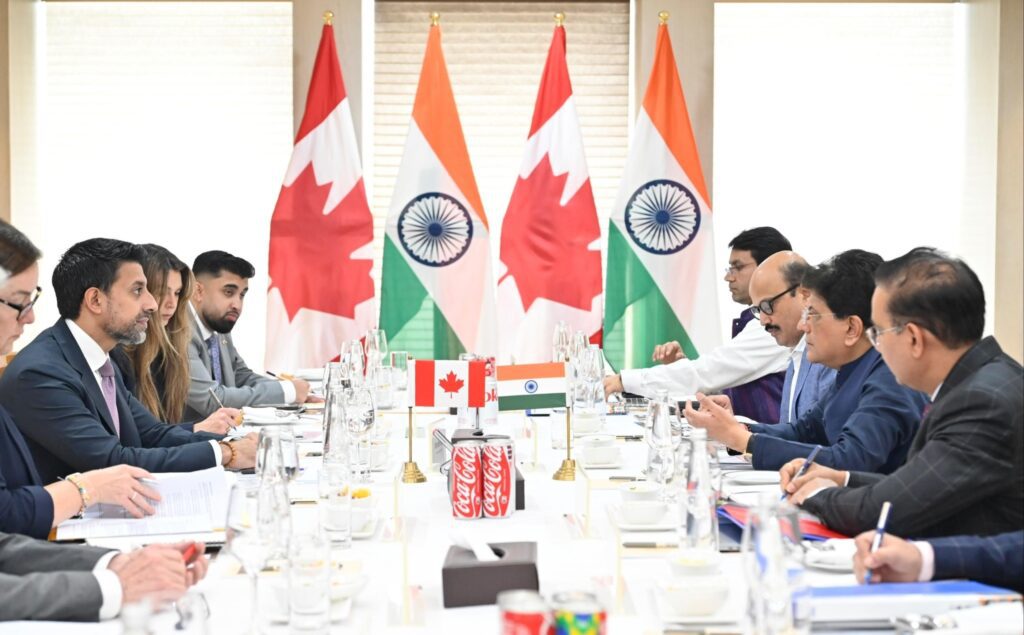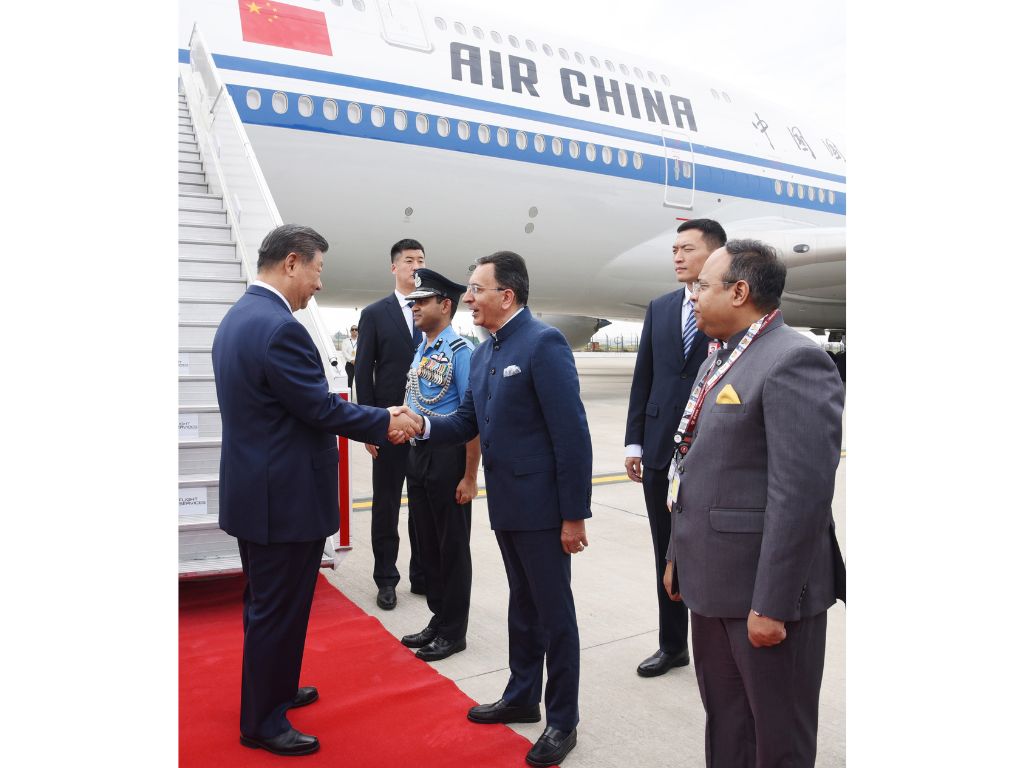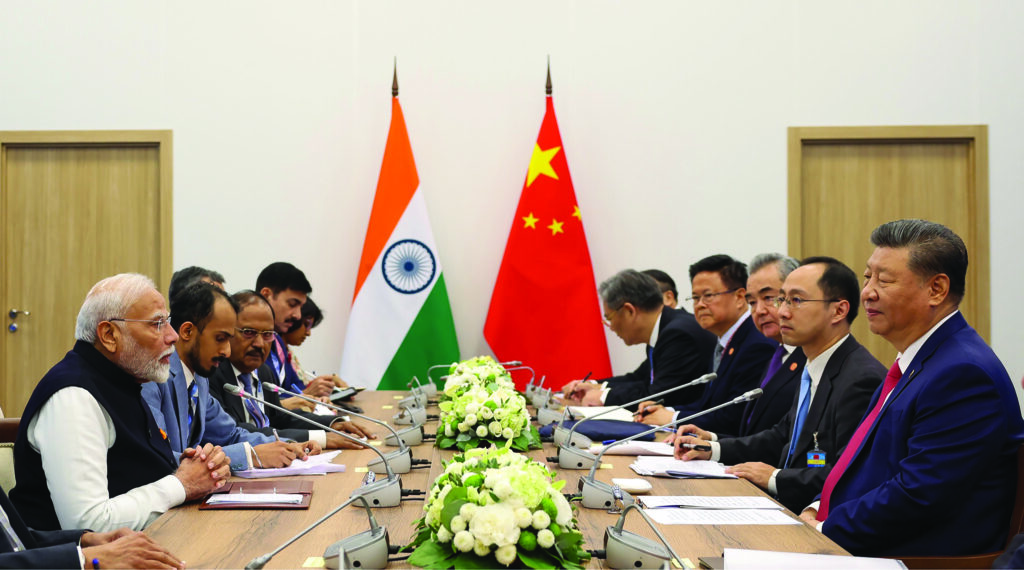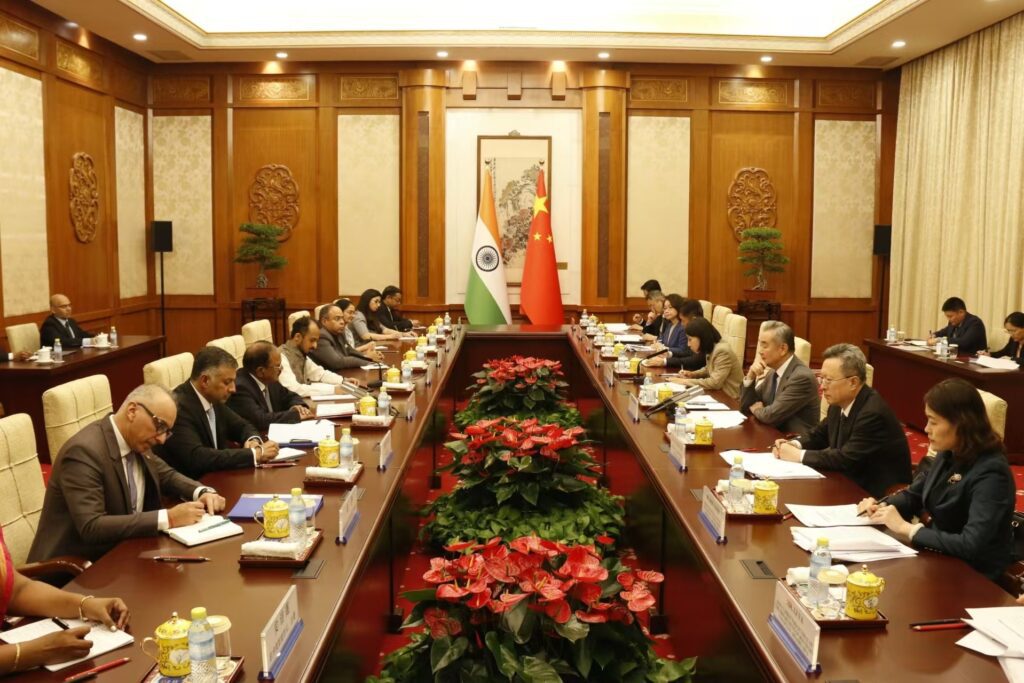
India’s National Security Adviser (NSA) Ajit Doval travelled to Beijing on 24 August for the 25th round of Special Representatives talks with Chinese Foreign Minister Wang Yi on the India-China boundary question. The talks were held on 25 August, and on 26 August the two sides released an eight-point outcome. It reaffirmed their commitment to peace and tranquillity in the border areas, committed them to using existing diplomatic and military channels to deal with situations along the Line of Actual Control (LAC), and announced a September meeting of the expert-level mechanism on trans-border rivers, including hydrological data sharing.
But one line in the outcome attracted particular attention. The two sides said that the Expert Group on Boundary Delimitation and the Working Group on Border Management would “advance discussions on an Early and Substantial Harvest of boundary delimitation and Border Management”. They added that the first task of both groups would be to agree on their respective terms of reference.
The wording is significant. But what exactly is an “early harvest”, and what has India actually agreed to?
What Is an “Early Harvest”?
“Early harvest” is not a defined term in the 2005 India-China boundary agreement, nor does the August 2026 outcome define it. In the context of the India-China negotiations, the expression has been used for the idea of making progress on portions of the boundary before reaching a final settlement of the entire dispute.
China’s proposal became publicly prominent in 2017 in relation to the Sikkim sector. In a statement during the Doklam crisis, Beijing said India and China had discussed making the Sikkim boundary an “early harvest” in settling the entire boundary question. China argued that the Sikkim boundary had already been delimited under the 1890 Convention between Britain and China.
The idea was subsequently brought into the Special Representatives process. China submitted its “early harvest” proposals to India in August 2019, with the Sikkim sector at the centre of the proposal. After the 22nd round of Special Representatives talks in December 2019, the Chinese readout said that the two sides should “promote early harvest consultations”, while the Indian readout did not use that formulation.
The terminology also requires a distinction between delimitation and demarcation. Delimitation concerns determining the course of the boundary; demarcation is the subsequent process of marking an agreed boundary on the ground. The 2005 agreement itself treats these as stages within the broader settlement process.
Most importantly, the current statement does not identify the sector that might be considered for an early harvest. It does not say Sikkim. It does not say the middle sector. The Expert Group has not yet begun work on a specified stretch of the boundary. It still has to agree its terms of reference.
Why Does the Idea Matter to India?
India’s traditional concern has been about sequencing.
The current boundary negotiations are built around a framework in which the eventual settlement is not conceived as a collection of unrelated sectoral agreements. Article III of the 2005 Agreement on Political Parameters and Guiding Principles says that the two sides should make mutually acceptable adjustments to their positions “so as to arrive at a package settlement” and that “the boundary settlement must be final, covering all sectors of the India-China boundary”.
That is the basis for India’s concern about a piecemeal approach.
A package settlement potentially allows concessions in one sector to be balanced against concessions in another.
An early harvest, by contrast, potentially allows one or more portions to be dealt with before the larger bargain is complete.
That does not automatically make the two approaches incompatible. An early agreement on one part could theoretically be treated as an incremental step towards the eventual comprehensive settlement. But it could also change the bargaining position of the two sides before the larger settlement is reached.
This is why the wording of the 2026 outcome deserves attention without automatically being described as a policy reversal.
The Older History of the “Package” Approach
The package approach itself is much older than the current “early harvest” proposal. In 1979, Deng Xiaoping proposed a “package solution” to then External Affairs Minister Atal Bihari Vajpayee, linking Chinese concessions in the eastern sector with Indian concessions in the west. Deng reiterated the idea publicly in 1980, saying that China could recognise the McMahon Line in the east if India accepted the status quo in the western sector.
The idea resurfaced during Rajiv Gandhi’s 1988 visit to Beijing. Former Chinese diplomat Yang Wenchang later recalled that Deng proposed reciprocal compromises in the eastern and western sectors, saying that the two sides could make concessions and arrive at a new boundary. Yang said Gandhi did not respond to the proposal. The account was reported in 2015, but was not independently confirmed by Indian officials and should therefore be treated as Yang’s recollection of the 1988 discussions.
Why Does the 2005 Agreement Matter Now?
The fifth round of Special Representatives talks in April 2005 produced the political parameters and guiding principles that became the foundation for the subsequent boundary process. The agreement was formally signed on 11 April 2005.
Article III is particularly important because it explicitly combines two ideas:
a “package settlement”
and a settlement
“covering all sectors of the India-China boundary”.
The agreement then envisages the development of an agreed framework before subsequent delineation and demarcation.
The significance of the current language is therefore that an incremental mechanism is being pursued inside a framework that still formally envisages a comprehensive settlement.
This is the central tension in the latest development.
Why Is Sikkim Associated With the Early Harvest?
The answer goes back to China’s 2017 proposal.
Beijing described Sikkim as a relatively settled section of the boundary and argued that the 1890 Convention had already established the boundary alignment. Chinese officials presented an India-China agreement on Sikkim as a possible early step towards resolving the larger boundary question.
The sector is sensitive because of its proximity to the India-China-Bhutan trijunction and the strategic geography of the Chumbi Valley and Doklam. During the 2017 Doklam standoff, the dispute over Chinese road construction brought these overlapping territorial questions into direct focus.
The issue is not only where the India-China boundary lies, but also how a settlement in Sikkim could affect the wider India-China-Bhutan boundary question. The location of the India-China-Bhutan trijunction remains contested, and the strategic significance of the area was underscored by the 2017 Doklam standoff. These factors have contributed to concerns in India about treating the Sikkim sector as a standalone settlement.
Those concerns are arguments about the strategic consequences of a potential settlement, not evidence that a Sikkim settlement has now been agreed. Although Sikkim has been discussed as a possible sector for an early harvest, the 2026 outcome does not specify it as the sector to be taken up.
What Changed in 2025?
The early-harvest idea moved from a Chinese proposal into a formal bilateral mechanism in August 2025.
At the 24th round of Special Representatives talks, India and China agreed to set up an Expert Group under the Working Mechanism for Consultation and Coordination on India-China Border Affairs to explore “Early Harvest of boundary delimitation on appropriate Sectors”. They also agreed to establish a Working Group on border management.
This was a significant development because the idea was now being incorporated into a formal bilateral mechanism. The 2026 formulation goes a step further in wording. The Expert Group is now to advance discussions on an “Early and Substantial Harvest”. But the process is still preliminary.
As Ananth Krishnan noted in Suhasini Haidar’s Worldview discussion, the Expert Group had been agreed a year earlier, but the sides were still at the stage of determining its terms of reference. He suggested that the language could eventually apply to sectors such as Sikkim or the middle sector, where the two sides have fewer pronounced disagreements, but presented that as an assessment of where the process could go, not as an agreed outcome.
The distinction matters because it prevents the current development from being exaggerated.
The 2005 Framework Has Also Returned to the Foreground
There is another feature of the recent talks that deserves attention.
The 2025 and 2026 outcomes both explicitly invoke the 2005 Agreement on Political Parameters and Guiding Principles as the framework for negotiations.
Shekhar Gupta’s analysis of the 25th round makes the useful observation that the 5th, 24th and 25th rounds provide a particularly revealing sequence for understanding the present moment. His point is not that every element of the new statement is new. Much of it repeats earlier diplomatic language. What matters are the provisions that create or revive mechanisms.
That is a useful way of reading the eight-point document.
There is considerable boilerplate on peace and tranquillity. But there are also institutional steps: the Expert Group, the border-management Working Group, additional military meeting points, additional hotline channels, and renewed discussion of trans-border rivers.
Why Now?
The current process comes after the most serious deterioration in India-China relations in decades.
The Galwan clash in June 2020 and the subsequent military standoff in eastern Ladakh produced a prolonged period of confrontation. Negotiations through military, diplomatic and political channels continued for several years. India insisted that peace and tranquillity along the LAC was fundamental to restoring the broader relationship.
The two sides reached an agreement on patrolling arrangements in October 2024 concerning Depsang and Demchok, followed by disengagement from the remaining friction points of the 2020 confrontation. India’s government has subsequently described the disengagement as completed.
That did not return the border to its pre-2020 condition.
Arzan Tarapore’s Annual Survey of India 2026 argues that the Ladakh crisis produced a “new normal” of a heavier Indian military presence and infrastructure along the China border, even after the crisis formally ended in 2024. (source: Tarapore, Arzan. “Tactical Successes and Strategic Challenges in Indian Defense Policy.” In Hoover Annual Survey of India 2026, edited by Šumit Ganguly. Stanford, CA: Hoover Institution Press, 2026)
The current negotiations therefore take place in a relationship that is being stabilised after the 2020 crisis, but in which the strategic and military consequences of that crisis remain.
What About the Rivers?
The trans-border rivers provision is not merely another line in the communiqué.
India and China have had arrangements for the sharing of hydrological information from rivers originating in Tibet and flowing into India. The Indian government records that the MoU concerning hydrological information on the Brahmaputra expired on 5 June 2023, while the corresponding Sutlej arrangement expired on 5 November 2020. Both are under consideration for renewal through diplomatic channels.
The August 2026 outcome says the two sides will hold the next meeting of their Expert-Level Mechanism on Trans-border Rivers in September and maintain communication on issues including hydrological data sharing and renewal of the relevant MoUs.
So the defensible description is that the two sides are resuming structured discussions on the issue, rather than that hydrological cooperation has already been restored.
What Happens Next?
The immediate next step is procedural rather than territorial.
The Expert Group has to agree its Terms of Reference. Only after that will it become possible to establish precisely what areas, questions or forms of delimitation the two sides intend to pursue.
There is therefore no factual basis yet for saying that India and China have agreed to settle Sikkim separately, that a particular section of the LAC will soon be demarcated, or that India has abandoned the 2005 package framework.
What has changed is more limited but still important: an “early harvest”, previously associated with China’s proposal for progress in the Sikkim sector, has since 2025 become part of the formal bilateral negotiating process. In 2026, that process has been given a more ambitious formulation, an “Early and Substantial Harvest”, while the same statement continues to reaffirm the 2005 framework for the eventual boundary settlement.
The significance of the phrase will therefore depend on what the Expert Group eventually puts inside it. For now, it represents a negotiating direction, not a boundary settlement.
Note: This explainer has been researched, edited, and fact-checked by India’s World staff and prepared with AI assistance.