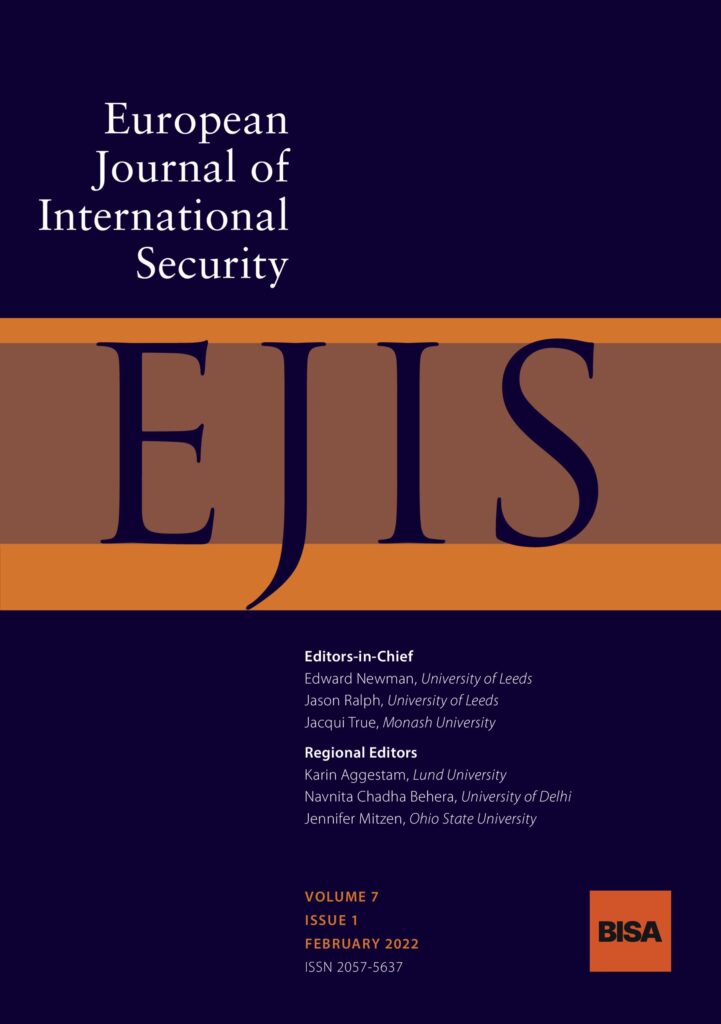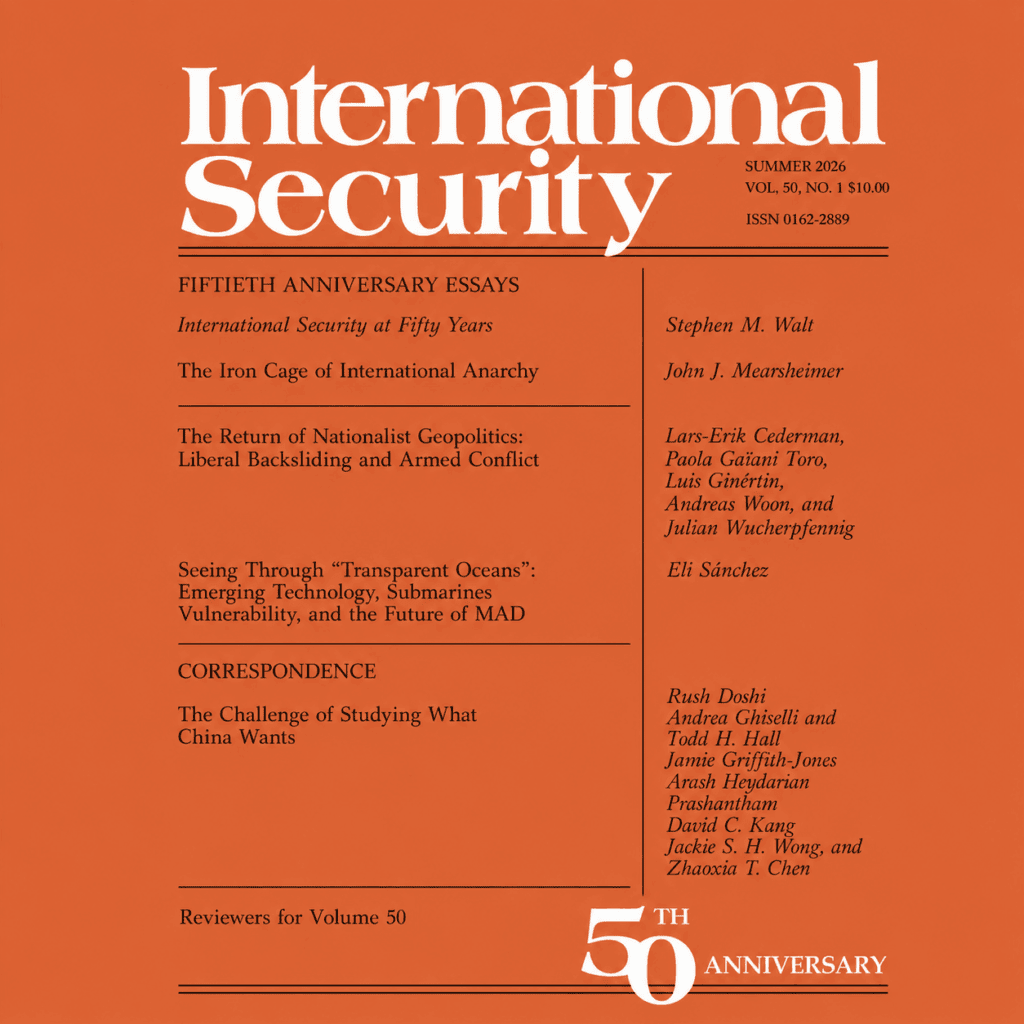
The article “The Iron Cage of International Anarchy”, by John J. Mearsheimer, R. Wendell Harrison Distinguished Service Professor of Political Science at the University of Chicago, published in International Security (2026) 51 (1): 32–79), examines great-power competition from 1800 to 2026 and considers how it is likely to unfold over the next fifty years. Mearsheimer argues that “Security competition among the great powers is the dominant feature of international politics”. The reason, he says, is that “States in anarchy have no choice but to compete”, since there is no higher authority capable of protecting them from external threats. The search for security is therefore “an inherently competitive enterprise that never goes away” and is “hardwired into the international system”.
Mearsheimer divides the modern international system into four periods: old multipolarity (1800–1945), bipolarity (1945–1991), the unipolar moment (1992–2016), and the new multipolarity (2017–2026). He argues that the roster of great powers and the distribution of power have changed across these periods, but security competition has remained a persistent feature. The old multipolarity was particularly war-prone, producing nine great-power wars, including the Napoleonic Wars, World War I and World War II. By contrast, the United States and Soviet Union engaged in intense security competition during the Cold War without fighting one another directly.
The end of the Cold War produced a historically unusual period of unipolarity, when the United States was the sole great power. Washington pursued what Mearsheimer calls “liberal hegemony”, seeking to spread liberal democracy, foster an open international economy and build international institutions. He argues that two policies were particularly consequential for the return of multipolarity: engagement with China and NATO expansion. Engagement helped China achieve rapid economic growth and integration into the global economy, but China did not become the liberal democracy Washington had expected. Instead, its growing wealth was translated into military power, helping it become a great power by about 2017.
The rise of China and the resurgence of Russia marked the return of great-power competition and multipolarity. Mearsheimer describes the United States as the most powerful of the three great powers, China as a close second and Russia as the weakest. The U.S.-China competition is the most important feature of the new multipolarity because China is not only powerful and rising but also a potential regional hegemon in East Asia. Beijing seeks to reintegrate Taiwan into China, claims much of the East and South China Seas, and is developing the capabilities needed to challenge the United States in the region.
Mearsheimer also links the Russia-Ukraine War to developments during the earlier unipolar period. He argues that NATO expansion, particularly Washington’s efforts to bring Ukraine into the alliance, antagonised Russia and helped set the conflict in motion. Although the full-scale invasion occurred in 2022 during the new multipolarity, he argues that its “driving forces” were established during unipolarity. The resulting alignment between Beijing and Moscow against Washington is, in his view, an important anomaly, since Russia and the United States would otherwise have strong incentives to cooperate in balancing China.
Looking ahead, Mearsheimer expects the international system to remain multipolar for the next fifty years, with China, Russia and the United States remaining the three great powers. He identifies India as the only country that might ascend to great-power status, although he considers this uncertain because, despite its large population, it may not possess sufficient wealth. He also expects China not to overtake the United States by 2076, pointing to demographic differences, China’s shrinking and ageing population, and the United States’ capacity to increase its population through immigration.
Mearsheimer’s analysis remains relevant to the fractured world order taking shape today because the return of multipolarity is changing both great-power relations and the institutions through which states cooperate. In his recent discussion of the article, he argues that institutions involving all three great powers are becoming increasingly difficult to operate effectively, while China and the United States are developing competing “bounded orders”. This helps explain why economic interdependence and international institutions have not eliminated strategic rivalry. Instead, as the distribution of power changes, states increasingly organise around competing security interests while retaining narrower areas of cooperation.
Mearsheimer concludes that the return of multipolarity means that great-power competition and the possibility of war remain central features of international politics. He identifies Taiwan, the South China Sea and the East China Sea as potential flashpoints between Washington and Beijing and warns of the possibility of a major U.S.-China crisis, including the risk of nuclear escalation. He believes it is “likely, maybe even highly likely” that there will be at least one major U.S.-China crisis over the next fifty years. His final assessment is stark: “Great power security competition is relentless, ruthless, and dangerous”, and he expects the world to be “a more dangerous place over the next fifty years” than it has been over the previous fifty.