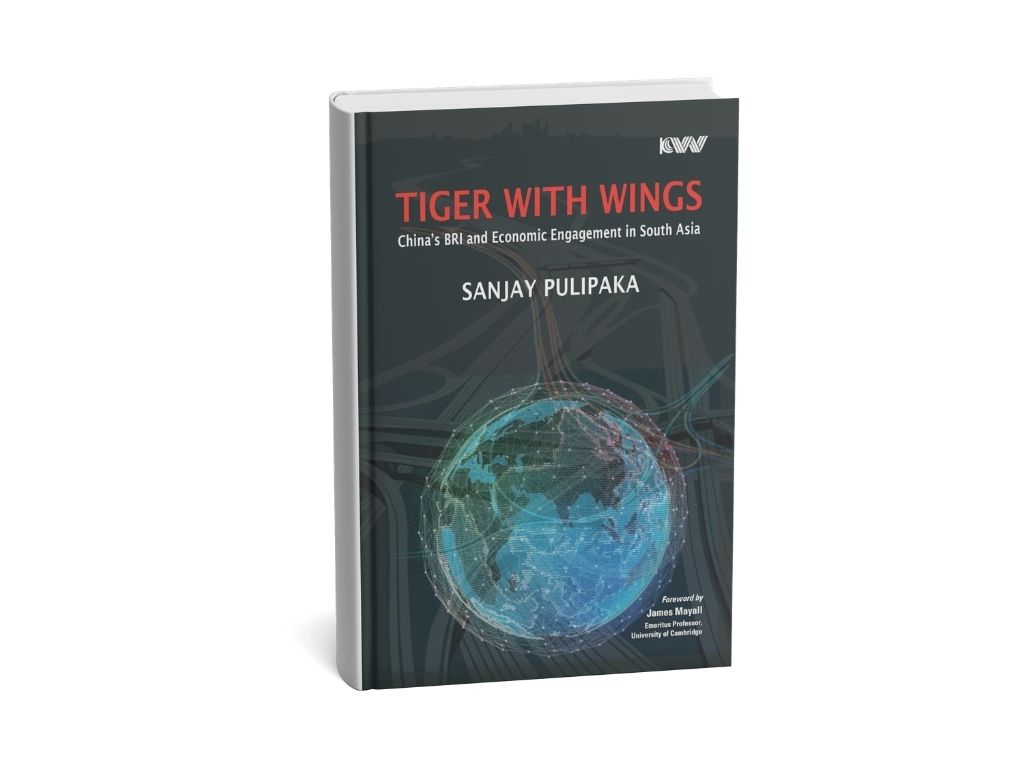
The Belt and Road Initiative (BRI) is widely seen as one of the most significant multi-sectoral and multi-domain initiatives that has emerged from within the maze of China’s statecraft. The sheer scale of the initiative, the speed with which it was rolled out, and the varying degrees of impact that it has had have been presented in a clear and concise manner in the book ‘Tiger with Wings’, authored by Sanjay Pulipaka.
An important feature of the book is that it looks at the BRI through the prism of an Indian scholar rather than through a Western lens. The 11 chapters covering 351 pages are laid out in a logical sequence and cover all of India’s immediate neighbours, and also describe India-China equations, in the backdrop of BRI.
An aspect of the book that will be of great interest to students of China is its detailed discussion of the historical underpinnings of BRI and how and why it evolved. Further, there are interesting discussions on whether the BRI was launched at the most opportune moment for China, or was its unveiling timed at a moment when circumstances were less than ideal? Can the BRI be compared to the United States’ Marshall Plan, or is it an entirely different strategic architecture?
A major portion of the book is rightly dedicated to assessing the impact of the BRI from the perspective of each country in the Indian subcontinent, while also providing a bird’s-eye view of its geopolitical and geoeconomic implications. Amalgamating both extensive details and the big-picture approach to the BRI, while keeping the writing style easy and engaging, is perhaps one of the best demonstrations of scholarship on this subject.
The phrase “China’s BRI and Economic Engagement in South Asia” is mentioned on the cover of the book, right under the main title “Tiger with Wings.” When examined carefully, it seems to suggest a differentiation between the ‘BRI’ and ‘Economic Engagement.’ This is an interesting proposition because a large part of the BRI appears to be rooted in economic activities and/or have economic consequences. Does this differentiation exist on the ground?
The BRI seems to have generated new governance frameworks in the region. Was this a part of the plan or an unintended spin-off of the BRI? BRI projects have been implemented under hostile circumstances and have also included digital infrastructure projects. Does this point to the strategic nature of the initiative and its eventual aim of enhancing China’s influence? This book stimulates the intellect and is a valuable resource for scholars, as it presents an Indian perspective on the overall impact of BRI on the countries of the Indian sub-continent