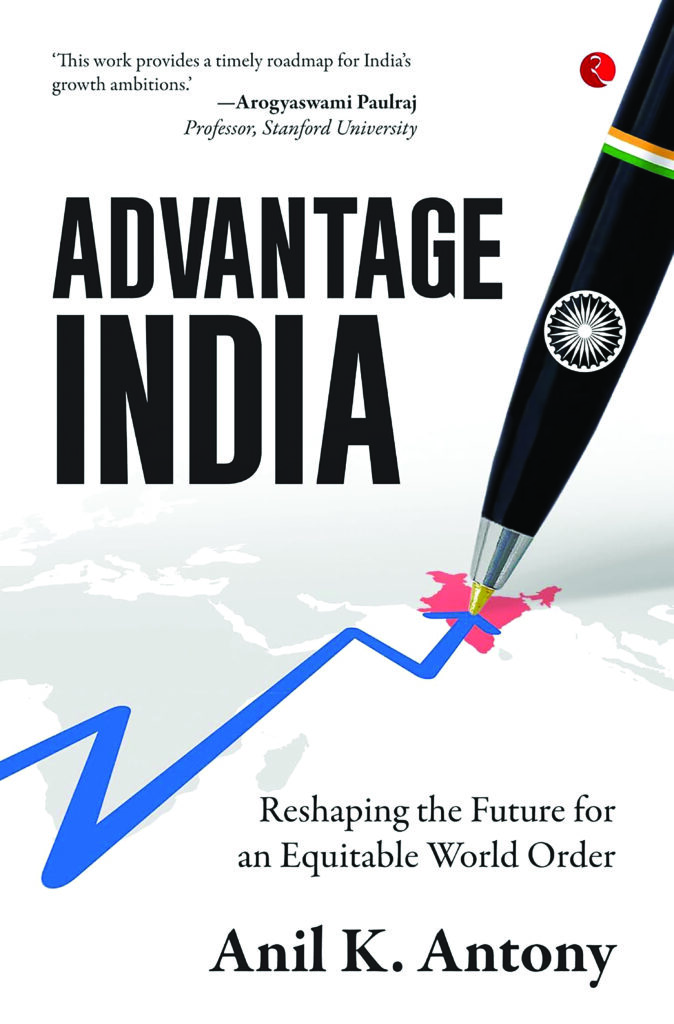
Prime Minister Narendra Modi has set 2047 as the target for India to become a “Viksit Bharat”. The question that naturally follows is: how is this meant to happen? Advantage India: Reshaping the Future for an Equitable World Order by Anil K. Antony is, at its core, an attempt to answer that question, suggesting that the answer being sought outside is often present within our own country’s capabilities.
The book’s central idea is that India’s rise cannot be seen in isolation; the Advantage already exists within the country. India’s capacity to act abroad is only as good as what it can produce, govern, and sustain at home.
The book is divided into two parts, moving from India’s domestic transformation to its global ascendance, with the opening chapters tracing the journey from Nehruvian planning to the post-2014 period, using technology as a key thread connecting several areas of this transformation and showing how progress ultimately depends on broader national capabilities like digital infrastructure, agriculture, and the green transition, alongside education, women, and youth.
Antony also contends that India’s digital ecosystem is not just a technological achievement but a representation of inclusion and participation. In his work, India is building for “base,” reflecting a larger philosophy: technology as a public good. He recalls the days of “disruption,” when India was still on 2G, which appears to have shaped his belief that intent and adaptation can matter as much as scale, and that grassroots reach determines whether technology makes a difference.
The same idea of indigenous capability runs through the discussion of defence and space. Defence modernisation, domestic manufacturing and calibrated deterrence are linked to the expansion of the private space sector. His discussion of the Northeast and Jammu and Kashmir also brings development, connectivity, and integration into the larger question of capacity.
The next half translates this capability into foreign policy, calling for strategic flexibility rather than alliances, making the case for India’s reliability as a real currency.
Across these areas, the meaning of Advantage India becomes clearer. India’s rise as a major world power rests on capabilities developed at home. For me, the most interesting takeaway was that many of the capabilities needed are already taking shape; the bigger question is how well we connect them and turn them into sustained progress.
Advantage India ultimately turns the Viksit Bharat question back on the reader: the “how” was never missing so much as unexamined. Few writers bridge the gap as seamlessly, offering a distinctive account for how one large democracy is reasoning its way through a fracturing world. So, if these capabilities are already taking shape, how do we bring them together to meet 2047 on India’s own terms? That makes it a worthwhile read.